Annotera AI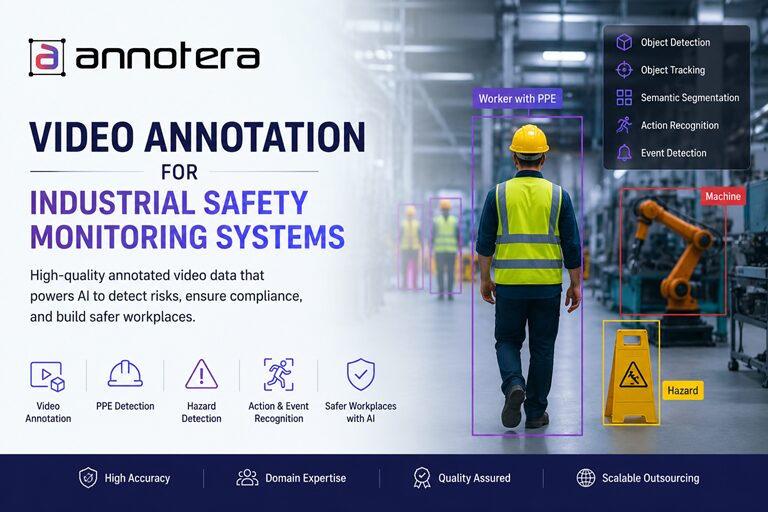
Industrial workplaces are becoming increasingly automated, connected, and data-driven. Manufacturing plants, warehouses, construction sites, oil and gas facilities, and logistics hubs now rely heavily on AI-powered monitoring systems to improve safety, compliance, and operational efficiency. However, the effectiveness of these systems depends largely on the quality of training data used to build them. This is where video annotation plays a critical role.
Video annotation enables artificial intelligence models to understand activities, behaviors, objects, and potential hazards captured by surveillance cameras and industrial monitoring systems. By accurately labeling video data, organizations can train machine learning models to detect unsafe actions, identify risks, and respond proactively before incidents occur.
At Annotera, we help enterprises develop reliable industrial safety monitoring solutions through high-quality video annotation services that support advanced computer vision applications across diverse industrial environments.
The Growing Need for Industrial Safety Monitoring
Industrial accidents can result in serious injuries, equipment damage, operational downtime, regulatory penalties, and financial losses. Traditional safety monitoring often relies on manual supervision, which can be limited by human fatigue, oversight, and the inability to monitor multiple locations simultaneously.
AI-driven safety monitoring systems address these challenges by continuously analyzing video feeds in real time. These systems can detect safety violations, hazardous situations, and unusual activities that may require immediate intervention.
Examples include:
- Detecting workers without personal protective equipment (PPE)
- Monitoring restricted area access
- Identifying unsafe machinery operation
- Detecting slips, trips, and falls
- Tracking worker proximity to hazardous equipment
- Monitoring forklift and vehicle movement
- Recognizing emergency situations
To perform these tasks accurately, AI models require vast amounts of precisely annotated video data.
What is Video Annotation in Industrial Safety Applications?
Video annotation is the process of labeling objects, actions, events, and environmental conditions across video frames. Unlike image annotation, video annotation captures temporal information, allowing AI systems to understand movement, behavior, and interactions over time.
For industrial safety monitoring systems, video annotation may involve:
- Worker detection and tracking
- PPE identification
- Hazard recognition
- Equipment monitoring
- Behavioral analysis
- Activity recognition
- Incident classification
- Zone-based safety monitoring
The resulting labeled datasets enable machine learning algorithms to learn patterns associated with safe and unsafe workplace conditions.
Key Types of Video Annotation for Industrial Safety
Bounding Box Annotation
Bounding boxes are commonly used to identify and track workers, machinery, vehicles, tools, and safety equipment across video frames.
For example, an AI system can learn to recognize forklifts operating near pedestrian pathways or workers entering hazardous zones.
Polygon Annotation
Industrial environments often contain complex objects with irregular shapes. Polygon annotation provides highly precise labeling for machinery, protective barriers, tools, and specialized equipment.
This detailed annotation improves object recognition accuracy in crowded and dynamic industrial settings.
Semantic Segmentation
Semantic segmentation assigns labels to every pixel in a frame, enabling AI models to distinguish between work areas, machinery zones, walkways, storage locations, and restricted regions.
This level of detail is essential for advanced safety monitoring and spatial awareness applications.
Object Tracking
Industrial safety systems frequently require continuous monitoring of workers and equipment throughout a facility.
Object tracking annotations maintain object identities across multiple frames, enabling AI systems to analyze movement patterns, worker behavior, and potential safety risks.
Action Annotation
Action annotation labels specific activities such as:
- Climbing ladders
- Operating machinery
- Carrying heavy materials
- Entering restricted zones
- Using safety equipment
- Performing maintenance tasks
These annotations help AI models understand workplace behavior and detect potentially dangerous actions.
Event Annotation
Certain safety-related incidents occur over a sequence of frames rather than a single image.
Examples include:
- Worker falls
- Equipment collisions
- Vehicle near-misses
- Chemical spills
- Unauthorized access events
Event annotation allows AI systems to recognize these complex scenarios and trigger appropriate alerts.
PPE Detection and Compliance Monitoring
One of the most common applications of video annotation in industrial safety is PPE compliance monitoring.
Workers in industrial environments are often required to wear:
- Hard hats
- Safety vests
- Protective gloves
- Goggles
- Face shields
- Respirators
- Safety footwear
Annotated video datasets train AI models to detect whether workers are wearing the required equipment correctly and consistently.
For example, a safety monitoring system can automatically identify workers entering a production area without helmets and notify supervisors in real time.
Hazard Detection and Risk Prevention
Industrial facilities contain numerous potential hazards that may not always be immediately visible to human supervisors.
Through high-quality video annotation, AI systems can learn to identify:
- Obstructed walkways
- Unsafe worker positioning
- Equipment malfunctions
- Vehicle congestion
- Fire and smoke incidents
- Falling objects
- Dangerous machine interactions
Early detection enables organizations to take preventive measures before accidents occur, significantly improving workplace safety outcomes.
Enhancing Worker Behavior Analysis
Industrial accidents often result from unsafe behaviors rather than equipment failures alone.
Video annotation supports behavior analysis by enabling AI systems to identify actions such as:
- Failure to follow safety protocols
- Improper equipment usage
- Unsafe lifting techniques
- Distracted operation of machinery
- Unauthorized area access
Behavior-focused monitoring helps organizations develop targeted safety training programs and improve overall compliance.
Challenges in Industrial Video Annotation
Despite its benefits, industrial video annotation presents several unique challenges.
Complex Environments
Factories, construction sites, and warehouses often contain dense machinery, variable lighting conditions, reflective surfaces, and crowded workspaces.
Accurate annotation requires skilled annotators who understand industrial environments and can label objects consistently.
Occlusion and Visibility Issues
Workers and equipment may become partially hidden behind machinery, vehicles, or infrastructure.
Maintaining annotation accuracy during occlusion is critical for developing reliable AI models.
High Frame Volumes
Industrial surveillance systems generate enormous amounts of video data daily.
Efficient annotation workflows are necessary to process large-scale datasets while maintaining quality standards.
Diverse Safety Scenarios
Different industries have unique safety requirements and operating conditions.
Annotation teams must adapt labeling guidelines to support sector-specific use cases such as manufacturing, mining, energy, logistics, or construction.
Why Quality Annotation Matters
The performance of industrial safety AI systems directly depends on annotation quality.
Poorly labeled datasets can lead to:
- False alarms
- Missed hazards
- Reduced detection accuracy
- Compliance risks
- Lower trust in AI systems
High-quality annotation ensures that machine learning models learn accurate patterns and perform reliably in real-world industrial environments.
Consistency, precision, and rigorous quality control are therefore essential components of successful industrial safety projects.
How Annotera Supports Industrial Safety AI Development
At Annotera, we provide scalable and accurate video annotation services designed specifically for computer vision applications in industrial environments.
As a trusted video annotation company, we support organizations developing advanced safety monitoring systems by delivering high-quality labeled datasets tailored to their operational requirements.
Our capabilities include:
- Bounding box annotation
- Polygon annotation
- Semantic segmentation
- Object tracking
- Action annotation
- Event labeling
- PPE detection datasets
- Hazard identification annotation
- Custom workflow development
- Multi-level quality assurance
As a specialized data annotation company, we combine experienced annotation teams, domain expertise, and robust quality control processes to ensure exceptional dataset accuracy.
Organizations seeking cost-effective scalability also benefit from our data annotation outsourcing and video annotation outsourcing solutions, enabling faster project delivery without compromising quality.
Conclusion
Industrial safety monitoring systems are transforming workplace risk management by enabling real-time hazard detection, compliance monitoring, and proactive incident prevention. However, the success of these AI-powered solutions depends on the availability of accurately labeled training data.
Video annotation provides the foundation that allows computer vision models to understand workplace activities, identify risks, monitor safety compliance, and recognize hazardous events. From PPE detection and worker tracking to behavioral analysis and incident recognition, annotated video data drives the intelligence behind modern industrial safety systems.
At Annotera, we help organizations build safer, smarter industrial environments through precise, scalable, and high-quality video annotation services. Whether businesses require specialized datasets for hazard detection, worker monitoring, or advanced AI-driven safety analytics, our expert annotation solutions provide the accuracy needed to power reliable industrial safety applications.


 Nirwana AI
 Dipak Straits