Seo Bix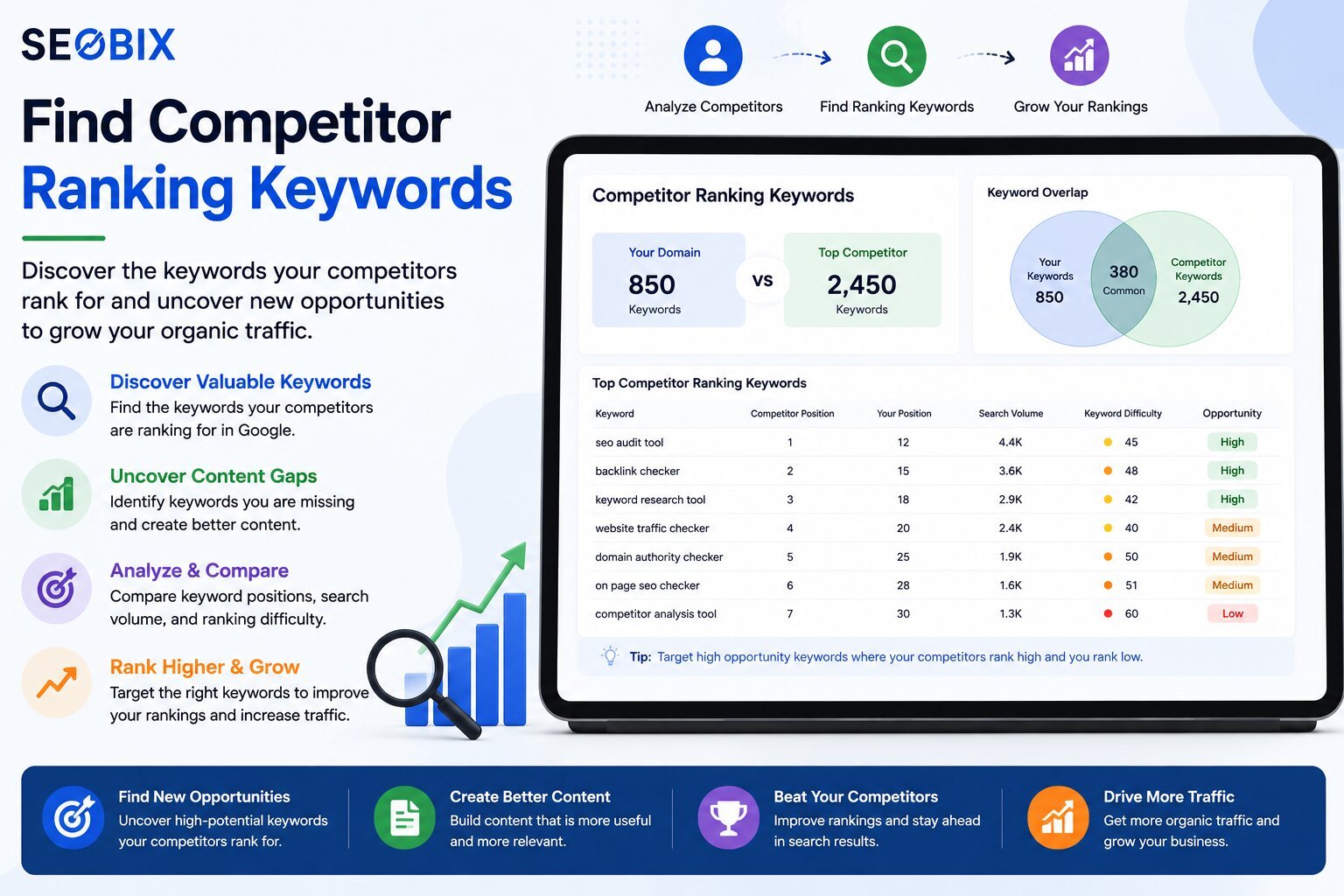
Understanding what your competitors are ranking for can give you useful ideas for improving your own SEO strategy. Instead of choosing keywords only through guesswork, you can study the search terms that already bring visibility to similar websites.
Researching competitor ranking keywords helps you discover topics, search terms, and content opportunities that may be relevant to your own website. It can also show where competitors are performing better and where you may have a chance to compete.
Why Competitor Keyword Research Matters
Every industry has keywords that attract different types of searches. Some people may be looking for information, while others may be ready to compare products or contact a service provider.
Your competitors may already be ranking for some of these searches.
By studying their keyword performance, you can learn:
- Which topics receive search visibility
- What keywords competitors are targeting
- Which pages are bringing them traffic
- Where there are gaps in your own content
- Which search terms may be worth targeting
This can make your SEO planning more focused.
Find Keywords You May Have Missed
Sometimes, a website can rank for keywords that the business owner never intentionally targeted. These keywords can reveal new content ideas.
For example, imagine you run a digital marketing website and mainly target terms related to SEO services. A competitor may also rank for searches related to backlink analysis, keyword tracking, SEO audits, or website traffic.
These additional terms could give you ideas for new pages or articles.
However, don’t automatically target every keyword you find. First, check whether the topic is relevant to your audience and business.
Look Beyond Search Volume
Search volume is useful, but it should not be the only factor you consider.
A keyword with thousands of searches may be extremely competitive and difficult to rank for. A more specific search with fewer searches may bring visitors who are much more interested in what you offer.
Look at factors such as:
- Search intent
- Competition
- Relevance
- Existing search results
- Content quality
- Business value
A balanced keyword strategy usually includes both broader terms and more specific searches.
Study the Pages Ranking for Those Keywords
Finding a competitor keyword is only the beginning. You should also look at the pages that rank for it.
Check what type of content Google is showing. Is it a detailed guide, service page, product page, comparison article, or list?
Understanding the search results can help you decide what type of page you should create.
Your goal should not be to copy the competitor. Instead, create something more useful, clearer, more complete, or better suited to your audience.
Find Content Gaps
Competitor research can help you identify topics where your website has limited or no useful content.
For example, if several competitors are ranking for a specific topic but your website has no dedicated page for it, that could be a potential content gap.
You can research the topic, understand what users want to know, and create a useful page that answers their questions.
This approach can help expand your website naturally without publishing random articles just to target more keywords.
Tools That Can Help
Several SEO platforms can make competitor keyword research easier. Ahrefs, Semrush, Moz, and Ubersuggest can provide information about competitor rankings, keywords, pages, and search visibility.
Google Search Console is also useful for understanding the queries your own website already appears for. Comparing your data with competitor research can help you identify areas where your website has room to grow.
Turn Research Into an SEO Plan
Once you have collected useful keywords, organize them according to search intent and topic. Decide which ones should be used for existing pages and which deserve new content.
Avoid adding keywords repeatedly just because they have good search volume. Use them naturally and make sure the content actually answers the user’s question.
Final Thoughts
Researching competitor ranking keywords can help you understand what works in your industry and uncover new opportunities for your website. It can reveal useful topics, content gaps, and search terms that you may not have considered before.
Use competitor data as a source of ideas rather than something to copy. Combine it with good content, technical SEO, internal linking, backlinks, and regular performance tracking to build a stronger and more practical SEO strategy.


 One studio
 Alex S