Alex S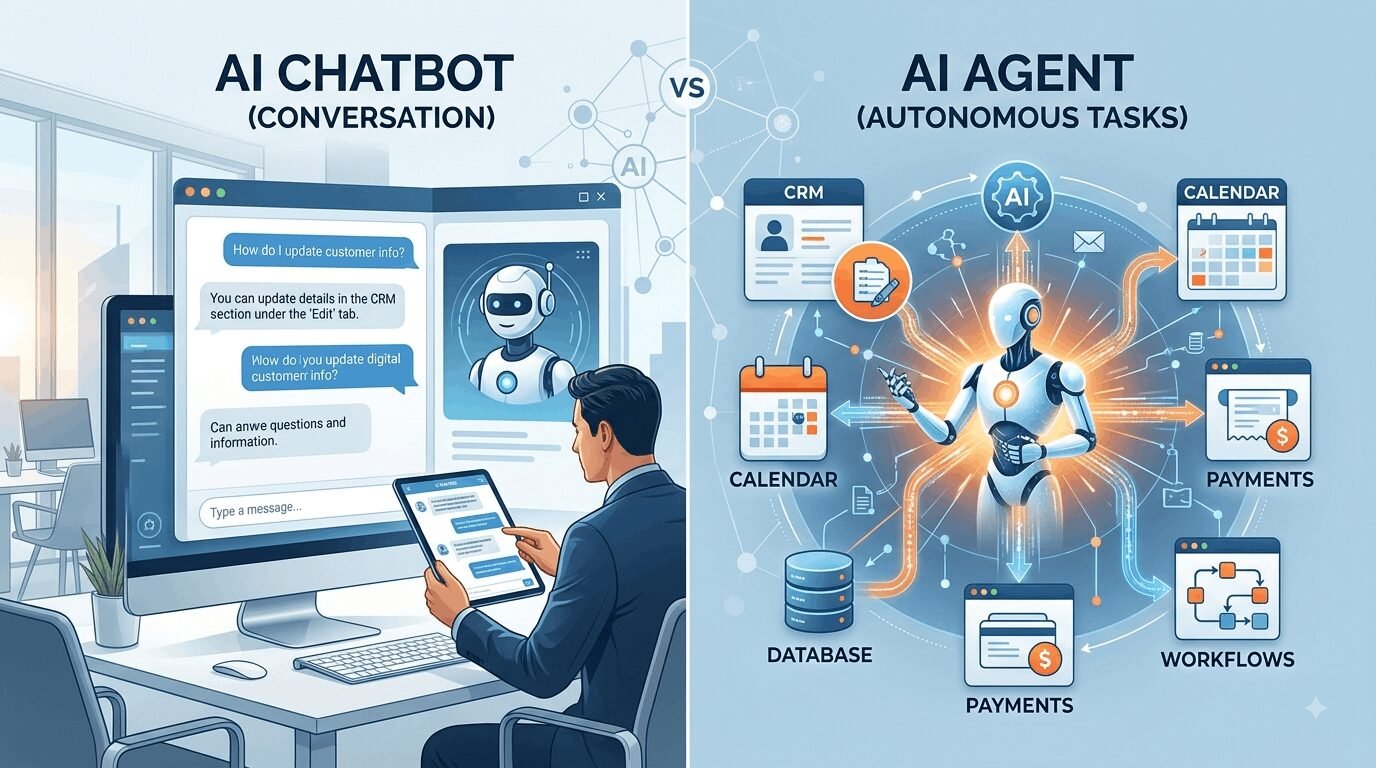
AI has become part of everyday business operations. From answering customer questions to supporting internal teams, businesses now use different AI tools for different needs. Two terms often used together are AI chatbots and AI agents. They may look similar at first but they work in very different ways.
A chatbot is mainly designed to communicate with users. An AI agent can go further by understanding a goal and taking actions to complete it. This difference matters when businesses decide how much of a process they want AI to handle.
What Is an AI Chatbot?
An AI chatbot is a software system that communicates with users through text or voice. It can understand questions and provide relevant responses based on its training and connected information. Chatbots are commonly used for customer support, FAQs, product information and basic troubleshooting.
For example, a customer may ask a chatbot about a return policy. The chatbot can find the relevant information and explain the process. It may also collect basic details before sending the customer to a human employee.
The main strength of a chatbot is communication. It can provide quick answers and remain available around the clock. However, traditional chatbots usually depend on predefined flows or specific instructions. Their ability to take independent action is limited.
What Is an AI Agent?
An AI agent is designed to do more than respond to a request. It can understand a goal, plan steps and use connected tools to complete a task. Depending on its design, an agent can interact with software systems, retrieve information and make decisions within defined rules.
Consider a customer who wants to change a flight booking. A chatbot may explain the airline’s change policy. An AI agent could check available flights, compare options and complete the change after receiving approval.
This ability to act is one of the biggest differences between the two technologies. An agent can become part of a business workflow instead of simply being a communication layer.
AI Agents vs AI Chatbots: Key Differences
The simplest way to understand the difference is to look at their purpose. Chatbots focus mainly on conversations. AI agents focus on completing goals.
A chatbot usually waits for a user request and responds to it. An agent can break a larger objective into smaller tasks. It can decide what information it needs and use connected tools to move the task forward.
Their level of autonomy is also different. Chatbots generally follow a defined conversation path. Agents can handle multi-step workflows based on business rules and permissions.
The systems they connect with can also vary. A chatbot may connect to a knowledge base or customer database. An AI agent can connect with CRM platforms, payment systems, calendars, enterprise software and other business tools.
Why Businesses Are Moving Toward AI Agents
The growing interest in AI agents reflects a wider shift in how companies think about automation. Microsoft reported in its 2025 Work Trend Index that 46% of leaders said their organizations were using agents to fully automate certain workflows or business processes. The report surveyed 31,000 workers across 31 countries.
Gartner also predicted that by 2029 agentic AI could autonomously resolve 80% of common customer service issues without human intervention. Gartner estimated this could lead to a 30% reduction in operational costs.
These figures show why companies are looking beyond basic conversational tools. Businesses want systems that can help employees complete work instead of simply providing information.
When Should You Use a Chatbot?
Chatbots remain useful when the main requirement is communication. They work well for answering common questions and guiding users through simple processes.
A company can use a chatbot for website support or appointment questions. It can also help employees find information from internal documents. These use cases do not always require complex decision-making or system actions.
For businesses with straightforward customer interactions, a chatbot can provide a practical starting point. It can reduce repetitive questions while allowing employees to focus on more complex issues.
When Should You Use an AI Agent?
AI agents are more suitable when a task involves multiple steps and requires interaction with business systems. They can support areas such as sales operations, customer service, finance, IT support and workflow automation.
For example, an agent could qualify a sales lead and update the CRM. It could then schedule a meeting and notify the sales representative. Each action can be controlled through permissions and business rules.
This is where AI Agent Development Services can help businesses design systems around specific workflows rather than simply adding another conversational interface.
The Future of AI-Powered Business Workflows
AI chatbots and AI agents will continue to have different roles. Chatbots are valuable for conversations and information access. Agents are better suited for tasks that require planning and action.
Microsoft found that 82% of leaders expected to use digital labor to expand workforce capacity within 12 to 18 months. This suggests that businesses are moving toward human and AI collaboration instead of treating AI as a standalone tool.
The right choice depends on the problem a business wants to solve. If the goal is to answer questions then a chatbot may be enough. If the goal is to complete a process then an AI agent may offer greater value.
Conclusion
AI chatbots and AI agents are connected technologies but they serve different purposes. A chatbot mainly talks with users while an agent can understand goals and take action. Businesses should choose based on workflow complexity and the level of automation they need. Companies looking to build practical AI solutions can explore Tech.us for solutions that align AI capabilities with real business processes.


 One studio
 Seo Bix