Blog poster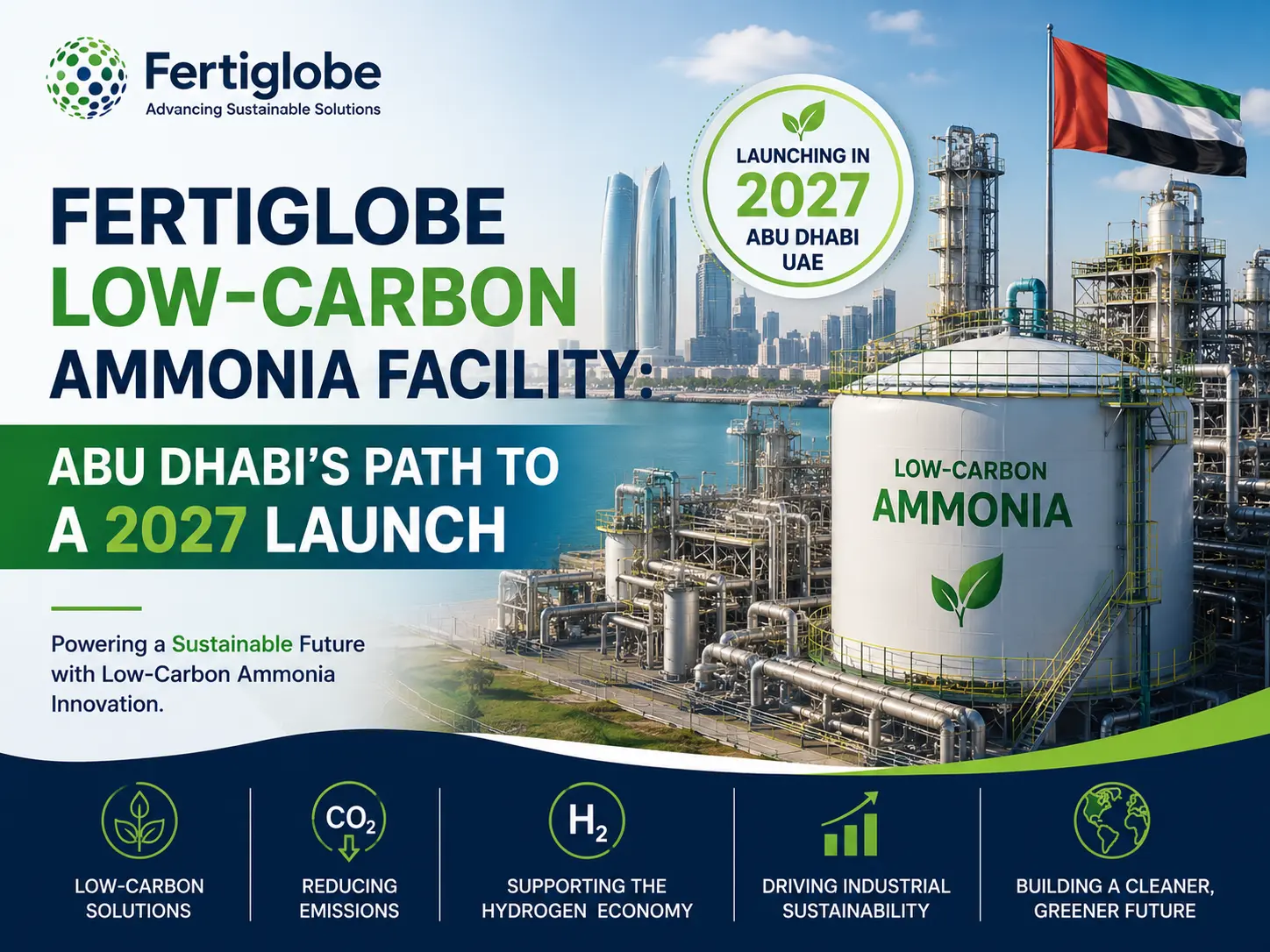
Fertiglobe low-carbon ammonia facility is set to become one of the most significant industrial decarbonization projects in the Middle East when it begins operations in 2027. Known internally as Project Harvest, the plant is rising inside the TA’ZIZ Industrial Chemicals Zone in Ruwais, Abu Dhabi, and represents a joint push by some of the region’s biggest energy and industrial names to position the UAE as a global supplier of cleaner ammonia. For anyone researching UAE clean energy projects, blue ammonia production, or Abu Dhabi industrial expansion, this facility offers a clear, well-documented case study of how oil-rich economies are diversifying into lower-carbon industrial exports.
What Is the Fertiglobe Low-Carbon Ammonia Facility?
Project Harvest is a large-scale ammonia production plant designed to manufacture ammonia with a meaningfully lower carbon footprint than conventional production methods. The facility sits on the Ruwais Industrial Complex, a hub that already anchors much of Abu Dhabi’s petrochemical and industrial output.
Key project facts include:
- Location: TA’ZIZ Industrial Chemicals Zone, Ruwais, Abu Dhabi
- Expected launch: 2027
- Production capacity: Approximately 1 million tonnes per annum of ammonia
- Site footprint: Roughly 10.8 hectares
- Daily output target: Around 3,000 tonnes of ammonia per day
The plant is often referred to using the shorthand “low-carbon” or “blue” ammonia, meaning it is produced using natural gas as a hydrogen source combined with carbon capture technology, rather than through fully renewable, electrolysis-based methods. This approach allows for large-scale, cost-competitive output while still delivering a measurable reduction in emissions intensity compared to traditional ammonia manufacturing.
Who Is Behind the Project?
The Fertiglobe low-carbon ammonia facility is not a single-company venture. It reflects a coordinated partnership structure that blends regional energy leadership with international industrial and financial expertise.
The Core Partners
- Fertiglobe – The lead developer and the largest nitrogen fertilizer producer in the Middle East and North Africa, majority owned by ADNOC.
- TA’ZIZ – A joint venture between ADNOC and Abu Dhabi sovereign wealth fund ADQ, responsible for developing the surrounding industrial chemicals zone.
- Mitsui & Co. – A major Japanese trading and investment house that has also arranged project financing through the Japan Bank for International Cooperation.
- GS Energy Corporation – A South Korean energy company adding further Asian market access and offtake potential.
The Engineering Team
Italy’s Tecnimont, part of the MAIRE Group, holds the Engineering, Procurement and Construction (EPC) contract, while US-based KBR supplies the underlying process technology. This combination of an established EPC contractor and a specialized technology licensor is typical of large-scale petrochemical builds where technical reliability at commercial scale is non-negotiable.
Project Timeline: From Concept to 2027 Launch
Understanding how this project evolved helps explain why 2027 is now treated as a firm, credible target rather than an aspirational date.
- Early 2023 – TA’ZIZ signs a shareholder agreement with Fertiglobe, Mitsui, and GS Energy to formally develop the facility.
- May 2024 – The partners award the construction contract to Tecnimont at the Make it in the Emirates forum, with construction targeted to begin in the third quarter of that year.
- July 2024 – The project reaches Final Investment Decision (FID), unlocking full-scale construction.
- Q4 2024 – Ground construction begins in earnest at the Ruwais site.
- Early 2026 – Fertiglobe confirms in its fourth-quarter 2025 results that construction has passed the 70 percent completion mark.
- 2027 – Commercial operations are scheduled to begin, with the plant reaching its full 1 million tonne annual capacity.
Notably, the original target for this project was 2025, meaning the current 2027 timeline already reflects one adjustment. Fertiglobe’s more recent public updates, however, have consistently reaffirmed 2027 as the operational start date, even as a separate, similarly sized project in the company’s pipeline, known as Project Rabdan, was rephased to a later stage. That distinction matters for anyone tracking the reliability of Fertiglobe’s guidance: Project Harvest has remained on schedule while other elements of the broader low-carbon portfolio have shifted.
How the Plant Reduces Carbon Intensity
A central part of the Fertiglobe low-carbon ammonia facility story is exactly how it achieves lower emissions compared to standard ammonia production, and how that reduction is expected to deepen over time.
Phase One: Baseline Carbon Reduction
A preliminary Life Cycle Assessment (LCA) study estimates that once operational, the facility will produce ammonia with up to 50 percent lower carbon intensity than conventional ammonia manufacturing. This reduction comes primarily from process efficiency improvements and the use of natural gas feedstock sourced directly from the surrounding Ruwais complex, cutting transportation-related emissions and losses.
Phase Two: Carbon Capture and Sequestration
Following the initial launch, the project is designed to add carbon capture and sequestration capabilities that will further reduce the plant’s carbon footprint. This phased approach mirrors a strategy Fertiglobe has already tested at smaller scale through its Fertil-2 facility, which became the UAE’s first carbon capture and storage operation for low-carbon ammonia, with sequestration activity beginning in late 2023.
That earlier, smaller pilot effectively served as a proof of concept for the technology and processes now being scaled up at Project Harvest, giving the larger facility a credible technical foundation rather than an unproven leap.
Why Ammonia, and Why Now?
Ammonia might seem like an unusual centerpiece for a clean energy story, but its role in global decarbonization efforts has expanded rapidly for a few concrete reasons.
- Maritime fuel transition: Low-carbon ammonia is increasingly viewed as a practical transitional fuel for shipping, an industry facing mounting pressure to cut emissions.
- Power generation co-firing: Ammonia can be blended into existing coal power stations to reduce their overall carbon output without requiring a complete infrastructure rebuild.
- Established global demand: Unlike some emerging clean energy carriers, ammonia already has a mature global trade infrastructure, storage network, and shipping system, since it has long been a critical fertilizer feedstock.
This combination of new decarbonization use cases layered onto decades of existing industrial demand is precisely why major energy companies are willing to commit hundreds of millions of dollars to scale up low-carbon ammonia capacity now, rather than waiting for entirely new fuel infrastructure to be built from scratch.
Comparing Fertiglobe’s Ammonia Pathways
Fertiglobe is not pursuing a single decarbonization strategy. The company operates across a spectrum of ammonia production methods, and understanding where Project Harvest fits clarifies its strategic role.
| Ammonia Type | Feedstock Source | Carbon Profile | Example Project |
|---|---|---|---|
| Conventional ammonia | Natural gas, no capture | Highest emissions | Existing UAE and Egypt plants |
| Low-carbon (blue) ammonia | Natural gas with carbon capture | Roughly 50% lower intensity, improving over time | Project Harvest |
| Renewable (green) ammonia | Hydrogen from renewable electrolysis | Lowest emissions | Egypt Green Hydrogen project |
Project Harvest occupies the middle ground of this spectrum. It is not a fully renewable facility, but it delivers meaningful emissions reductions at a scale and cost point that renewable-only projects cannot yet match. This makes it a commercially pragmatic bridge technology while fully green ammonia production continues to mature globally.
Financial and Strategic Structure
The Fertiglobe low-carbon ammonia facility also reflects a distinctive ownership and capital strategy worth understanding for anyone analyzing the broader ADNOC ecosystem.
- Fertiglobe currently holds a 30 percent stake in Project Harvest but retains the option to increase its ownership to 54 percent once the facility is completed.
- Total project capital expenditure has been described by the company as competitive, at under $500 million.
- ADNOC, which owns roughly 86 percent of Fertiglobe, has committed to transferring its own stakes in low-carbon ammonia projects to Fertiglobe at cost once they are ready for startup, reinforcing Fertiglobe’s role as ADNOC’s downstream nitrogen and clean ammonia platform.
This structure gives Fertiglobe significant flexibility. Rather than committing full capital upfront, the company can scale its ownership as the project de-risks through construction and early operations, preserving balance sheet discipline while still securing long-term access to the facility’s output.
What This Means for the UAE’s Industrial Strategy
The Fertiglobe low-carbon ammonia facility fits neatly into a broader pattern of Abu Dhabi positioning itself as a global hub for lower-carbon industrial exports. Several factors reinforce this alignment:
- In-Country Value mandates: A significant share of construction spending is designed to flow back into the UAE’s domestic economy, strengthening local supply chains.
- TA’ZIZ zone development: Project Harvest is only one component of a much larger industrial chemicals zone designed to attract multiple large-scale manufacturing tenants.
- Export market alignment: With Mitsui and GS Energy as partners, the facility already has built-in offtake relationships pointing toward Japan, South Korea, and broader Asian markets, key regions actively seeking cleaner ammonia imports for both fuel and industrial uses.
Taken together, these elements show that Project Harvest is not an isolated environmental initiative. It is a calculated piece of Abu Dhabi’s long-term industrial diversification strategy, one that leverages existing energy infrastructure and trading relationships rather than starting from zero.
The Broader Blue Ammonia Market Context
To fully appreciate why the Fertiglobe low-carbon ammonia facility matters, it helps to zoom out and look at where blue ammonia sits within the global energy transition conversation. Over the past several years, blue ammonia has moved from a niche discussion among energy analysts to a mainstream component of national decarbonization strategies across Asia, Europe, and the Middle East.
Japan and South Korea, in particular, have emerged as anchor markets for low-carbon ammonia imports. Both countries face structural limitations in scaling domestic renewable energy fast enough to meet emissions targets, which has pushed their governments and utilities to explore ammonia co-firing in existing power plants as a bridge strategy. This demand backdrop is precisely why Mitsui and GS Energy, both of which have deep ties to Japanese and South Korean industrial buyers, were natural partners for Project Harvest rather than opportunistic investors chasing a trend.
Europe has followed a somewhat different path, driven more by shipping decarbonization mandates and industrial feedstock diversification than by power sector co-firing. Fertiglobe’s earlier win in the H2Global auction, which secured a long-term renewable ammonia supply agreement into the European Union, shows the company is positioning itself across multiple demand centers rather than betting on a single export market. Project Harvest’s blue ammonia output complements that renewable pipeline, giving Fertiglobe a two-track strategy: lower-cost, large-volume blue ammonia for near-term demand, and smaller-volume renewable ammonia for buyers willing to pay a premium for fully green credentials.
This dual-track approach is becoming increasingly common among established fertilizer and energy producers entering the clean ammonia space. Rather than waiting for renewable hydrogen costs to fall enough to compete at scale, companies like Fertiglobe are using blue ammonia projects to capture near-term market share and build trading relationships, while renewable projects mature in parallel. It is a pragmatic strategy that reflects the current economic reality of the energy transition more accurately than an all-or-nothing renewable approach would.
Risks and Considerations Going Forward
No industrial project of this scale is without risk, and a balanced look at the Fertiglobe low-carbon ammonia facility should acknowledge the factors that could still influence its trajectory between now and full commercial operation.
Regulatory and demand-signal uncertainty. Fertiglobe itself has acknowledged that the global low-carbon ammonia market remains in an early stage of development, with regulatory frameworks and demand signals still evolving. This uncertainty was part of the reasoning behind rephasing the separate Project Rabdan facility, and it remains a relevant consideration even for Project Harvest, though the latter has continued to move forward without delay.
Execution risk during final construction stages. While the project has passed the 70 percent completion threshold, the final stretch of any large industrial build, commissioning, testing, and ramp-up to full capacity, often carries its own technical challenges that can affect the exact timing of first commercial output.
Competitive pressure from other blue and green ammonia projects. Abu Dhabi is not the only region racing to build low-carbon ammonia capacity. Competing projects in Saudi Arabia, the United States, and Australia mean that Fertiglobe’s ability to secure favorable long-term offtake agreements will depend partly on how quickly it can bring Project Harvest online relative to global peers.
Carbon capture performance at scale. The phase-two carbon capture and sequestration component, which is central to further lowering the plant’s emissions intensity beyond the initial 50 percent target, still needs to prove its performance at full commercial scale, building on the smaller pilot experience gained at the Fertil-2 facility.
None of these factors currently threaten the project’s fundamental viability, but they are worth tracking for anyone using this facility as a benchmark for evaluating similar low-carbon industrial investments across the region.
Frequently Asked Questions
What is the Fertiglobe low-carbon ammonia facility? It is a large-scale ammonia production plant, known as Project Harvest, being built in the TA’ZIZ Industrial Chemicals Zone in Ruwais, Abu Dhabi, designed to produce ammonia with significantly lower carbon intensity than conventional methods.
When will the facility begin operations? The plant is scheduled to start commercial operations in 2027, following a Final Investment Decision reached in July 2024 and construction that began in the fourth quarter of that year.
Who are the main partners in the project? The project is led by Fertiglobe in partnership with TA’ZIZ, Japan’s Mitsui & Co., and South Korea’s GS Energy Corporation, with Tecnimont as the EPC contractor and KBR as the technology provider.
How much ammonia will the plant produce? Once fully operational, the facility is expected to produce approximately 1 million tonnes of ammonia per year, or roughly 3,000 tonnes per day.
How does the plant reduce carbon emissions compared to standard ammonia production? A preliminary assessment estimates the facility will initially produce ammonia with up to 50 percent lower carbon intensity, with further reductions planned through a later-phase carbon capture and sequestration system.
Is this the only low-carbon ammonia project Fertiglobe is developing? No. Fertiglobe is also advancing other initiatives, including a renewable ammonia project in Egypt and a separate blue ammonia facility known as Project Rabdan, though Rabdan’s timeline has been adjusted while Project Harvest remains on track for 2027.
Final Thoughts
The Fertiglobe low-carbon ammonia facility stands out as one of the clearest examples of the Gulf region’s shift toward exportable, lower-carbon industrial capacity. With construction already past the 70 percent mark and a well-capitalized, internationally backed partnership structure behind it, Project Harvest is on track to reinforce Abu Dhabi’s position as a serious, credible supplier in the global clean ammonia market well before the end of the decade.
Interested in how large-scale industrial decarbonization projects like this one are shaping regional energy strategy? Reach out to explore deeper insights and ongoing coverage of the UAE’s evolving clean energy landscape.

 Robert Daniel
 Carnegie Automotive