JustStart Technologies Pvt Ltd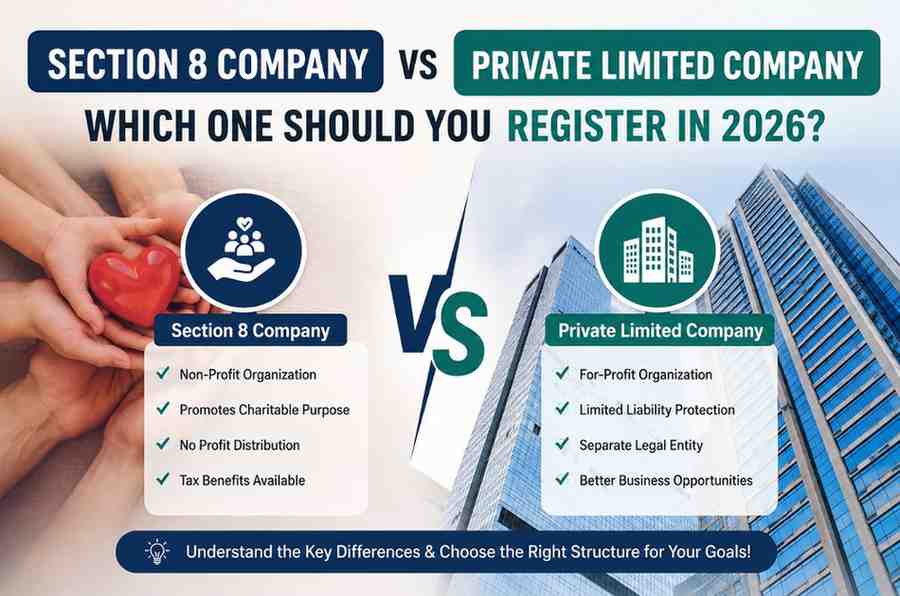
If you’re trying to figure out how to register a company in India, whether for a business or a social cause, one of the first forks in the road is choosing the right legal structure. Two of the most common options entrepreneurs and social founders compare are the Private Limited Company and the Section 8 Company. They sound similar on paper (both fall under the Companies Act, 2013, and both are registered through the MCA’s SPICe+ form), but they exist for almost opposite reasons.
This blog breaks down the real differences, legally, financially, and practically, so you can make a confident, informed decision instead of guessing. Whether you’re exploring NGO registration for a nonprofit mission or planning a for-profit startup, you’ll find a clear answer here.
The Core Difference: Purpose Before Paperwork
Before comparing compliance costs or paperwork, it helps to understand why each structure exists.
A Private Limited Company is a commercial entity. Its entire purpose is to generate profit and distribute it among shareholders as dividends. It’s the default choice for startups, small businesses, and growth-focused companies that plan to raise investment, scale operations, and eventually reward founders and shareholders financially.
A Section 8 Company, on the other hand, is a nonprofit structure created under Section 8 of the Companies Act, 2013. It exists to promote charitable, social, educational, religious, scientific, or environmental objectives. Any income it earns must be reinvested into furthering its mission; it can never be distributed as profit or dividends to members. This is precisely why Section 8 Company registration is the go-to route for NGOs, foundations, and social enterprises that want the credibility of a corporate structure without a profit motive.
Everything else- capital requirements, naming rules, compliance burden, and tax treatment, flows from this fundamental distinction in purpose.
Section 8 Company vs Private Limited Company: Side-by-Side Comparison
|
Parameter |
Private Limited Company |
Section 8 Company |
|
Primary objective |
Profit generation for shareholders |
Charitable, social, or nonprofit purpose |
|
Governing provision |
Section 2(68), Companies Act, 2013 |
Section 8, Companies Act, 2013 |
|
Minimum members |
2 shareholders |
2 (private) or 7 (public) subscribers |
|
Maximum members |
200 |
No cap (public); 200 if private |
|
Minimum directors |
2 |
2 (private) or 3 (public) |
|
Minimum paid-up capital |
No statutory minimum (as per current rules) |
No minimum paid-up capital required |
|
Central Government license |
Not required |
Mandatory prior approval before incorporation |
|
Name suffix |
Must end with “Private Limited” |
Cannot use “Limited”/”Private Limited”; typically ends in Foundation, Association, Council, Forum, etc. |
|
Profit distribution |
Allowed as dividends to shareholders |
Strictly prohibited; profits must be reinvested |
|
Stamp duty on MOA/AOA |
Applicable |
Exempt |
|
Tax exemption eligibility |
Not applicable by default |
Eligible for 12A and 80G registration under Income Tax Act |
|
Registration timeline |
Roughly 10–15 working days |
Roughly 20–30 working days (due to license approval) |
Why Founders Choose a Private Limited Company
If your goal is to build a scalable business, a tech startup, a manufacturing unit, a consultancy, or an e-commerce venture, a Private Limited Company is almost always the practical choice. It gives you:
- Limited liability protection for shareholders, so personal assets stay separate from business debts
- Easier access to funding, since most venture capital firms and angel investors prefer investing in Pvt Ltd structures because they can hold equity
- Simpler governance, without the added layer of central government licensing
- Faster incorporation, typically completed within two weeks when documentation is in order
The tradeoff is that a Private Limited Company doesn’t get any special tax exemptions just for being a company; its profits are taxed like any other business, and dividends are taxed in the hands of shareholders.
Why Founders Choose a Section 8 Company
If your mission is centered on public benefit, education, healthcare, environmental conservation, poverty alleviation, arts, or research, a Section 8 Company offers structural advantages that trusts and societies typically can’t match:
- Higher credibility with donors and grant-making bodies, since Section 8 companies are regulated by the MCA and subject to stricter disclosure norms than trusts or societies
- Nationwide operation without needing separate state-level registrations, unlike societies, which are governed by state-specific acts
- Eligibility for 12A and 80G tax benefits, which exempt the organization’s income from tax and make donations to it tax-deductible for donors, a major factor for anyone serious about NGO registration
- No minimum capital requirement, so you can start with whatever funds are necessary to pursue your objectives
- Perpetual succession and limited liability, giving members the same legal protection as shareholders in a regular company
The tradeoff is a longer runway to incorporation, since you need Central Government approval (via the Registrar of Companies) before the company is formally licensed, and ongoing compliance is more document-heavy because regulators want assurance that funds are being used for their stated charitable purpose.
How to Register a Company
Regardless of which structure you choose, the registration process runs through the same government portal, the MCA’s SPICe+ (Simplified Proforma for Incorporating Company Electronically Plus) web form. Here’s the general workflow:
- Obtain a Digital Signature Certificate (DSC) for all proposed directors, since forms are filed electronically.
- Apply for a Director Identification Number (DIN) for each director through the SPICe+ form itself.
- Reserve your company name using the RUN (Reserve Unique Name) facility or directly within SPICe+ Part A.
- Draft the Memorandum of Association (MOA) and Articles of Association (AOA, for a Section 8 Company; these must explicitly state the charitable objective and, if limited by guarantee, the guarantee amount per member.
- For Section 8 Companies only: file Form INC-12 with the Registrar of Companies to obtain the special license, along with your draft MOA/AOA and a declaration of your charitable purpose.
- Submit SPICe+ Part B with incorporation documents, registered office proof, and PAN/TAN applications.
- Receive your Certificate of Incorporation (COI) once the Registrar verifies everything. This document officially brings your company into legal existence, complete with a Company Identification Number (CIN).
A Private Limited Company usually completes this process within 10 to 15 working days if the paperwork is clean. A Section 8 Company generally takes longer, often 20 to 30 working days, because of the additional license approval step.
Common Questions Founders Ask
1) Can a Section 8 Company make a profit?
Ans. Yes. It can absolutely generate surplus income from donations, grants, membership fees, or even service charges. The restriction isn’t on earning money; it’s on distributing that money to members as dividends. Every rupee of surplus must go back into the organization’s stated objectives.
2) Is a Section 8 Company better than a Trust or Society for NGO registration?
Ans. It depends on your priorities. Trusts and societies are simpler and cheaper to set up, but a Section 8 Company offers stronger legal recognition, easier fund transfer and asset management, unrestricted nationwide operation, and generally higher credibility with institutional donors and CSR-driven corporates.
3) Can I convert a Private Limited Company into a Section 8 Company, or vice versa?
Ans. Conversion is legally possible but procedurally complex, requiring Regional Director approval and adjustments to membership, capital structure, and objectives. It’s rarely a quick fix, most founders find it easier to choose the right structure from the start.
4) Do Section 8 Companies pay income tax?
Ans. Not automatically. Tax exemption isn’t automatic upon incorporation; the organization must separately apply for and obtain 12A registration (for income tax exemption) and 80G registration (to make donor contributions tax-deductible) from the Income Tax Department.
Making the Right Choice for Your Vision
There’s no universally “better” option between these two structures, only the one that matches your actual objective. If your north star is building a scalable, revenue-generating business that can attract investors and reward founders, a Private Limited Company gives you the flexibility and speed to do that. If your north star is creating measurable social impact, gaining donor trust, and reinvesting every rupee into your cause, a Section 8 Company is purpose-built for exactly that.

 Jayendra G
 Thatware LLP