Abhinay gadi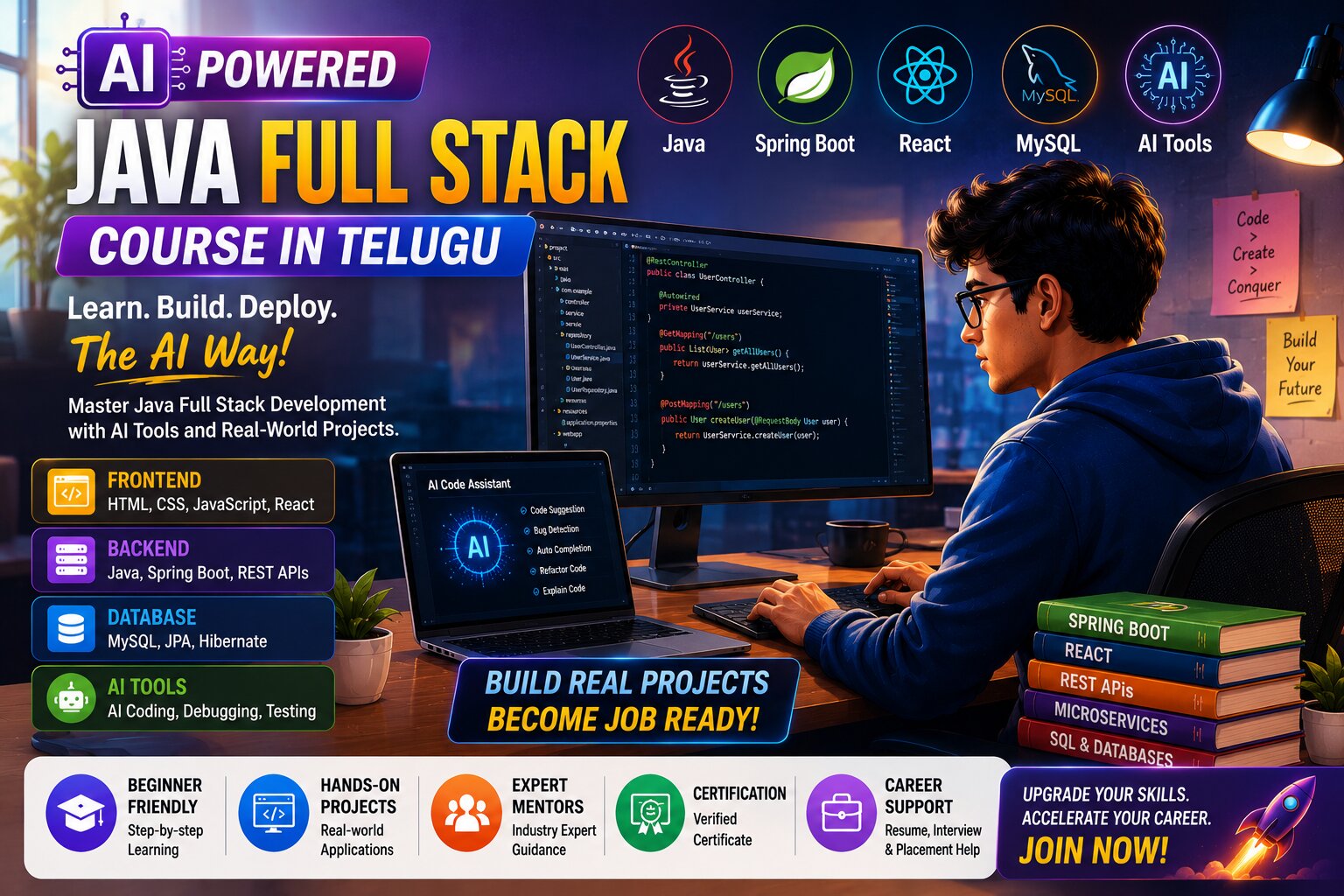
Introduction
Enterprise software has evolved far beyond traditional monolithic applications. Today, organizations build scalable systems using Spring Boot, REST APIs, and Microservices to support millions of users and rapidly changing business requirements. These technologies enable development teams to build applications that are easier to maintain, update, and scale independently. At the same time, Artificial Intelligence is helping developers write cleaner code, automate repetitive programming tasks, and improve development efficiency. An AI Powered Java Full Stack Course in Telugu introduces learners to Spring Boot, API development, Microservices architecture, and AI-assisted coding practices that prepare them for modern enterprise software development.
Understanding Spring Boot
Spring Boot is one of the most popular Java frameworks for backend development.
It simplifies application development by providing:
- Automatic configuration.
- Embedded web servers.
- Secure authentication.
- Database integration.
- REST API support.
- Production-ready deployment.
These features reduce development time while maintaining enterprise-level quality.
What Are REST APIs?
REST APIs allow different applications to communicate with each other.
They help developers:
- Exchange data securely.
- Connect frontend and backend.
- Integrate third-party services.
- Support mobile applications.
- Enable cloud communication.
- Build scalable architectures.
API development has become a core skill for every Full Stack Developer.
Why Microservices Matter
Microservices divide large applications into smaller independent services.
This architecture offers:
- Easier maintenance.
- Independent deployment.
- Better scalability.
- Faster updates.
- Improved fault isolation.
- Flexible development.
Many large technology companies use Microservices to manage complex software systems.
Real-World Example: Online Retail Marketplace
Imagine building a large e-commerce platform.
Instead of one massive application, the system is divided into services for:
- Customer accounts.
- Product catalog.
- Order management.
- Payments.
- Inventory.
- Shipping.
Each Microservice is developed using Spring Boot and communicates through REST APIs.
AI tools assist developers by generating service templates, improving API documentation, identifying coding issues, and suggesting performance optimizations.
This architecture supports future expansion without disrupting the entire platform.
Skills You’ll Learn
An AI Powered Java Full Stack Course in Telugu provides practical knowledge of:
- Spring Boot
- REST APIs
- Microservices
- Java
- SQL
- React
- Git
- AI Coding Tools
These technologies are widely used in enterprise software development.
Best Practices for Enterprise Development
Professional developers should:
- Design reusable APIs.
- Write modular code.
- Test every service.
- Secure application endpoints.
- Document APIs clearly.
- Validate AI-generated code.
These practices improve software reliability and maintainability.
Career Opportunities
Mastering enterprise backend development prepares learners for roles such as:
- Java Backend Developer
- Full Stack Developer
- API Developer
- Software Engineer
- Microservices Developer
- Enterprise Application Engineer
These positions are highly valued across product companies, financial institutions, healthcare organizations, and cloud technology firms.
Conclusion
Spring Boot, REST APIs, and Microservices form the foundation of modern enterprise software development. When combined with Artificial Intelligence, developers can build scalable applications more efficiently while maintaining high-quality coding standards. An AI Powered Java Full Stack Course in Telugu provides hands-on training in these technologies, enabling learners to confidently develop enterprise-ready applications and pursue successful software engineering careers.

 Quiz Training
 Assignment world