Jacob foster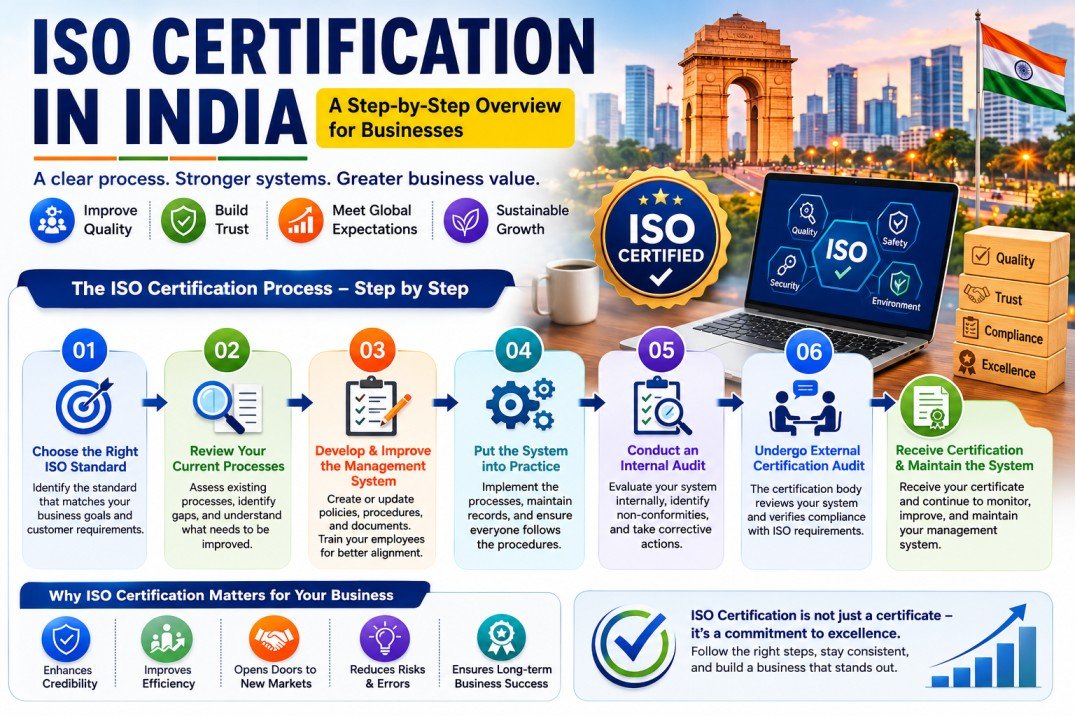
Many businesses in India consider ISO certification when they want to improve their processes, meet customer expectations, or enter new markets. Yet, the certification journey can seem complicated when you do not know what happens at each stage.
A clear understanding of the process can make things much easier.
ISO certification is not simply about obtaining a certificate. It involves reviewing existing processes, improving the management system, training employees, and demonstrating that the organization follows the relevant requirements.
The exact process can vary based on the ISO standard, company size, business activities, and certification scope. However, most organizations follow a similar path.
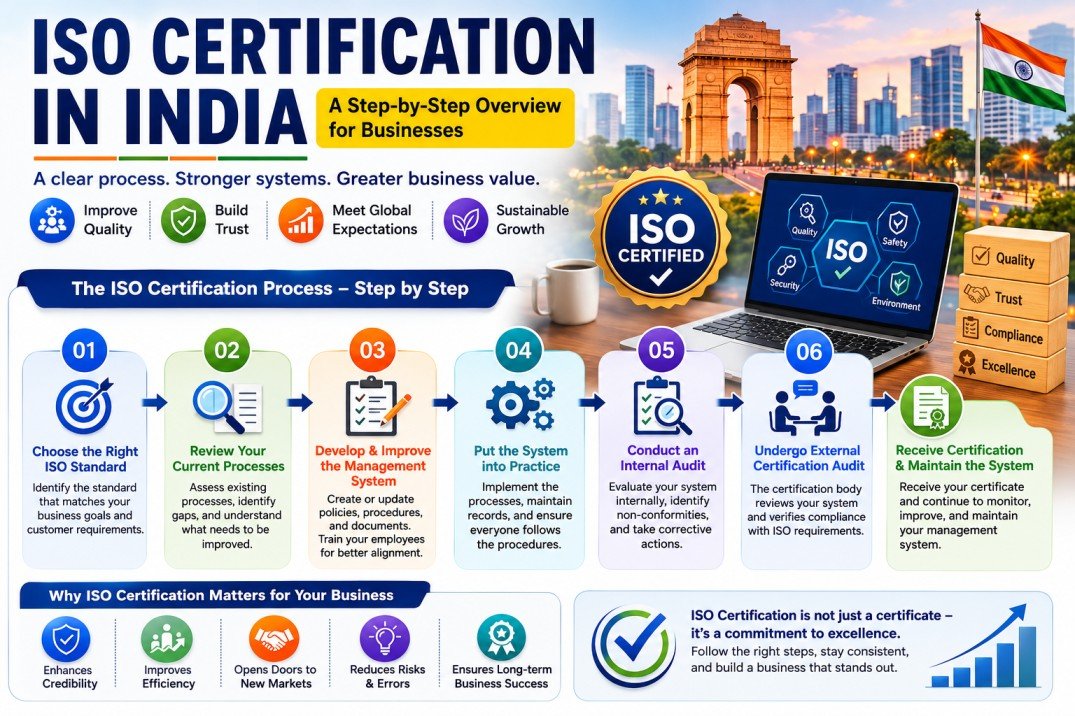
This guide explains the main stages of ISO certification in India and shows how businesses can prepare for each one.
Step 1: Choose the Right ISO Standard
Every organization has different needs. The first step is to identify the ISO standard that fits your business objectives.
For example, ISO 9001 focuses on quality management. ISO 14001 addresses environmental management. ISO 27001 focuses on information security, while ISO 45001 covers occupational health and safety.
Start With Your Business Goals
Think about the challenges your organization wants to address.
Do customers want stronger quality controls? Are you concerned about information security? Does your business need better environmental practices?
Your answers can help you select the right standard.
Avoid choosing a certification simply because another company has it. The standard should provide value for your own organization.
Consider Customer and Market Requirements
Customer expectations can also influence your decision.
Some industries or contracts may require specific ISO certifications. International customers may also ask suppliers to demonstrate effective management systems.
Review these expectations before you begin. Doing so can help you avoid choosing a standard that does not support your business goals.
Step 2: Review Your Current Processes
After choosing the standard, look at your existing system.
Do not assume that you need to build everything from scratch. Many organizations already follow useful processes. They simply need to improve or formalize them.
Identify Gaps Honestly
Compare your current practices with the requirements of the chosen standard.
Look at your policies, procedures, records, responsibilities, controls, and day-to-day activities.
This review can highlight areas that need improvement.
For example, you may discover that employees follow different methods for the same task. You may also find that important records are missing.
Create a Practical Action Plan
Record the gaps you find.
Then, create a simple action plan. Assign responsibility for each task and set realistic deadlines.
A clear plan gives your team a practical roadmap. It also makes progress easier to track.
Step 3: Develop and Improve the Management System
The next stage involves addressing the gaps identified during the review.
Some businesses may need to create new processes. Others may only need to improve existing ones.
Keep Documentation Practical
Documentation plays an important role in many ISO management systems.
However, your goal should not be to create piles of paperwork.
Documents should help employees understand their responsibilities. They should also reflect how the business actually operates.
Keep procedures clear and easy to follow. Update them when your processes change.
Train Your Employees
Employees need to understand the management system.
Explain the processes that affect their daily work. Show them why these processes matter.
Training also gives employees an opportunity to ask questions. It can help them feel more comfortable with changes introduced during implementation.
A management system works best when employees understand it and use it consistently.
Step 4: Put the System into Practice
Creating procedures is only one part of certification.
Your organization must also put those procedures into practice.
Employees should follow the defined processes during normal operations. The organization should also maintain suitable records and monitor important activities.
Give the System Time to Work
Do not rush directly from documentation to certification assessment.
Give employees time to use the new or improved processes. This period can reveal practical problems that were not obvious during planning.
You may discover that a procedure needs clarification. Perhaps a form takes too long to complete. Another process may need additional employee training.
Fix these issues before the formal assessment.
For businesses exploring ISO certification in India, this stage can make a major difference to the overall success of the project.
Step 5: Conduct an Internal Audit
An internal audit allows your organization to review its own management system before the external certification assessment.
The audit should provide an honest picture of your current performance.
Check Processes and Evidence
Internal auditors review processes, records, and other forms of objective evidence.
They also speak with employees and observe how work takes place.
The goal is to determine whether the organization follows its established processes and meets the applicable requirements.
Correct Problems before the External Audit
Internal audits can reveal nonconformities and other improvement opportunities.
Once you identify an issue, investigate its cause. Then, take suitable corrective action.
This approach gives your team time to resolve problems before the certification assessment.
It also helps employees gain confidence in the management system.
Step 6: Complete the Certification Assessment
After adequate preparation, the organization can move toward the formal certification assessment.
An independent certification body evaluates the management system against the requirements of the selected ISO standard.
Review the Management System
The auditor examines relevant documents and records.
They also ask questions and speak with employees. Depending on the standard and assessment arrangements, auditors may observe processes and activities.
The assessment focuses on evidence.
Employees should answer questions honestly and explain how they perform their responsibilities.
Understand Audit Findings
The auditor may identify areas that meet requirements and areas that need attention.
If the audit identifies a nonconformity, your organization should understand the issue clearly.
Work with the responsible team to investigate the cause. Then, take corrective action and provide appropriate evidence.
Do not view audit findings only as negative results. They can also highlight opportunities to strengthen your management system.
Step 7: Receive and Maintain Certification
Once the organization successfully completes the certification process, the certification body issues the relevant certification.
However, certification does not mean the work ends there.
A management system needs ongoing attention.
Continue Internal Reviews
Regular internal audits help organizations monitor performance.
They can also identify new risks, process changes, and improvement opportunities.
Management reviews provide another useful opportunity to evaluate the effectiveness of the system.
Keep Improving the System
Businesses change over time.
New employees join. Processes evolve. Customer expectations change. Technology also creates new opportunities and risks.
Your management system should evolve with the business.
Regular updates can help keep the system useful and relevant.
The Importance of Keeping Clear Records
Good records can help your organization demonstrate how its management system works.
Keep track of important decisions, training activities, internal audits, corrective actions, reviews, and improvement activities.
Organized records can also help new employees understand the history of the management system.
They provide useful evidence during future audits and reassessments.
Who Should Understand the Certification Process?
Organizations pursuing certification for the first time can benefit greatly from understanding the full process.
It helps management set realistic expectations. It also helps employees understand why their participation matters.
Growing companies can benefit as well.
When certification forms part of a broader growth strategy, businesses can build processes that support expansion instead of creating unnecessary bureaucracy.
Common Questions about ISO Certification in India
How Long Does ISO Certification Take?
There is no fixed timeline for every organization.
The duration depends on factors such as company size, business complexity, certification scope, existing processes, employee readiness, and the selected standard.
Organizations with mature systems may need less preparation than businesses starting from the beginning.
Can a Business Skip Internal Audits?
Skipping internal audits can increase the risk of problems during the certification assessment.
An internal audit gives your organization a chance to identify and correct gaps before an external auditor reviews the system.
Is ISO Certification Only for Large Companies?
No.
Small and medium-sized businesses can also pursue ISO certification.
The management system should match the organization’s size, activities, and operational needs. A small company does not need the same level of complexity as a large multinational organization.
Does ISO Certification Guarantee Business Growth?
No certification can guarantee business growth.
However, an effective management system can improve process consistency, customer confidence, risk management, and operational control.
These improvements can support wider business objectives.
Learn From Other Certified Organizations
Businesses can also learn from companies that have already completed certification.
Talk to industry peers when possible. Ask about the challenges they faced and the improvements they made.
However, avoid copying another company’s system.
Every organization has different risks, processes, customers, and goals. Use other businesses as a source of ideas rather than as a direct template.
Make ISO Certification Part of Your Business Strategy
The best results often come when organizations connect certification with real business objectives.
For example, a company may want certification to meet customer requirements. Another business may use it to improve internal processes before expanding into new markets.
Think beyond the certificate.
Ask how the management system can improve your business. Consider how it can help employees work more consistently and how it can support better decision-making.
This approach can turn certification into a valuable business improvement project.
Final Thoughts
ISO certification in India involves more than completing an application and receiving a certificate.
Businesses need to choose the right standard, review their existing processes, address gaps, train employees, operate the management system, conduct internal audits, and prepare for formal assessment.
The process may require time and coordination. However, careful preparation can make the journey much easier.
Most importantly, treat ISO certification as an opportunity to improve the way your organization works.
When employees understand the system and management supports it, certification can become part of everyday business operations. That is where the real value of ISO certification begins.


 Canadian studies
 Jenisha A