Krishna Kumar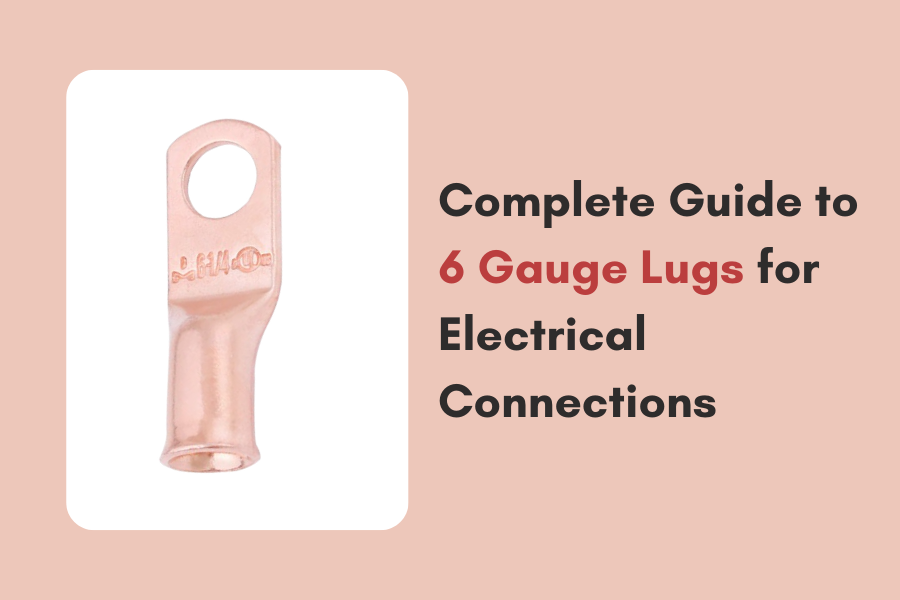
What Are 6 Gauge Lugs, and Why Do They Matter?
If you’ve ever wired a solar system, replaced a battery bank, or done any serious electrical work, you’ve probably run into the question: “What connector do I use for this wire?” That’s usually where 6 gauge lugs come in. A 6 gauge lugs, also referred to as a 6 gauge wire lugs, is simply an electrical terminal connector designed to fit 6 AWG wire. Both terms mean exactly the same thing — just different ways people in different trades happen to say it.
A 6 AWG wire is roughly 4 mm in diameter and can handle 55 to 75 amps depending on the setup. 6 gauge wire lugs are what connect that wire cleanly and safely to a terminal, stud, or bus bar. Skip the lug or use the wrong one, and you’re looking at loose connections, arcing, and in the worst case, a fire. Used correctly, they’re one of the most reliable components in any electrical system.
The Main Types You’ll Come Across
Walk into any electrical supply house and you’ll find several styles of 6 gauge lugs. The most common is the ring terminal — it has a closed hole that fits over a bolt, so it can’t accidentally come loose. Great for battery terminals and solar panels where vibration is a concern.
Fork (spade) lugs have an open U-shape instead, which lets you attach and remove them without fully unscrewing the fastener. Handy for control panels where you’re swapping wires regularly. Then there are pin-style lugs, which plug directly into terminal blocks — common in industrial and European-style panels.
You’ll also choose between insulated and non-insulated versions. Insulated 6 gauge wire lugs come with a color-coded plastic sleeve (yellow for 6 AWG) that adds a layer of protection and makes identification faster on the job. Non-insulated ones are used when you’re applying your own heat shrink or additional insulation.
Copper, Tinned, or Aluminum — Which Should You Use?
Material matters more than most people realize. Straight copper 6 gauge lugs give you the best conductivity and are the default choice for most indoor applications. If you’re working in a marine environment, outdoors, or anywhere with moisture, go with tinned copper instead — the tin coating resists corrosion and extends the life of the connection significantly.
Aluminum 6 gauge wire lugs are lighter and less expensive, but they need anti-oxidant compound applied at installation to prevent oxidation from building up at the connection point. Skip that step and resistance will climb over time. Bi-metal lugs (aluminum barrel, copper tongue) exist specifically for connecting aluminum wire to copper bus bars without the risk of galvanic corrosion.
How to Install Them Properly
Installing 6 gauge lugs isn’t complicated, but getting it right matters. Strip about 3/4” of insulation from your wire, slide it fully into the barrel, and crimp it with a ratchet crimper using the correct 6 AWG die. The ratchet mechanism is important — it won’t release until the crimp is complete, which takes the guesswork out of it. Once crimped, give the wire a firm tug. It shouldn’t move at all.
A few things to avoid: don’t use the wrong die size, don’t leave stray strands outside the barrel, and always torque the bolt to spec when you bolt the lug down. Under-tightening lets 6 gauge wire lugs work loose over time. Over-tightening can crack the tongue. Both lead to problems down the road.
Where Are 6 Gauge Wire Lugs Actually Used?
6 gauge wire lugs show up in more places than you’d expect:
- Solar systems: Connecting panels, charge controllers, and inverters
- Automotive and marine: Amplifiers, winches, and starter circuits
- Battery banks: RV, UPS, and home energy storage systems
- Residential panels: Sub-panel feeds and grounding conductors
Final Thoughts
Choosing the right 6 gauge lugs for your application and installing them correctly is the difference between a connection that holds for decades and one that fails at the worst possible moment. Match the type to your terminal, the material to your environment, and always crimp properly. Do that, and your 6 gauge wire lugs will outlast the rest of the system.

 Oliver oliver