Nirwana AI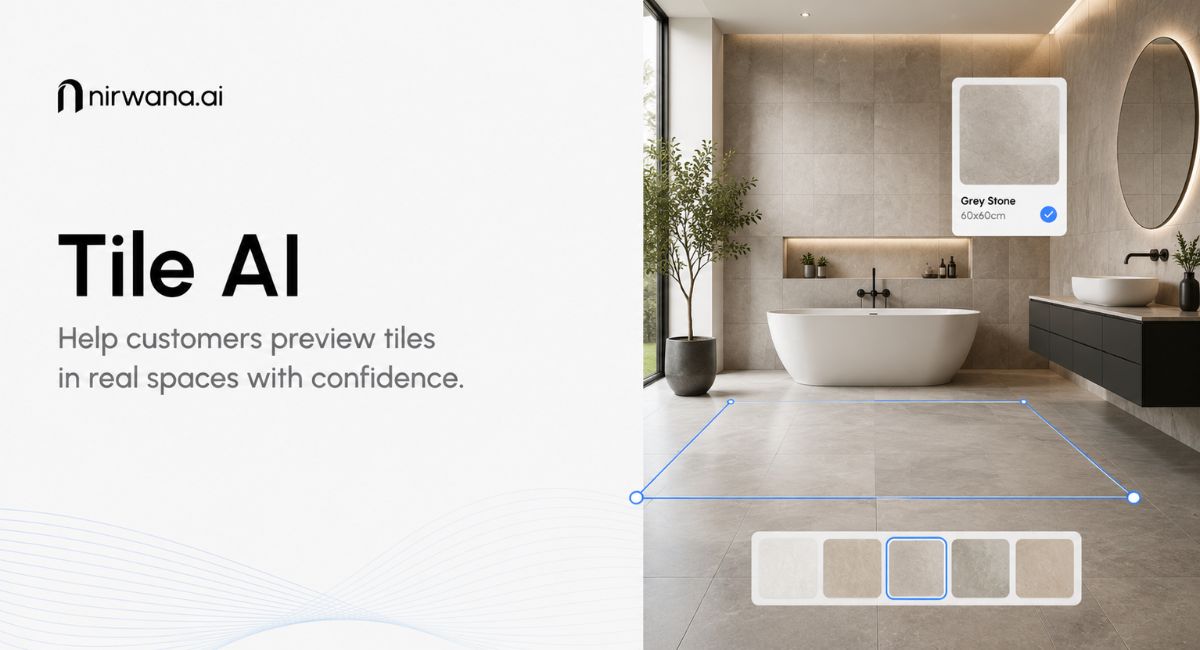
Choosing the right tile should feel exciting. But for many homeowners, architects, designers, and retailers, it quickly becomes confusing.
A customer may like a tile sample in a showroom but still wonder how it will look across an entire living room floor. Will the pattern feel too busy? Will the colour work with the furniture? Will the tile size make the room feel larger or smaller?
These questions often delay purchasing decisions.
This is where Tile AI is changing the experience. Instead of asking customers to imagine the final result, AI-powered visualization allows them to see selected tiles inside realistic room environments before making a purchase.
For tile businesses, this means more confident customers, faster decisions, and a more engaging buying journey.
What Is Tile AI?
Tile AI refers to artificial intelligence technology designed to help customers visualize, compare, and select tiles more effectively.
A customer can upload a photograph of a room or choose a preset interior. The system identifies surfaces such as floors and walls and digitally applies the selected tile to the appropriate area.
Unlike basic editing software, advanced visualization technology can understand:
- Room perspective
- Floor and wall boundaries
- Tile dimensions
- Pattern direction
- Lighting conditions
- Grout placement
- Surface angles
The result is a realistic preview that helps customers understand how a tile may look after installation.
This experience is especially useful for tile retailers, manufacturers, distributors, architects, and interior designers who want to make product selection easier for their customers.
Why Traditional Tile Selection Can Be Difficult
Customers usually make tile decisions using small samples, printed catalogues, showroom displays, or product images.
Although these methods are useful, they do not always show the complete picture.
A 60 x 60 cm tile sample may look attractive when viewed individually, but the effect can change when the same tile is repeated across a large floor. Veins, patterns, grout lines, lighting, and surrounding colours all influence the final appearance.
Customers Struggle to Imagine the Finished Room
Most customers are not trained interior designers. They may find it difficult to mentally place a tile inside their kitchen, bathroom, bedroom, or living room.
This uncertainty creates common questions:
- Will this tile match my cabinets?
- Is the pattern too bold for the room?
- Should I choose a lighter colour?
- Will a larger tile make the space look better?
- What grout colour should I use?
When customers cannot answer these questions, they often postpone the purchase or visit multiple stores before deciding.
Small Samples Do Not Show Pattern Repetition
Tile designs can appear very different when repeated across a large surface.
For example, a marble-look tile may have beautiful veining on one sample. However, customers also need to understand how multiple pieces will appear together. The direction, variation, rotation, and repetition of the design can significantly affect the final result.
A realistic visualizer can present the tile across the entire surface, giving the customer a much clearer idea of the completed space.
How Tile AI Improves the Buying Experience
The biggest advantage of Tile AI is that it turns an uncertain decision into a visual experience.
Instead of relying only on imagination, customers can explore different products inside a familiar space.
Customers Can Visualize Tiles in Their Own Rooms
A homeowner can upload a photograph of an unfinished bathroom and test different wall and floor tiles. They can compare a light stone design with a darker option, explore different tile sizes, and see how each selection affects the overall mood.
This makes the experience personal because the customer is not viewing a generic catalogue image. They are seeing a possible version of their own home.
Multiple Products Can Be Compared Quickly
Traditional comparison requires customers to carry samples, browse separate catalogue pages, or repeatedly walk between showroom displays.
With a digital visualizer, they can switch between different tile options within seconds.
For example, a customer selecting flooring for a living room may compare:
- Beige marble-look tiles
- Grey concrete tiles
- Warm wood-look tiles
- Large-format stone tiles
Seeing the options in the same room makes differences in colour, pattern, and style much easier to understand.
Tile Size and Layout Become Easier to Understand
Tile dimensions can completely change the appearance of a space.
Large-format tiles may create a more continuous look with fewer grout lines, while smaller tiles may add texture and detail. Layouts such as straight stack, brick pattern, diagonal placement, or herringbone can also create different visual effects.
Advanced Tile AI solutions can represent tile scale and placement more accurately, helping customers select a suitable combination before installation begins.
Benefits for Tile Retailers and Manufacturers
AI visualization is not only helpful for customers. It can also support sales teams and improve the way tile companies present their collections.
Faster and More Confident Decisions
Customers often delay purchases because they are afraid of making the wrong choice. Tiles are not easy to replace once installed, so the perceived risk is high.
A realistic preview can reduce this fear by giving customers a clearer understanding of the expected outcome. Sales representatives can use the visualization during consultations to explain products and recommend suitable alternatives.
This can shorten the decision-making process without making the customer feel pressured.
A More Engaging Showroom Experience
Retailers can add a tile visualizer to a touchscreen, kiosk, tablet, or large showroom display.
Imagine a customer selecting a tile from the showroom collection, scanning its code, and immediately seeing it applied inside a bathroom or living room. The salesperson can then adjust the surface, layout, grout, or tile size during the conversation.
This creates a more interactive experience than simply showing physical samples.
Better Online Product Presentation
A tile brand may have hundreds or even thousands of products. Showing every product inside professionally designed room scenes can require significant photography, rendering, and editing.
Platforms such as Nirwana.ai help businesses present tile collections through AI-powered visualization, allowing customers to explore products in different environments without requiring a separate photoshoot for every design.
This can make websites more useful and improve the experience for customers who begin their product research online.
Real-World Example of AI-Powered Tile Selection
Consider a customer renovating a compact bathroom.
The customer initially selects a dark tile because it looks premium in the showroom. After applying it digitally across every wall, they realise that the room feels smaller and darker than expected.
They then try the same design on only one feature wall and use a lighter tile on the remaining surfaces. The updated combination feels more balanced.
Without visualization, the customer may have discovered this problem only after installation. With Tile AI, they can explore the idea before purchasing the material.
The retailer also benefits because the customer receives clearer guidance and feels more confident about the final order.
What Features Should a Good Tile Visualizer Offer?
Not every visualizer provides the same level of accuracy. A practical solution should make the experience easy while preserving the appearance of the actual tile product.
Important features may include:
Automatic Surface Detection
The system should identify walls and floors accurately so that tiles are placed only on the selected surface.
Realistic Tile Scaling
The preview should reflect the actual tile dimensions. A 120 x 60 cm tile should not appear the same size as a 30 x 30 cm tile.
Pattern and Layout Controls
Customers should be able to explore rotation, alignment, randomization, and common installation layouts when relevant.
Grout Customization
Grout colour and width can influence the overall appearance. Allowing users to test grout combinations creates a more complete preview.
Lighting and Perspective Accuracy
The tile should follow the room’s perspective and respond naturally to existing lighting, shadows, corners, and objects.
Nirwana.ai uses AI-powered visualization to help tile businesses deliver realistic product previews while making their digital and in-store selection process more interactive.
The Future of Tile Shopping
Customers increasingly expect personalized and visual digital experiences. They want to research products online, compare options quickly, and understand how a purchase will fit into their lives.
Tile AI supports this shift by connecting product catalogues with real customer spaces.
In the future, tile visualization may become a standard part of both online and showroom purchasing. Customers will be able to explore complete tile collections, generate realistic room previews, save combinations, share designs with family members, and request quotations from the same experience.
Businesses that adopt these tools early can create a smoother buying journey while giving their sales teams a more practical way to explain products.
Conclusion
Selecting tiles no longer has to depend entirely on imagination.
With Tile AI, customers can preview different tiles, layouts, sizes, and grout combinations before making a final decision. This reduces uncertainty, improves product understanding, and creates a more confident purchasing experience.
For tile brands and retailers looking to modernize their customer journey, an AI-powered visualizer from Nirwana.ai can be a valuable step toward making tile selection simpler, faster, and more engaging.


 Antonio Thomas
 Pc Help Reviews