SoundBox Store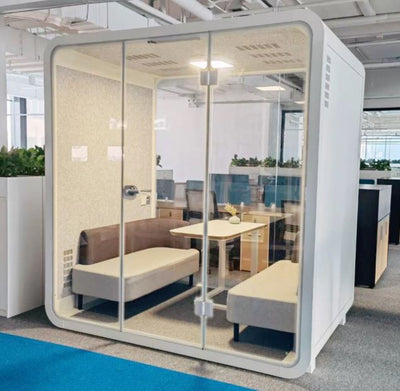
A lot of companies still assume they need traditional conference rooms because that is what offices have always had. Then they look at booking data and realise the room sits empty most of the week. The space gets used for occasional client meetings, monthly team updates, and not much else.
We have seen the opposite happen with meeting pods. Small teams use them constantly. Hybrid meetings happen inside them. Managers use them for one-to-ones. Sales teams use them for client calls. Instead of occupying a large section of the office waiting for the occasional meeting, a meeting pod tends to earn its floor space every day.
The bigger question is not whether a meeting pod can replace a conference room. The real question is whether your conference room is actually being used enough to justify the space it occupies.
Are Traditional Conference Rooms Becoming Less Relevant?
Most conference rooms were designed for a workplace where everybody sat in the office five days a week. That is not how most companies operate anymore. Teams are smaller, hybrid work is common, and meetings increasingly involve people joining remotely.
The result is a strange mismatch. Companies dedicate significant floor space to large meeting rooms while most daily meetings involve two to four people.
That is exactly why meeting pods have become popular. They match the way people actually work today rather than the way offices worked ten years ago.
Do Meeting Pods Save Money Compared to Building New Meeting Rooms?
Creating a traditional conference room often involves construction work, electrical changes, disruption to staff, and permanent floorplan decisions. Once the room is built, it stays where it is.
A meeting pod solves the same privacy problem without requiring major alterations to the office. Many models can be installed quickly and relocated if the business moves or expands.
That flexibility becomes important because office requirements rarely stay the same for long.
Are Meeting Pods Private Enough for Important Conversations?
This is probably the first question buyers ask. The answer depends on the product.
A properly engineered meeting pod is designed specifically for privacy. Acoustic performance matters far more than appearance. Some businesses focus on furniture and aesthetics while overlooking sound control entirely.
That usually becomes a mistake once confidential conversations start happening inside the space.
This is one reason many organisations now choose dedicated acoustic solutions rather than attempting to convert open areas into informal meeting zones.
What Are Companies Missing When Comparing Meeting Pods and Conference Rooms?
Most comparisons focus on cost. The bigger issue is utilisation. A conference room may be larger, though size means very little if it spends most of its time empty. A meeting pod that gets used twenty times a day often creates more value than a room used twice a week.
This is where many office planners get the calculation wrong. The goal is not maximising square metres. The goal is maximising useful space.
Are Meeting Pods Replacing Conference Rooms Completely?
Not entirely. Large board meetings, presentations, and company-wide discussions still benefit from dedicated conference rooms. Those situations are not going away. What is changing is the ratio.
Many companies are reducing the number of traditional meeting rooms and replacing part of that space with meeting pods and soundproof office pods. The result is usually a more flexible workplace that supports both collaboration and focused work.
Final Thoughts
For most modern workplaces, the debate is no longer meeting pod versus conference room. The better question is how much of each you actually need.
Companies that rely heavily on hybrid meetings, client calls, and small team collaboration often discover that a meeting pod delivers better day-to-day value than a large conference room. When combined with soundproof office pods, businesses can create private, productive spaces without committing significant floor space to rooms that sit empty most of the time.


 Garry Smith
 Jessica Smith