Empowrd AI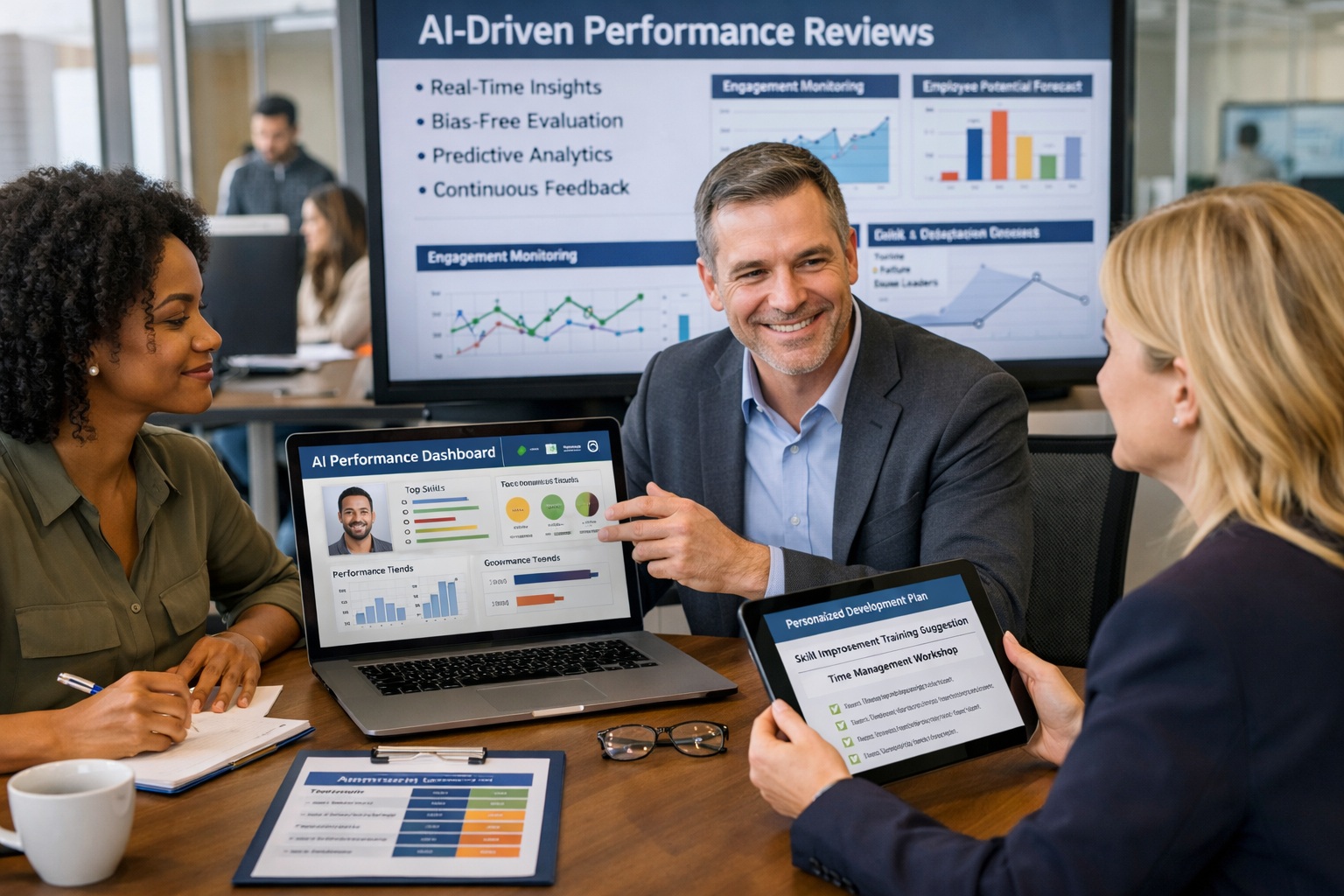
Let’s be honest, performance reviews have never been anyone’s favorite activity. Employees often feel nervous, managers feel overloaded, and HR departments spend countless hours gathering, organizing, and analyzing feedback. But now, with technology advancing faster than ever, there’s a new player changing the entire experience: Artificial Intelligence. The implementation of AI in human resources is transforming how organizations measure, support, and improve employee performance. In short, AI in HR is making performance reviews smarter, smoother, and far more meaningful.e
- Turning Data Chaos into Meaningful Insights
Traditional performance reviews often rely on scattered data emails, spreadsheets, meeting notes, or vague memories from months ago. This creates inconsistency and bias. AI solves this by automatically collecting and organizing performance data in real time. Imagine a system that quietly observes key work indicators like project completion rates, collaboration patterns, and even feedback from teammates and then turns all of that into a clear performance snapshot.
With AI tools, HR teams don’t need to spend weeks preparing reports. The system can highlight top performers, identify skill gaps, and even suggest personalized growth opportunities. This means managers can focus more on having valuable conversations rather than crunching numbers. It’s like having a silent, super-organized assistant who never forgets a single achievement or piece of feedback.
- Making Reviews Fair and Bias-Free
One of the biggest issues in traditional reviews is unconscious bias. Sometimes, managers may favor employees who are more visible or who share similar traits, while others get overlooked despite great work. AI helps reduce this by relying on objective data rather than personal opinions.
By analyzing measurable performance metrics, attendance patterns, and peer reviews, AI systems create a more balanced picture of an employee’s contributions. It ensures recognition is based on real work, not workplace politics. Moreover, AI-driven systems can even alert HR when they detect patterns of unfair scoring or favoritism across departments. This transparency helps create a culture where everyone feels valued and judged by the same standards.
- Personalizing Employee Growth Paths
No two employees are the same, and neither should their career growth be. AI brings personalization into performance management by identifying each person’s unique strengths and areas for improvement. For example, if the system notices that an employee consistently excels at creative problem-solving but struggles with time management, it can recommend targeted training modules or mentoring sessions.
This type of tailored feedback keeps employees motivated because it shows that the organization cares about their personal progress not just quarterly numbers. When people feel seen and supported, they naturally perform better. And when HR uses tools like Empowrd AI, this personalization becomes seamless, saving both time and effort while delivering better outcomes.
- Predicting Future Performance and Potential
One of the most exciting things AI can do in HR is predict not just record performance trends. By analyzing past data, AI can forecast which employees are likely to excel in leadership roles, which teams may face burnout, or where performance might dip in the coming months. This predictive power helps HR leaders act early instead of waiting for problems to surface.
For instance, if AI detects a drop in engagement levels across a department, HR can intervene with training, recognition, or workload adjustments before performance declines. It’s a proactive approach that turns performance management from a reactive task into a strategic advantage.
Table: Traditional Reviews vs. AI-Powered Reviews
|
Aspect |
Traditional Method |
AI-Driven Method |
|
Data Collection |
Manual and time-consuming |
Automated and continuous |
|
Bias Level |
High (subjective opinions) |
Low (data-driven insights) |
|
Feedback Frequency |
Once or twice a year |
Real-time, ongoing |
|
Employee Growth |
Generic and broad |
Personalized and specific |
|
Decision Making |
Reactive |
Predictive and proactive |
- Building a Culture of Continuous Feedback
One of the best outcomes of AI-powered reviews is the shift toward continuous feedback. Instead of waiting for annual evaluations, employees receive small, timely nudges and insights throughout the year. These micro-feedback sessions make improvement a natural part of the work process rather than a once-a-year stress event.
AI tools can send automated reminders to managers to check in, highlight recent wins for recognition, or suggest development conversations at the right moments. Over time, this creates a culture where feedback is normalized, and employees grow steadily instead of in sporadic bursts.
“Performance reviews shouldn’t be about judgment—they should be about growth. AI helps us turn that idea into reality.”
FAQ
Q1. Will AI replace HR professionals in performance reviews?
Not at all. AI acts as a supportive tool, not a replacement. It automates repetitive tasks and data collection, allowing HR professionals to focus on meaningful discussions and employee development.
Q2. How does AI ensure fair evaluations?
AI systems use measurable, unbiased data instead of subjective impressions. They analyze performance metrics and identify potential bias patterns, ensuring more objective outcomes.
Q3. Is AI hard to integrate with existing HR systems?
Modern platforms like Empowrd AI are designed to integrate smoothly with current HR software, making the transition easy and efficient without overhauling existing processes.
Q4. Can AI help in setting better performance goals?
Yes! AI can analyze past performance and market benchmarks to recommend realistic, data-backed goals that push employees without overwhelming them.
Conclusion: The Future of HR is Smarter, Not Harder
AI isn’t here to replace the human touch—it’s here to make it stronger. By automating the tedious parts of performance reviews, providing real-time insights, and ensuring fair evaluation, AI allows HR teams to focus on what truly matters: people. It takes the guesswork out of performance management and replaces it with clarity, accuracy, and empathy.
As workplaces continue to evolve, those that embrace AI-driven HR tools will have a clear advantage. They’ll not only boost productivity but also create a culture of fairness, growth, and trust. Because when performance reviews stop being a source of stress and start becoming a source of learning, everyone wins—and that’s the real promise of AI in HR.
Read More: AI-Powered Sales Funne


 Class hud
 nikita pawar