Bidz Professional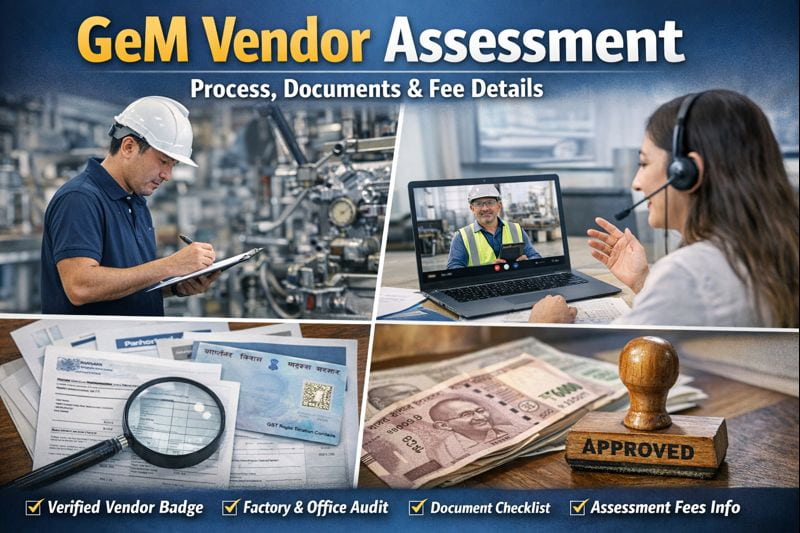
The Government e-Marketplace (GeM) is India’s official online procurement platform where government departments, PSUs, and public institutions purchase goods and services. To ensure quality, transparency, and trust, GeM has introduced a verification system known as GeM Vendor Assessment. This assessment plays a vital role in identifying genuine and capable sellers, especially manufacturers and OEMs.
In this article, we will explain what GeM Vendor Assessment is, who needs it, its benefits, step-by-step process, required documents, and fee details, all in simple language for easy understanding.
What Is GeM Vendor Assessment?
GeM Vendor Assessment is a structured evaluation process carried out through a GeM-approved agency to verify a seller’s business authenticity, production or service capability, quality systems, and financial stability. The goal is to confirm that the seller can reliably fulfill government orders.
After successful completion, the seller receives a Vendor Assessment (VA) status on the GeM portal. This status improves the seller’s credibility and helps government buyers make confident purchasing decisions.
Vendor Assessment is especially important for sellers who claim to be manufacturers, OEMs, or brand owners.
Who Is Required to Complete GeM Vendor Assessment?
Vendor Assessment is not mandatory for every seller on GeM. It is mainly required for:
- Manufacturers and OEMs selling their own products
- Sellers listing products under Quality Categories (Q1 / Q2)
- Businesses applying for OEM authorization or brand listing on GeM
- Sellers participating in high-value or technically sensitive bids
Traders and resellers usually do not need vendor assessment unless they want OEM status or are bidding where assessment is compulsory.
Why Is GeM Vendor Assessment Important?
Completing GeM Vendor Assessment offers multiple long-term benefits:
- Builds trust with government buyers
- Adds a Verified Vendor badge to your GeM profile
- Improves chances of winning large and restricted tenders
- Required for OEM certification on GeM
- Enhances visibility in GeM product search results
- Helps MSMEs compete with larger suppliers
For serious sellers, vendor assessment is not just compliance—it is a growth opportunity.
GeM Vendor Assessment Process – Step by Step
The GeM Vendor Assessment process is simple but requires proper preparation. Below is a clear step-by-step explanation.
Step 1: Seller Registration on GeM
First, the seller must be registered on the GeM portal with complete and accurate business details, including PAN, GST, bank account, and contact information.
Step 2: Initiate Vendor Assessment Application
After login, the seller needs to apply for Vendor Assessment from the GeM dashboard. During this step, the seller selects the relevant product or service category and submits required information.
Step 3: Upload Documents
All necessary documents related to business registration, finance, quality, and operations must be uploaded on the portal. Incorrect or missing documents can cause delays or rejection.
Step 4: Fee Payment
The vendor assessment fee must be paid online through the GeM portal. The fee depends on the seller type and annual turnover.
Step 5: Desktop Evaluation
The assessment agency reviews submitted documents to verify business legitimacy, compliance, and claimed capabilities.
Step 6: Video or Virtual Assessment
A video assessment may be conducted where the seller shows their office, factory, machinery, or service setup. This helps confirm real operational capacity without a physical visit.
Step 7: Final Approval
Once all checks are successfully completed, the seller receives GeM Vendor Assessment approval, and the VA status is updated on the profile.
Documents Required for GeM Vendor Assessment
Preparing correct documents is the most important part of GeM Vendor Assessment. Below is a commonly required list.
Business Registration Documents
- Certificate of Incorporation / Partnership Deed / Proprietorship proof
- PAN Card of the business
- GST Registration Certificate
- Bank account details with cancelled cheque
Financial Documents
- Latest balance sheet and profit & loss statement
- Turnover declaration or CA certificate (if required)
Product or Service Documents
- Product catalog with specifications
- Manufacturing process details (for manufacturers)
- List of machinery, tools, or infrastructure
- Quality certifications such as ISO, BIS, CE (if applicable)
Operational Proof
- Factory or office address proof
- Photographs or videos of premises
- Past work experience or purchase orders (optional but helpful)
Providing genuine and clear documents increases approval chances and speeds up the process.
GeM Vendor Assessment Fee Details
The GeM Vendor Assessment fee is non-refundable and varies based on seller type and annual turnover. Below is an approximate structure (excluding GST).
Vendor Assessment Fee for Manufacturers / OEMs
- Turnover up to ₹20 lakh – Low fee category
- ₹20 lakh to ₹1 crore – Medium fee category
- Above ₹1 crore – Higher fee category
Vendor Assessment Fee for Resellers
- Lower fees compared to manufacturers
- Depends on declared turnover
The exact fee is shown on the GeM portal at the time of application. In some cases, exemptions may apply for certain government entities or certified manufacturers.
Common Mistakes to Avoid During Vendor Assessment
Many sellers face rejection due to small errors. Avoid these common mistakes:
- Uploading incorrect or outdated documents
- Mismatch between GeM profile and documents
- Poor video quality during virtual assessment
- Claiming manufacturing capability without proof
- Not responding to assessment queries on time
Professional assistance can help avoid these issues.
Conclusion
GeM Vendor Assessment is a crucial step for sellers who want to build trust, gain OEM recognition, and win high-value government orders. By understanding the process, document requirements, and fee structure, sellers can prepare better and avoid delays.
If you are a manufacturer, OEM, or serious GeM seller, completing Vendor Assessment on GeM is not optional—it is essential for long-term success on the platform. With proper planning and accurate documentation, the process becomes smooth and rewarding.


 amelia lily
 Alfre Noe