Patricia Smith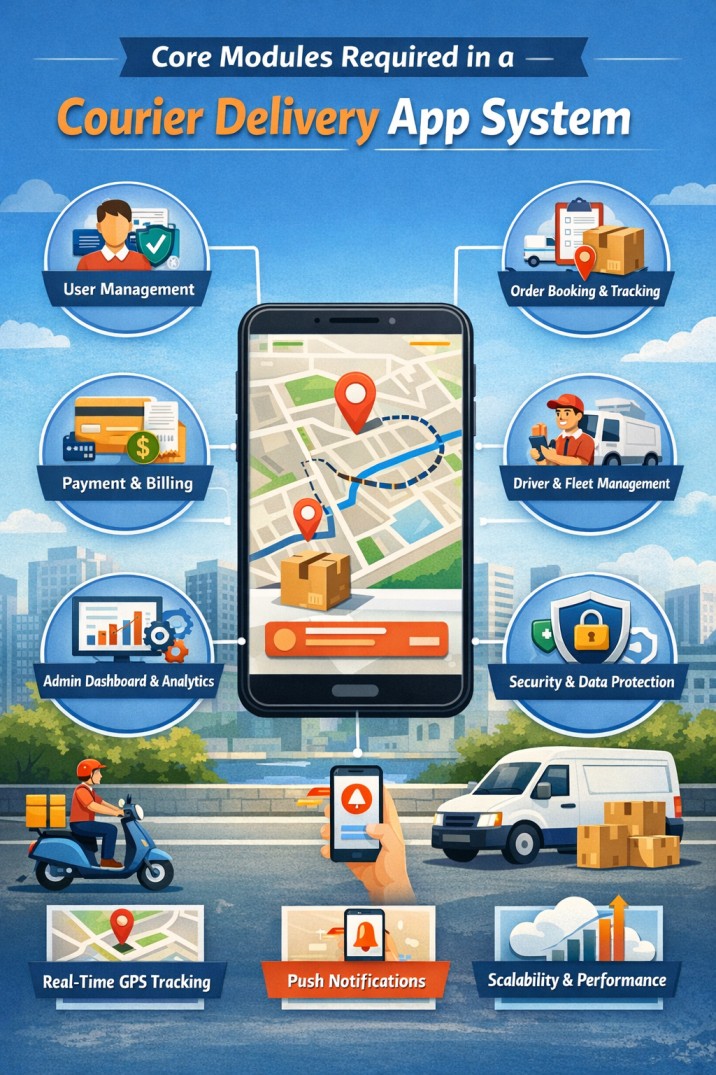
The courier and logistics industry is rapidly evolving as digital platforms streamline parcel movement across cities and borders. Businesses today require scalable, secure, and efficient applications that manage real-time operations while delivering a seamless customer experience. An effective courier delivery platform must integrate booking, dispatch, payments, tracking, and analytics into a unified ecosystem. Organizations investing in on demand courier app development must understand the essential modules that power operational efficiency, cost optimization, and long-term sustainability in a competitive logistics environment.
Core Architecture Components of Courier App Systems for Modern Firms
A courier application is not a single interface but a multi-layered ecosystem built on structured architecture. Successful on demand courier app development begins with defining the system architecture that ensures reliability, performance, and scalability.
The core architectural layers typically include:
- Presentation Layer: Mobile and web interfaces for customers, drivers, and administrators.
- Application Layer: Business logic managing bookings, routing, and notifications.
- Data Layer: Secure databases storing shipment, user, and transaction data.
- Integration Layer: APIs connecting payment gateways, mapping services, and third-party logistics tools.
A well-structured backend ensures that multiple stakeholders can operate simultaneously without performance degradation. Microservices architecture is often preferred because it allows independent scaling of modules such as tracking or payments. Cloud-based deployment further enhances uptime and fault tolerance.
Without a stable architectural foundation, even feature-rich courier platforms struggle to maintain operational efficiency. Therefore, defining the correct architecture is a critical first step in building a reliable system.
User Registration Authentication and Profile Controls Management Tools
User management is the backbone of any courier delivery ecosystem. This module handles onboarding, identity verification, and access control for customers, drivers, and administrative staff.
Key elements include:
- User Registration: Email, phone-based sign-up, and social authentication.
- Verification Mechanisms: OTP validation, document uploads, and identity checks for drivers.
- Profile Management: Address management, preferred payment methods, and delivery history.
- Role-Based Access Control: Permissions tailored for dispatch managers, drivers, and customers.
Strong authentication frameworks protect against unauthorized access and fraudulent activities. Multi-factor authentication and token-based sessions are commonly implemented to enhance security.
A refined user module ensures transparency and trust. For instance, verified drivers and traceable delivery history increase accountability. From a compliance perspective, secure storage of personal data must align with regional data protection regulations.
User experience design also plays a crucial role. Registration and login workflows must remain intuitive while maintaining security standards. Striking this balance directly impacts adoption and long-term engagement.
Order Booking Scheduling and Real Time Tracking Infrastructure Module
The order management module serves as the operational engine of the courier system. It enables customers to schedule pickups, define delivery preferences, and monitor shipment progress.
Core functionalities typically include:
- Instant and scheduled booking options
- Automated fare estimation
- Address validation and geolocation integration
- Real-time driver assignment
- Live tracking using GPS and mapping APIs
In on demand courier app development, real-time tracking is one of the most technically demanding components. The system must continuously update parcel location without excessive battery drain or bandwidth consumption. WebSockets and event-driven architectures are frequently used to maintain synchronization between driver and customer interfaces.
Push notifications inform users about status changes such as pickup confirmation, transit updates, and delivery completion. From a business standpoint, accurate tracking reduces support inquiries and increases transparency.
This module also integrates proof-of-delivery features such as digital signatures, photo uploads, and barcode scanning. These capabilities ensure accountability and reduce disputes.
Integrated Payment Gateways and Billing Systems Management Framework
Secure financial processing is essential for operational continuity. The payment module handles transaction authorization, invoicing, refunds, and settlement management.
Important components include:
- Multiple payment methods including cards and digital wallets
- Automated invoice generation
- Commission management for drivers
- Tax calculation and compliance reporting
- Refund and dispute resolution workflows
Transaction security must comply with global standards such as PCI DSS. Encryption and tokenization techniques protect sensitive financial information during transmission and storage.
The billing module also provides transparency through detailed transaction histories. Customers can review completed payments, while administrators monitor revenue and operational margins.
Understanding the delivery app development cost often depends on the complexity of the payment integration. Advanced billing features, multi-currency support, and tax automation can significantly influence the overall development budget.
Driver Partner Management and Fleet Oversight Tools Dashboards
Drivers form the operational backbone of courier platforms. Efficient driver management ensures timely deliveries and service consistency.
The driver management module includes:
- Driver Onboarding: Background verification and document validation.
- Availability Controls: Online and offline status management.
- Route Optimization: Intelligent algorithms minimizing travel time and fuel consumption.
- Performance Monitoring: Ratings, delivery time metrics, and incentive tracking.
- Fleet Tracking: Monitoring vehicle condition and utilization.
Fleet oversight dashboards provide dispatch managers with real-time visibility into delivery operations. Heat maps, route efficiency data, and delay alerts enable proactive intervention.
Effective pickup and delivery app development incorporates intelligent dispatch logic that matches drivers to orders based on proximity, workload, and route optimization. This reduces idle time and enhances overall efficiency.
Driver incentives and performance analytics further support retention strategies, ensuring long-term operational stability.
Admin Panel Analytics and Operational Control Center Functions
The administrative dashboard acts as the strategic command center of the courier ecosystem. It consolidates data from every module into actionable insights.
Key capabilities include:
- Order monitoring and manual intervention controls
- Revenue analytics and financial summaries
- User and driver management tools
- Complaint resolution workflows
- Reporting and export functionalities
Advanced analytics help identify operational bottlenecks. For example, administrators can track average delivery time, peak demand hours, and geographic service density.
Customizable dashboards allow decision-makers to view key performance indicators aligned with business objectives. Data visualization tools convert raw metrics into understandable charts and reports.
When organizations engage MVP app development services, they often prioritize building a simplified version of this control center. Even in early stages, visibility into operational metrics remains essential for informed decision-making.
Security Compliance and Data Protection Mechanisms Architecture
Security is a non-negotiable requirement in courier systems. Applications handle personal information, payment data, and real-time location details, making them potential targets for cyber threats.
Critical security measures include:
- End-to-end encryption
- Secure API authentication
- Role-based access permissions
- Intrusion detection systems
- Regular security audits
Compliance with regional regulations such as data privacy laws ensures lawful data processing and storage. Secure coding practices and vulnerability testing further mitigate risks.
Database protection strategies include encrypted storage, secure backups, and disaster recovery planning. Logging and monitoring tools track suspicious activities and enable quick incident response.
A robust security architecture protects not only data but also brand reputation. Security vulnerabilities can disrupt operations and erode customer trust, making preventive strategies indispensable.
Scalability Performance Optimization and Maintenance Planning
Courier platforms must accommodate fluctuating demand. Peak seasons, promotional campaigns, or sudden demand spikes require infrastructure capable of rapid scaling.
Scalability strategies involve:
- Cloud-based infrastructure with auto-scaling capabilities
- Load balancing to distribute traffic evenly
- Caching mechanisms for faster response times
- Database optimization for high-volume queries
Performance testing is a fundamental aspect of on demand courier app development. Stress testing identifies system limitations under heavy traffic conditions, ensuring consistent service delivery.
Regular maintenance cycles address bug fixes, feature upgrades, and compatibility updates. Continuous monitoring tools track system health metrics such as server load, response time, and error rates.
Planning for scalability at the design stage prevents costly re-engineering later. Efficient resource allocation supports long-term growth without compromising performance.
Strategic Roadmap and Future Ready Courier Platforms Development
Building a courier delivery system requires a phased and structured roadmap. Organizations must align technical modules with long-term operational goals.
A strategic roadmap typically includes:
- Requirement analysis and workflow mapping
- Prioritization of core modules
- Prototype validation and stakeholder feedback
- Gradual feature expansion
- Continuous performance evaluation
Future-ready platforms incorporate emerging technologies such as AI-driven route optimization, predictive demand forecasting, and automated dispatch algorithms. Integrating data intelligence enhances operational precision and customer satisfaction.
Additionally, interoperability with external logistics partners, warehouse systems, and enterprise software strengthens ecosystem connectivity. As digital transformation continues to reshape logistics, adaptable systems remain essential.
Conclusion
A courier delivery app system is a complex, multi-layered platform that integrates architecture, user management, booking engines, financial processing, analytics, security, and scalability planning. Each module plays a distinct yet interconnected role in ensuring efficient parcel movement and operational transparency. By structuring development around these essential components, organizations can create resilient, high-performing courier platforms capable of meeting evolving logistics demands while maintaining service reliability and data integrity.

 Tanushree Bhattacharya
 Levin John