Jake Scott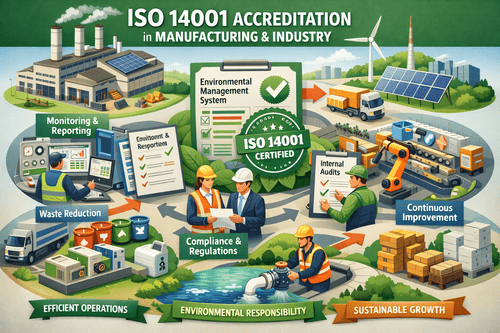
A Structured Approach to Environmental Management and Operational Discipline
ISO 14001 accreditation represents a formal recognition that a manufacturing or industrial organization has established a structured environmental management system capable of controlling and reducing its environmental impact. Unlike general guidance documents, ISO 14001 accreditation is assessed through defined criteria. As a result, organizations must demonstrate consistency, traceability, and accountability across their operations.
In manufacturing environments, this is not a theoretical exercise. Production lines, heavy machinery, material handling, and energy consumption create measurable environmental effects. Therefore, ISO 14001 accreditation ensures that these effects are identified, evaluated, and managed through a repeatable system rather than informal practices or reactive decisions.
Ultimately, the significance of ISO 14001 accreditation lies in its ability to integrate environmental responsibility into operational control without disrupting productivity. In this way, it creates a balance between industrial output and environmental discipline.
Understanding the Scope of ISO 14001 Accreditation
ISO 14001 accreditation applies to all activities, products, and services within the defined scope of an organization. In manufacturing companies, for instance, this typically includes procurement, production processes, maintenance, storage, waste handling, and logistics support functions.
To begin with, the accreditation process requires organizations to define boundaries clearly. This includes physical locations, operational units, and outsourced processes that may influence environmental performance. Consequently, ISO 14001 accreditation does not permit ambiguity in scope definition, as incomplete boundaries can lead to gaps in environmental control.
By establishing a well-defined scope, organizations ensure that environmental risks are not overlooked. At the same time, it creates accountability across departments, ensuring that each function understands its role within the environmental management system.
Environmental Policy as a Foundational Requirement
ISO 14001 accreditation begins with the establishment of an environmental policy. Importantly, this policy is not a general statement but a formal commitment approved by top management. Specifically, it outlines the organization’s intent to comply with applicable environmental requirements, prevent pollution, and improve environmental performance over time.
In manufacturing environments, the environmental policy must reflect operational realities. For example, it should address energy consumption, emissions, waste generation, and resource usage in measurable terms. Furthermore, ISO 14001 accreditation requires that this policy be communicated across the organization and understood by employees at all levels.
As a result, the policy serves as a reference point for decision-making. In turn, it ensures that environmental considerations are embedded in planning, procurement, and operational activities.
Identification of Environmental Aspects and Impacts
A central requirement of ISO 14001 accreditation is the identification and evaluation of environmental aspects and their associated impacts. In practice, manufacturing processes involve multiple interactions with the environment, including air emissions, water discharge, material consumption, and waste generation.
Accordingly, organizations must systematically identify these aspects and assess their significance based on defined criteria. In addition, ISO 14001 accreditation requires consideration of both normal operating conditions and abnormal situations, such as equipment failure or emergency incidents.
Through this process, organizations gain a structured understanding of environmental risk. Consequently, significant aspects receive priority attention, allowing resources to be allocated effectively and ensuring control over high-impact activities.
Legal and Regulatory Awareness within ISO 14001 Accreditation
ISO 14001 accreditation requires organizations to identify and maintain access to applicable environmental legal requirements. For manufacturing companies in particular, this includes regulations related to emissions, waste disposal, hazardous material handling, and resource usage.
Beyond identification, however, the system must ensure that these requirements are integrated into operational controls. In other words, ISO 14001 accreditation treats compliance as a baseline expectation rather than a final objective.
To maintain this standard, organizations are required to evaluate their compliance status periodically. As a result, regulatory obligations are consistently met, and any deviations are identified and corrected in a timely manner.
Planning and Risk-Based Thinking
Planning within ISO 14001 accreditation is structured around risk-based thinking. At this stage, organizations must identify risks and opportunities related to environmental aspects, compliance obligations, and other relevant factors.
In manufacturing environments, for example, risks may include chemical spills, excessive energy consumption, equipment malfunction, or improper waste segregation. Therefore, ISO 14001 accreditation requires organizations to plan actions that address these risks while also identifying opportunities for improvement.
By adopting this approach, environmental management becomes proactive rather than reactive. Consequently, potential issues are anticipated, and controls are established before problems occur.
Operational Control and Process Integration
ISO 14001 accreditation requires the establishment of operational controls for significant environmental aspects. In manufacturing settings, specifically, this involves integrating environmental considerations directly into production processes and maintenance activities.
Operational controls may include standard operating procedures for waste handling, emission control systems, preventive maintenance schedules, and monitoring of resource consumption. Moreover, ISO 14001 accreditation ensures that these controls are documented, implemented, and consistently followed.
When properly integrated, these controls do not disrupt production. On the contrary, they enhance efficiency by reducing waste and improving resource management.
Competence, Training, and Awareness
Human factors play a critical role in ISO 14001 accreditation. Therefore, organizations must ensure that employees performing tasks that can impact the environment are competent based on education, training, or experience.
To achieve this, training programs must be structured and relevant to specific roles. For instance, machine operators should understand emission controls, while maintenance personnel should be trained in handling hazardous substances. In addition, ISO 14001 accreditation requires awareness of the environmental consequences of actions.
As a result, environmental management extends beyond documentation and becomes an active part of daily operations.
Communication and Information Flow
Effective communication is essential for maintaining ISO 14001 accreditation. Accordingly, organizations must establish processes for internal and external communication related to environmental management.
Internally, this includes sharing information about environmental performance, incidents, and improvement initiatives. Externally, it may involve communication with regulatory authorities, stakeholders, or clients.
To ensure consistency, ISO 14001 accreditation requires that communication processes are controlled. Consequently, transparency is maintained, and decision-making is supported at all organizational levels.
Documented Information and System Integrity
ISO 14001 accreditation requires organizations to maintain documented information necessary for system effectiveness. This includes, among other things, policies, procedures, records, and performance evidence.
Equally important, documentation must be controlled to ensure accuracy, accessibility, and traceability. In manufacturing environments, for example, this may involve emissions monitoring records, waste disposal logs, and maintenance reports.
Ultimately, documented information provides evidence that the system is functioning as intended and supports continuous evaluation and improvement.
Monitoring, Measurement, and Performance Evaluation
ISO 14001 accreditation emphasizes the need for monitoring and measuring environmental performance. To begin with, organizations must define what needs to be monitored and how it will be measured.
In manufacturing settings, this may include energy consumption, emission levels, waste generation, and water usage. Furthermore, ISO 14001 accreditation requires that measurement methods are consistent and reliable.
As a result, performance evaluation becomes data-driven. Consequently, organizations can make informed decisions and implement targeted improvements.
Internal Audits as a Control Mechanism
Internal audits are a mandatory requirement for ISO 14001 accreditation. In essence, they provide a structured method for evaluating whether the system conforms to planned arrangements and is effectively implemented.
To ensure effectiveness, audits must be conducted at planned intervals and performed by competent personnel. Additionally, ISO 14001 accreditation requires that findings are documented and corrective actions are implemented.
In this way, internal audits act as an early detection mechanism. Therefore, potential issues are identified before they escalate.
Management Review and Strategic Oversight
Top management involvement is a critical component of ISO 14001 accreditation. Specifically, management reviews provide a formal mechanism for evaluating overall system performance.
During these reviews, management assesses audit results, environmental performance data, compliance status, and improvement opportunities. Subsequently, decisions are made to enhance system effectiveness.
As a result, environmental management remains aligned with organizational strategy and business objectives.
Continuous Improvement within ISO 14001 Accreditation
Continuous improvement is a fundamental principle of ISO 14001 accreditation. Accordingly, organizations are expected to enhance environmental performance over time.
Improvement initiatives may include reducing energy consumption, minimizing waste, improving efficiency, or adopting cleaner technologies. However, ISO 14001 accreditation does not prescribe specific targets. Instead, it requires organizations to define and pursue their own objectives.
This approach provides flexibility while maintaining accountability.
Cost Implications and Operational Benefits
ISO 14001 accreditation involves investment in system development, training, monitoring, and certification. However, these costs are often offset by operational benefits.
For example, improved resource efficiency reduces material and energy costs, while better waste management lowers disposal expenses. In addition, enhanced process control minimizes environmental risks and liabilities.
Therefore, ISO 14001 accreditation supports both environmental and financial performance.
Role of Certification Bodies in Accreditation
Certification bodies play a significant role in ISO 14001 accreditation. In particular, they provide independent assessment of the environmental management system against ISO requirements.
Their responsibilities include conducting audits, verifying compliance, and issuing accreditation upon successful evaluation. As a result, certification ensures credibility and market recognition.
Common Challenges in Implementation
Manufacturing organizations often encounter challenges during ISO 14001 accreditation. For instance, these may include inadequate understanding of environmental aspects, insufficient training, or poor system integration.
Another common issue is treating ISO 14001 as a documentation exercise rather than an operational system. Consequently, gaps may arise between procedures and actual practices.
To overcome these challenges, organizations need strong management commitment, clear communication, and continuous employee engagement.
Conclusion
ISO 14001 accreditation provides a structured framework for managing environmental responsibilities within manufacturing and industrial organizations. In particular, it ensures that environmental considerations are integrated into operations, decision-making, and strategy.
Ultimately, its value lies in creating consistency, accountability, and continuous improvement. As a result, environmental management evolves from a reactive task into a controlled and measurable system.
For manufacturing companies, therefore, ISO 14001 accreditation is not just about compliance—it is a disciplined approach that supports sustainability, reduces risk, and enhances overall performance.


 Raja Ganapathi