Ojasvi IAS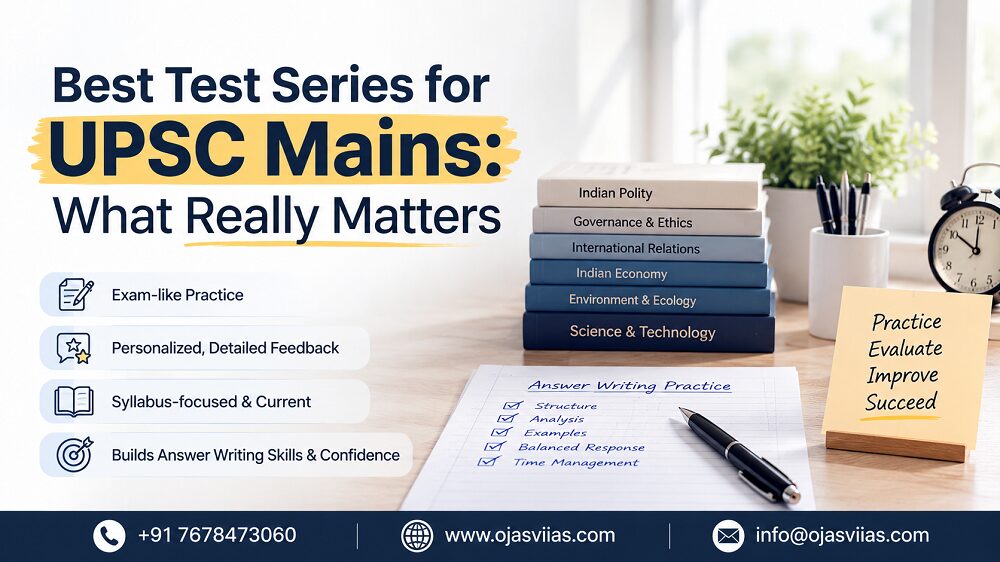
I’ve looked at a lot of evaluated answer sheets from different test series over the years, and honestly, the difference usually isn’t in the questions themselves; most institutes copy the same exam pattern anyway. It’s in what happens after you submit. I remember one candidate showing me her evaluated copy where the comment just said “attempt is okay, work on structure,” and that was it, no explanation of what structure even meant in her case. Compare that to another sheet I saw where the evaluator had actually gone through and marked the exact line where her argument started repeating itself instead of building forward. That’s the real gap between test series, not the number of tests on offer.
Why More Tests Aren’t the Same as Better Tests
Most places sell you on quantity. Thirty tests, thirty-five tests, sometimes they’ll throw in a free bonus test if you sign up early. None of that matters much if the evaluation is shallow. What you actually need is someone reading your answer closely enough to tell you why it didn’t work, not just that it didn’t.
Ojasvi IAS keeps its best online mains test series for UPSC smaller than most competitors, and that’s on purpose. The papers are built around the current GS pattern along with essay and optional-specific tests, and the evaluation goes deeper than a generic score. If your argument falls apart in the third paragraph, that’s where the note shows up, not a blanket comment at the end.
Why Feedback Speed Matters More Than People Think
Feedback timing matters more than people give it credit for too. I’ve had candidates tell me they got their evaluated copies back a month after submitting, and by then, they’d forgotten what they were even thinking when they wrote that answer. There’s no fixing what you can’t remember writing. The best mains test series for UPSC that turns feedback around quickly, within a few days, actually lets you correct the course before your next attempt instead of after you’ve already repeated the same mistake three more times.
Is Online Evaluation Actually As Good?
There’s also this idea floating around that online evaluation can’t be as personal as sitting with a mentor face-to-face. I’d push back on that a bit. In a packed offline batch, evaluators often get through thirty or forty papers in a single sitting, and the comments reflect that rushed pace. Someone submitting online, if the evaluation is done properly, often gets more individual attention because there’s no crowd to rush through. Ojasvi IAS evaluates each paper with margin notes tied to specific weak points rather than generic labels like “needs improvement,” which honestly tells you nothing on its own.
When to Actually Start
As for when to start, I’d say right after you finish your first full read of the syllabus. Writing under a clock with actual exam pressure is a different experience than writing at your own pace at home, and that only gets easier through repeated practice against feedback that actually explains itself.
FAQs
How many mains tests should I attempt before Mains?
No fixed number works for everyone, but a smaller batch of well-evaluated tests will usually teach you more than a long list where the feedback is generic.
Does Ojasvi IAS’s test series include the optional subject?
Yes, it covers GS papers, essays, and optional-specific tests, all built around the current exam pattern.
When’s a good time to start a test series?
Right after your first read of the syllabus works well since it gives you enough time to get comfortable writing under exam conditions before the Mains actually arrive.

 Jacob foster
 Canadian studies