AxioBio Solutions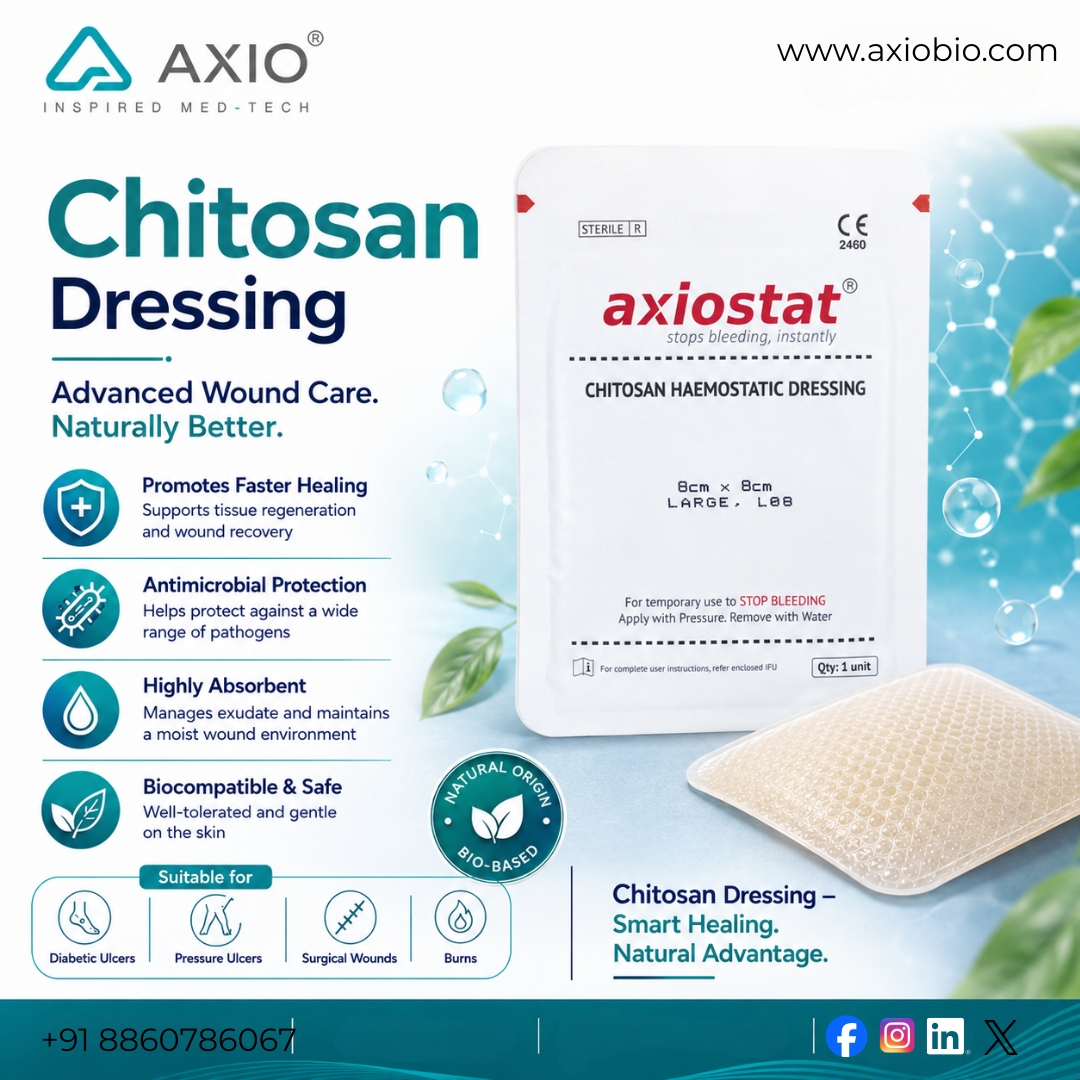
Every trauma surgeon, paramedic, and battlefield medic knows the same hard truth: uncontrolled bleeding kills faster than almost any other injury. In the golden hour after a severe wound, the difference between survival and loss of life often comes down to how quickly bleeding can be stopped. This is exactly why the conversation around a reliable bleeding control dressing has moved from specialist medical circles into mainstream healthcare planning across India.
Ahmedabad, with its growing base of hospitals, trauma centers, and emergency response units, has become one of the cities where this shift is most visible. Hospitals are actively reassessing what they stock in their emergency trolleys and ambulances, and increasingly, the answer points toward a chitosan dressing built for rapid clot formation.
What Makes a Bleeding Control Dressing Different From Regular Gauze
Ordinary gauze absorbs blood. It does not stop it. A true bleeding control dressing is designed to actively interact with blood at a molecular level, triggering rapid clot formation rather than simply soaking up fluid until natural clotting eventually kicks in on its own.
This is where chitosan enters the picture. Chitosan is a naturally derived biopolymer sourced from crustacean shells, and it carries a positive ionic charge. Blood cells, by contrast, carry a negative charge.
How chitosan works on contact with a wound:
- The positive charge in chitosan attracts negatively charged red blood cells
- Blood cells clump together almost instantly at the injury site
- A protective seal forms within minutes, not the ten to fifteen minutes standard gauze may require
- The clot holds even under movement, which matters during patient transport
This mechanism is the reason chitosan gauze has earned a place in military first-aid kits, ambulance services, and now, increasingly, in civilian and hospital trauma protocols across India.
Why Hemostatic Gauze Is Becoming Standard Equipment
A decade ago, hemostatic gauze was viewed as a specialized product reserved for combat medicine or high-end trauma centers. That perception has changed considerably. Road traffic accidents remain one of India’s leading causes of preventable death, and a significant share of those deaths are linked to blood loss before the patient reaches a hospital.
This has pushed emergency response teams, industrial safety officers, and hospital procurement departments to ask a more practical question: what is the best hemostatic gauze available for real-world, high-pressure situations?
Three benchmarks hospitals typically evaluate:
- Speed of action — how quickly the dressing initiates clotting
- Ease of application under stress — whether first responders with minimal training can use it correctly
- Shelf stability in varied climates — a real concern given India’s temperature range across regions
Products built on chitosan technology tend to perform well against all three benchmarks, which is part of why they are being adopted more widely by hospitals, ambulance networks, and industrial safety teams in Gujarat and beyond.
Chitosan Wound Dressing in Everyday Trauma Care
While battlefield use often gets the spotlight, the reality is that a chitosan wound dressing has just as much relevance in everyday trauma care. Construction site injuries, factory accidents, road traffic incidents, and even complications during surgery all present situations where rapid bleeding control determines the outcome.
Common everyday settings where these dressings are now used:
- Industrial and factory floor injuries involving lacerations
- Road traffic accident first response, before hospital arrival
- Surgical wards managing post-operative bleeding
- Ambulance and paramedic emergency kits
Ahmedabad’s industrial base, which includes textile manufacturing, chemical processing, and heavy engineering, means that workplace injuries involving lacerations and blood loss are not rare. Hospitals and occupational health units serving these industries have started prioritizing hemostatic dressings as part of standard first-response kits, rather than treating them as optional or emergency-only supplies.
This shift also extends to healthcare events and medical conferences across India, where chitosan-based hemostatic products are now a regular feature at exhibitions focused on trauma care, emergency medicine, and surgical innovation. Clinicians attending these events are increasingly asking manufacturers detailed questions about clotting speed, biocompatibility, and cost per unit, signaling that awareness has moved well past the early-adopter stage.
The Technology Behind the Dressing
Understanding chitosan technology helps explain why this category of dressing performs differently from older alternatives like gelatin sponges or plain cotton gauze.
Why the material performs differently:
- Processed into a flexible, non-woven fabric that conforms to irregular wound shapes
- Makes full contact with deep lacerations and puncture wounds where flat gauze often fails
- Biocompatible and breaks down naturally in the body
- Reduces allergic reaction risk compared with some synthetic hemostatic agents
For hospitals managing large patient volumes, this combination of effectiveness and safety profile matters as much as raw clotting speed. AxioBio’s range of dressings, built specifically around this chitosan platform, reflects years of applied research into how hemostatic materials behave under real trauma conditions rather than only in controlled lab settings.
Axio vs Others: What Sets This Approach Apart
When hospitals and trauma units evaluate options, the comparison usually comes down to Axio vs others in terms of clotting time, ease of use for first responders with minimal training, and consistency of performance across different wound types.
What procurement teams typically compare:
- Clotting time under real trauma conditions, not just lab tests
- Ease of use for staff with varying levels of training
- Consistency of performance across wound types and severities
- Availability of independently reviewed clinical data
Independent comparative evidence reviewing these factors is publicly available for clinicians who want to make an informed, data-backed procurement decision rather than relying on manufacturer claims alone. This transparency matters. In a field where a delayed or failed intervention has irreversible consequences, hospitals in Ahmedabad and across Gujarat are increasingly unwilling to make purchasing decisions on brand reputation alone.
Choosing the Right Trauma Dressing for Your Facility
Not every clinical setting needs the same product. A trauma dressing suited for a battlefield or high-casualty accident site may differ in packaging and application format from one designed for a hospital’s day-to-day surgical ward.
Factors facilities should weigh before choosing:
- Typical patient volume and case severity
- Staff training levels and response time requirements
- Storage conditions, including temperature and shelf life
- Packaging format needed — ambulance kits, ward stock, or industrial first-aid
The full range of available options, including packaging formats designed for ambulances, hospital wards, and industrial first-aid kits, can be explored through AxioBio’s product catalog, which outlines specifications for each use case.
Industry Perspective
The bleeding control category in India is shifting from a niche military-adjacent product line into a mainstream component of hospital and emergency care infrastructure. This is not a passing trend. It reflects a broader recognition within Indian healthcare that pre-hospital and immediate trauma response deserves the same rigor as later-stage surgical care.
For hospitals, ambulance services, and industrial safety teams in Ahmedabad evaluating their current trauma kits, the question worth asking is not whether chitosan-based hemostatic dressings work, since the clinical data on that is well established, but whether their current supply chain and training protocols are keeping pace with what the technology now makes possible.
Facilities and clinicians interested in reviewing AxioBio’s background and clinical credentials can find more detail on the About Us page, and those looking to discuss procurement or product trials can book an appointment or reach the team directly at +91 8860786067.
People also ask
What is a bleeding control dressing used for?
It is used to stop or significantly slow severe bleeding from wounds, often as a first-response measure before a patient reaches definitive surgical care.
How does chitosan stop bleeding faster than regular gauze?
Chitosan carries a positive charge that attracts negatively charged red blood cells, causing rapid clot formation at the wound site rather than relying only on absorption.
Is hemostatic gauze safe for all types of wounds?
It is primarily designed for moderate to severe bleeding wounds, including lacerations and puncture injuries, and should be used according to standard first-aid or clinical training protocols.
How is chitosan dressing different from standard cotton gauze?
Standard gauze absorbs blood passively, while chitosan dressing actively triggers clotting, typically reducing bleeding control time considerably.
Where can hospitals in Ahmedabad source these dressings?
Hospitals and clinics can contact AxioBio directly through their contact page or by phone to discuss product availability and procurement.
Contact Information
Website: https://axiobio.com
Email: info@axiobio.com
Phone no: +91 8860786067
Follow Axiobio on Social Media
LinkedIn | Facebook | Instagram | YouTube
Stay connected with Axiobio for the latest updates on hemostatic innovations, wound care advancements, clinical insights, healthcare education, and new product developments.


 enfield abudhabi
 Enfield Abu dhabi