Annotera AI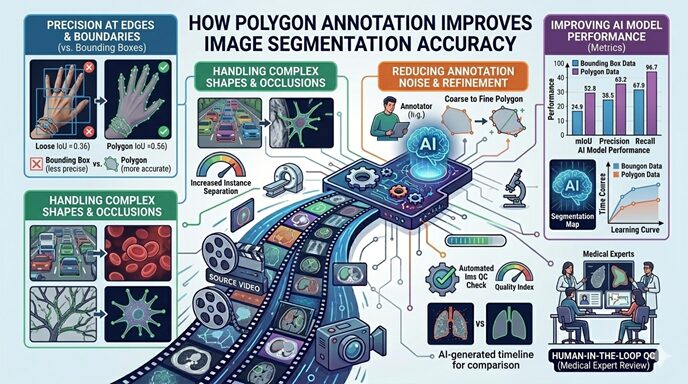
Artificial intelligence and machine learning models depend heavily on high-quality training datasets. For computer vision applications, the accuracy of an AI model often depends on how precisely objects are labeled within images. One of the most effective techniques used to achieve detailed labeling is polygon annotation. Compared with simpler annotation methods like bounding boxes, polygon annotation allows for highly accurate object segmentation, which significantly improves the performance of AI models.
As organizations increasingly rely on visual AI systems across industries such as healthcare, retail, autonomous driving, agriculture, and manufacturing, the need for precise data labeling has become more critical than ever. A professional data annotation company plays an important role in delivering the detailed datasets required for advanced computer vision applications. Polygon annotation is one of the key methods used by annotation experts to improve segmentation accuracy and enable AI models to understand images with greater precision.
This article explores how polygon annotation works, why it enhances image segmentation accuracy, and how businesses benefit from working with reliable data annotation outsourcing partners.
Understanding Polygon Annotation in Image Labeling
Polygon annotation is a data labeling technique in which annotators draw multi-point polygons around objects within an image. Instead of enclosing objects with rectangular bounding boxes, polygon annotation traces the exact shape of the object by placing multiple points along its edges.
These connected points form a closed polygon that closely matches the contours of the object being labeled. The result is a far more accurate representation of the object compared with traditional methods.
Polygon annotation is particularly useful for labeling irregularly shaped objects such as:
-
Human bodies and body parts
-
Roads, lanes, and traffic signs
-
Buildings and infrastructure
-
Medical organs and tumors
-
Animals and vegetation
-
Manufacturing components
Because the annotation precisely follows the shape of the object, machine learning models can learn more detailed features during training. This improves the accuracy of image segmentation, a computer vision process where every pixel in an image is classified as belonging to a specific object or background.
A specialized data annotation company often relies on polygon annotation for projects that require highly accurate segmentation data.
The Role of Image Segmentation in AI Models
Image segmentation is a critical component of many modern AI systems. Unlike object detection, which simply identifies the presence of an object, segmentation determines the exact boundaries of objects within an image.
There are two main types of segmentation used in AI:
-
Semantic segmentation – Every pixel is assigned a category label.
-
Instance segmentation – Each individual object instance is separately identified.
High-quality segmentation datasets allow AI models to understand complex visual scenes. For example:
-
Autonomous vehicles must identify roads, pedestrians, vehicles, and traffic signals.
-
Medical imaging systems must detect tumors or abnormalities with pixel-level precision.
-
Agricultural AI must differentiate crops, soil, weeds, and pests.
Polygon annotation helps create these detailed datasets by ensuring that objects are labeled accurately and consistently. This is why many organizations rely on data annotation outsourcing providers to scale large segmentation projects.
Why Polygon Annotation Improves Segmentation Accuracy
1. Precise Object Boundaries
The biggest advantage of polygon annotation is its ability to capture the exact shape of an object. Bounding boxes often include unnecessary background pixels, which can introduce noise into training datasets.
Polygon annotation minimizes this problem by closely tracing object edges. This allows AI models to learn accurate object boundaries and reduces segmentation errors.
For applications like medical imaging or autonomous driving, even small improvements in segmentation accuracy can significantly impact performance.
2. Better Representation of Irregular Shapes
Many real-world objects do not fit neatly into rectangular shapes. Bounding boxes often struggle to represent curved, angled, or complex objects.
Polygon annotation solves this problem by using multiple points to outline irregular shapes. Annotators can adjust the number of points to match the complexity of the object.
For example:
-
Trees and plants have irregular outlines
-
Human poses involve complex contours
-
Roads and sidewalks have curved boundaries
A professional data annotation company uses polygon annotation to capture these details, helping AI models learn more accurate visual representations.
3. Improved Pixel-Level Learning for AI Models
Segmentation models rely heavily on pixel-level classification. If annotations contain large amounts of background noise, the model may struggle to learn meaningful patterns.
Polygon annotation reduces background noise by isolating the exact pixels belonging to the object. This improves the quality of the training data and leads to better segmentation performance.
Accurate pixel labeling is especially important in fields like:
-
Healthcare diagnostics
-
Satellite imagery analysis
-
Robotics vision systems
-
Industrial inspection
Organizations that require large volumes of detailed annotations often choose data annotation outsourcing to ensure scalability and quality control.
4. Enhanced Model Training and Performance
High-quality annotations lead to better model training. When objects are labeled precisely, machine learning algorithms can extract more accurate features from the data.
Polygon annotations help models learn:
-
Object shapes and contours
-
Spatial relationships between objects
-
Fine-grained structural details
As a result, AI systems become more reliable in real-world scenarios. Companies developing advanced computer vision systems often collaborate with a data annotation company that specializes in complex annotation techniques like polygon labeling.
5. Reduced Annotation Ambiguity
Bounding boxes can sometimes create ambiguity when multiple objects overlap or when objects are closely packed together.
Polygon annotation helps resolve this challenge by clearly defining object boundaries. Annotators can outline each object individually, even in crowded scenes.
This is particularly useful for:
-
Retail shelf analysis
-
Traffic monitoring systems
-
Crowd analytics
-
Wildlife detection
High-precision annotation reduces confusion during model training and improves the model’s ability to distinguish between similar objects.
Applications of Polygon Annotation Across Industries
Polygon annotation is widely used in industries that depend on accurate visual data.
Autonomous Vehicles
Self-driving systems rely on segmentation models to detect roads, lanes, pedestrians, vehicles, and obstacles. Polygon annotation ensures that these elements are labeled with high precision, improving navigation and safety.
Healthcare and Medical Imaging
Medical AI systems analyze scans such as X-rays, MRIs, and CT images to detect diseases. Polygon annotation helps accurately label organs, tumors, and abnormalities, enabling better diagnostic models.
Agriculture Technology
AI-powered agricultural systems monitor crops, soil conditions, pests, and plant health. Polygon annotation allows models to differentiate crops from weeds and other environmental elements.
Retail and Smart Surveillance
Retail analytics solutions use segmentation models to monitor shelves, track inventory, and analyze shopper behavior. Accurate annotations help these systems recognize products and customer interactions.
Video-Based AI Systems
Although polygon annotation is commonly used in images, it also plays an important role in video analysis. A reliable video annotation company can apply polygon annotations frame by frame to track objects in motion.
Businesses that require large-scale video labeling often rely on video annotation outsourcing to handle the complexity and volume of video datasets.
The Importance of Data Annotation Expertise
Creating accurate polygon annotations requires trained annotators, advanced tools, and strict quality control processes. Errors in annotation can significantly reduce the performance of AI models.
A professional data annotation company typically follows structured workflows that include:
-
Expert annotator training
-
Multi-level quality assurance
-
Annotation guidelines and validation checks
-
AI-assisted labeling tools
-
Scalable workforce management
These processes ensure that datasets maintain consistency and accuracy across large volumes of images and videos.
Many organizations choose data annotation outsourcing to reduce operational costs while maintaining high annotation quality.
How Annotera Supports High-Quality Polygon Annotation
Annotera delivers specialized data labeling services designed to support advanced AI and machine learning projects. As an experienced data annotation company, Annotera provides precise polygon annotation services that improve segmentation accuracy across multiple industries.
The company combines skilled human annotators with advanced annotation tools to create high-quality datasets tailored to client requirements. Annotera’s services include image labeling, segmentation, and video analysis through its scalable video annotation outsourcing capabilities.
Organizations that require large volumes of accurate training data can rely on Annotera to manage complex annotation workflows efficiently.
Conclusion
Polygon annotation plays a critical role in improving image segmentation accuracy for modern AI systems. By capturing precise object boundaries and reducing background noise, polygon labeling allows machine learning models to learn detailed visual patterns.
This level of accuracy is essential for applications such as autonomous driving, medical imaging, retail analytics, and agricultural monitoring. However, producing high-quality segmentation datasets requires expertise, advanced tools, and scalable annotation workflows.
Partnering with a trusted data annotation company enables organizations to access reliable data annotation outsourcing services that deliver precise training data. Similarly, businesses developing video-based AI applications can benefit from working with a specialized video annotation company that offers scalable video annotation outsourcing solutions.
As AI continues to expand across industries, high-quality polygon annotation will remain a fundamental component in building accurate and reliable computer vision models.


 Kennedy Brown
 steve Johnson