eByte Logic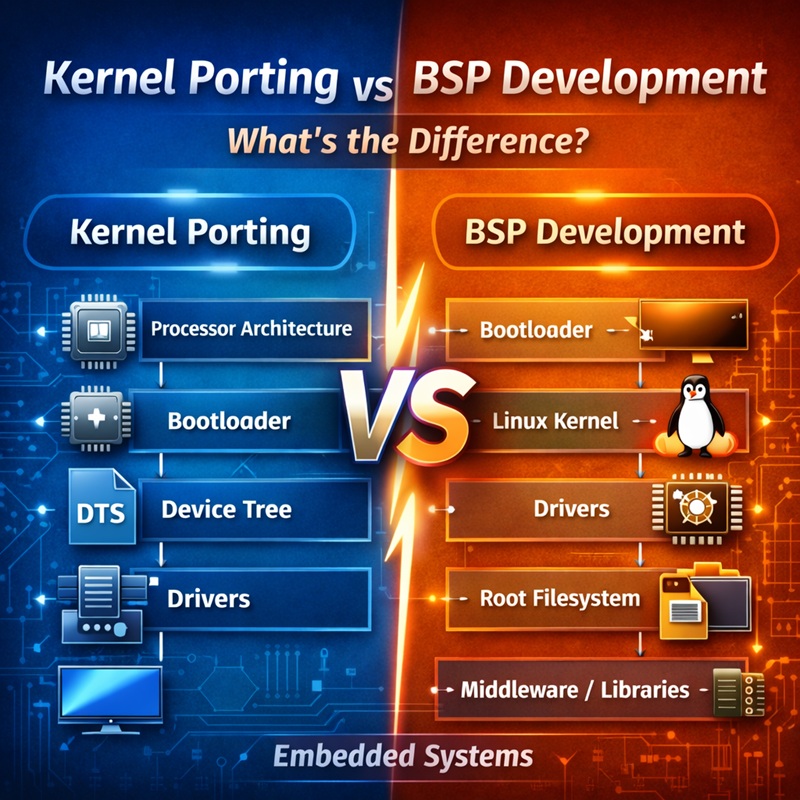
Embedded systems power modern devices such as industrial controllers, smart displays, networking equipment, and IoT devices. These products often run Linux or Android on custom hardware boards. To make the operating system work correctly with the hardware, engineers must perform two key tasks: kernel porting and Board Support Package development.
Many teams confuse these two terms. In reality, they are closely related but not the same.
Understanding the BSP Development Workflow for Embedded Systems helps engineering teams build stable firmware, reduce debugging time, and accelerate product launches.
This guide explains the difference between kernel porting and BSP development, how they work together, and when each step becomes critical in embedded product development.
What is Kernel Porting?
Kernel porting is the process of adapting the Linux kernel to run on a specific hardware platform. The Linux kernel acts as the core layer between software and hardware.
When engineers design a custom board using processors such as NXP, TI, Qualcomm, or Rockchip, the kernel must be configured and modified so it can communicate with the hardware.
Kernel porting usually involves:
-
Adapting the kernel to a new processor architecture
-
Configuring memory management
-
Supporting hardware peripherals
-
Updating boot configuration
-
Enabling hardware drivers
According to the official Linux kernel documentation, the kernel handles process management, memory management, device drivers, and hardware abstraction.
Without proper kernel support, the operating system cannot interact with the board components.
Key Tasks in Kernel Porting
Kernel porting focuses on enabling the operating system to boot and interact with hardware components.
Common activities include:
-
Processor architecture configuration
-
Bootloader integration
-
Device tree configuration
-
Kernel configuration
-
Hardware driver integration
-
Debugging kernel crashes
These steps ensure the kernel can recognize the processor, memory, and peripherals.
What is BSP Development?
A Board Support Package is a collection of software components that allow an operating system to run on a specific hardware board.
BSP development goes beyond kernel porting. It includes everything required to make the system fully operational.
A typical BSP contains:
-
Bootloader
-
Linux kernel
-
Device drivers
-
Hardware configuration files
-
Root filesystem
-
Middleware libraries
The BSP acts as the complete software layer that connects the operating system to the hardware.
In embedded product development, BSP development ensures that the device can boot, interact with peripherals, and run applications reliably.
Components of a Typical BSP
A BSP for embedded Linux usually includes the following components.
| Component | Purpose |
|---|---|
| Bootloader | Initializes hardware and loads the kernel |
| Linux Kernel | Core operating system layer |
| Device Drivers | Enable communication with hardware peripherals |
| Device Tree | Describes hardware layout |
| Root File System | Contains system libraries and utilities |
| Middleware | Provides system services and APIs |
These components work together to enable a fully functional embedded system.
BSP Development Workflow for Embedded Systems
The BSP Development Workflow for Embedded Systems usually follows a structured process.
1 Hardware Analysis
Engineers study the board schematic, processor documentation, and hardware interfaces.
Important components include:
-
CPU
-
Memory
-
Storage
-
Display interfaces
-
Network modules
-
Sensors
2 Bootloader Development
The bootloader initializes hardware and loads the operating system.
Common bootloaders include:
-
U Boot
-
Barebox
-
Das U Boot
Bootloader tasks include:
-
Memory initialization
-
Clock configuration
-
Peripheral initialization
3 Kernel Porting
At this stage engineers adapt the kernel to the hardware.
Tasks include:
-
Kernel configuration
-
Device tree setup
-
Driver integration
4 Device Driver Development
Drivers allow the operating system to communicate with hardware peripherals.
Examples include:
-
Camera drivers
-
Display drivers
-
Network drivers
-
SPI and I2C drivers
5 Root File System Integration
The root filesystem provides essential tools and libraries.
Popular build systems include:
-
Yocto Project
-
Buildroot
The Yocto Project documentation describes it as a system for creating custom Linux distributions for embedded devices.
6 System Testing and Optimization
Engineers perform extensive testing.
Testing includes:
-
Boot time validation
-
Peripheral testing
-
Performance tuning
-
Stability verification
Kernel Porting vs BSP Development
Although both tasks are related, their scope differs significantly.
The table below highlights the key differences.
| Feature | Kernel Porting | BSP Development |
|---|---|---|
| Scope | Focused task | Complete system enablement |
| Objective | Run kernel on hardware | Deliver full embedded platform |
| Components | Kernel configuration and drivers | Bootloader, kernel, drivers, filesystem |
| Complexity | Moderate | High |
| Output | Bootable kernel | Fully functional system |
Kernel porting is therefore a subset of BSP development.
Why BSP Development is Critical for Embedded Products?
Embedded devices must operate reliably for years. A stable BSP ensures that hardware and software interact correctly.
Key benefits include:
Faster Product Development
A structured BSP workflow reduces debugging time and accelerates product launch.
Reliable Hardware Integration
Drivers and hardware interfaces function correctly.
Better System Stability
Kernel crashes and hardware failures become easier to diagnose.
Long Term Maintainability
Teams can upgrade kernels and drivers without breaking the system.
Many hardware companies depend on BSP engineering because internal teams often lack deep kernel expertise.
Common Challenges in Kernel Porting and BSP Development
Even experienced teams face technical challenges.
Typical issues include:
-
Kernel panics during boot
-
Incorrect device tree configuration
-
Driver compatibility problems
-
Hardware timing issues
-
Peripheral communication failures
These problems often delay product launch timelines.
Best Practices for BSP Development
Engineering teams can improve results by following proven practices.
Use Upstream Kernel Sources
Upstream kernels improve long term support and security.
Maintain Clean Device Tree Structure
Clear device tree configuration helps simplify debugging.
Implement Modular Driver Architecture
Reusable drivers reduce development effort.
Automate Build Systems
Using Yocto or Buildroot improves reproducibility.
FAQ Section
What is kernel porting in embedded Linux?
Kernel porting is the process of modifying and configuring the Linux kernel so it can run on a specific hardware platform.
What is a BSP in embedded systems?
A Board Support Package is a software layer that allows an operating system to run on a hardware board. It includes the bootloader, kernel, drivers, and root filesystem.
Is kernel porting part of BSP development?
Yes. Kernel porting is one stage within the BSP development workflow for embedded systems.
Why do embedded devices need BSP development?
BSP development ensures that the operating system can interact correctly with hardware components such as processors, sensors, displays, and network modules.
Which tools are used for BSP development?
Common tools include:
-
Yocto Project
-
Buildroot
-
U Boot bootloader
-
Linux kernel build system
Conclusion
Kernel porting and BSP development are both essential parts of embedded product engineering. Kernel porting focuses on adapting the operating system to the hardware platform, while BSP development delivers the complete software environment required to run the device.
Understanding the BSP Development Workflow for Embedded Systems helps engineering teams reduce development risk, speed up product deployment, and ensure long term system stability.
Companies building custom hardware platforms often require deep expertise in kernel architecture, device drivers, and system integration. eByteLogic specializes in embedded Linux engineering, BSP development, kernel porting, and device driver development for custom hardware platforms, helping hardware companies bring reliable embedded products to market faster.


 Rose Conn
 EZ AUTO Lakeland