satyam harishchan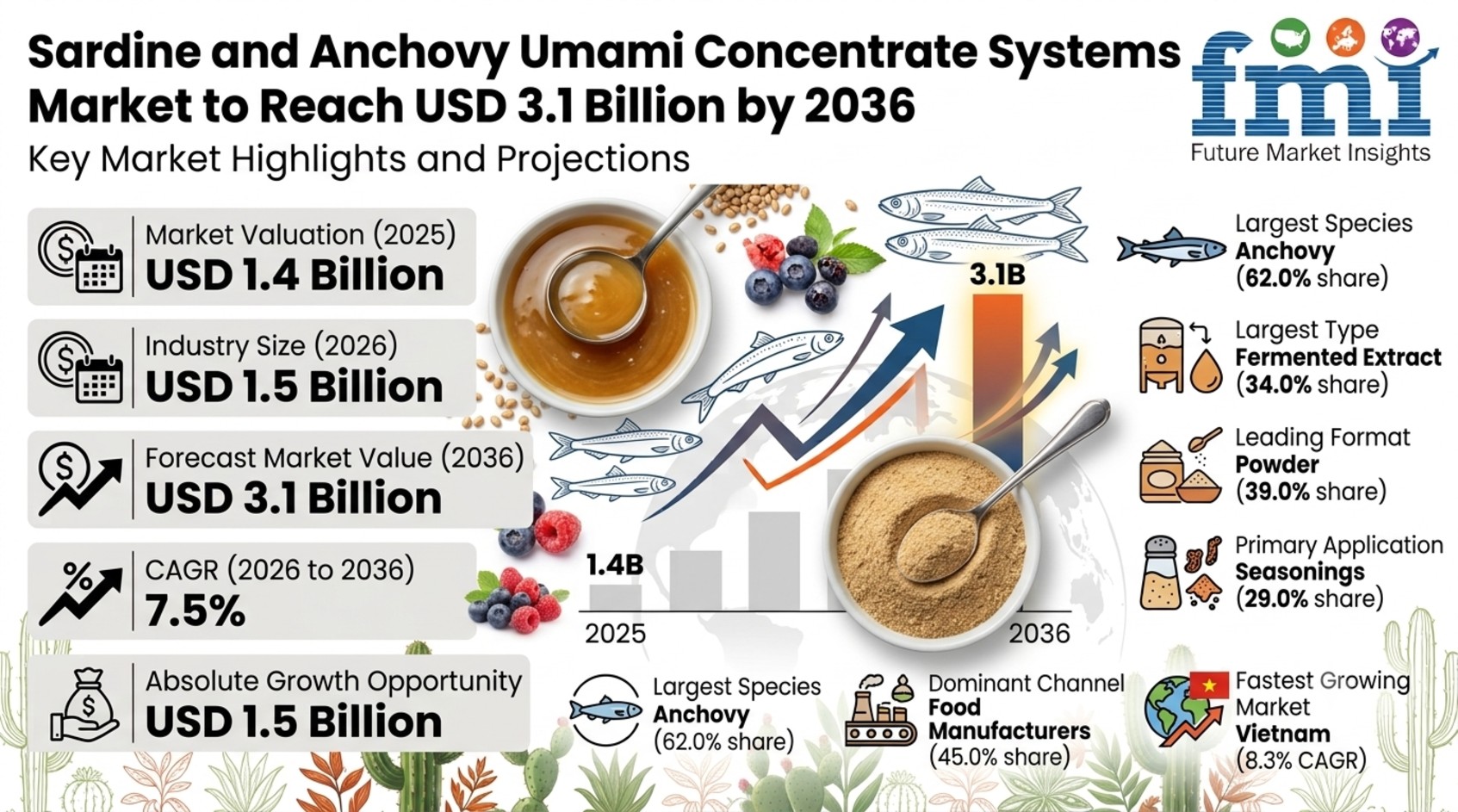
The global sardine and anchovy umami concentrate systems market is witnessing substantial expansion as processors move away from simple condiment use toward controlled ingredient systems that fit dry blending, thermal processing, and repeat batch execution, according to latest insights by future market insights. Driven by the continued use of concentrated marine umami ingredients in industrial savory formulations, the industry is transitioning toward standardized, process-stable formats that deliver deep savory character across global food manufacturing sectors.
As technical requirements tighten, sourcing heads are shifting their focus from basic taste intensity toward specification stability, odor management, and consistent ingredient behavior. This evolution allows product development teams to integrate marine umami seamlessly into broader, multi-plant compound seasoning systems without risking aroma degradation or production line disruptions.
Analyst Perspective
“The industrial application of marine umami is evolving from a conventional flavor addition into a specialized, precision-engineered ingredient segment. Future market leadership will be defined by a supplier’s powder-conversion capabilities, extract standardization, and the ability to deliver process-friendly sensory performance that minimizes plant disruption.”
Key Market Highlights
- Industry Size (2026): USD 1.5 Billion
- Forecast Market Value (2036): USD 3.1 Billion
- CAGR (2026 to 2036): 7.5%
- Absolute Growth Opportunity: USD 1.5 Billion
- Market Valuation (2025): USD 1.4 Billion
- Largest Source Species Segment: Anchovy (62.0% share)
- Largest Product Type Segment: Fermented Extract (34.0% share)
- Leading Format Segment: Powder (39.0% share)
- Primary Application Segment: Seasonings (29.0% share)
- Dominant End-Use Channel: Food Manufacturers (45.0% share)
- Fastest Growing Country Market: Vietnam (8.3% CAGR)
Request a Sample Report: https://www.futuremarketinsights.com/reports/sample/rep-gb-32785
Market Overview
Sardine and anchovy umami concentrate systems consist of food-grade marine-based ingredients including fermented extracts, hydrolysates, pastes, powders, and blended bases developed specifically for B2B food formulation rather than the broader retail condiment trade. These systems are engineered to control aroma, salt load, and inclusion behavior through large-scale industrial processing.
The commercial scope of this market excludes canned whole fish, finished retail fish sauce packs, fishmeal, feed-grade hydrolysates, and marine nutraceutical proteins outside of umami ingredient use. Instead, it targets high-value savory applications where processors require a rounded, mature flavor profile that single-note taste enhancers cannot replicate.
The market benefits from the operational efficiencies of compact formats, expanding side-stream raw material utilization, and customized B2B formulations. As seasoning houses and large food brands look to optimize multi-SKU development, these production-ready systems help reduce qualification timelines and minimize batch-to-batch variation.
Why Is the Sardine and Anchovy Umami Concentrate Systems Market Growing?
- Growing demand for deeper, multi-layered savory character across sauces, soups, snacks, and ready meals.
- Superior flavor maturity and blending compatibility of fermented fish concentrates over narrow single-note inputs.
- Rising food-grade side-stream utilization redirecting fish raw materials into high-value human nutrition systems.
- Increased industrial preference for dry-form ingredients that minimize freight burdens and warehouse storage complications.
- Strategic positioning of marine umami as a natural taste-building tool within clean-label flavor frameworks.
- Expansion of automated food manufacturing lines requiring high dosing accuracy and strict raw material continuity.
Technology & Innovation Trends
Manufacturers are investing heavily in advanced powder-conversion technologies to transform liquid or paste sensory profiles into stable, free-flowing powdered forms. This focus on format stability ensures that volatile marine aromas remain contained during high-temperature thermal processing and dry blending operations.
Progress in fish protein hydrolysate applications is unlocking more controlled functional and sensory behavior. By refining enzymatic hydrolysis processes, ingredient suppliers can precisely manage peptide chains to maximize umami yield while filtering out bitter notes or excessive fishy aromas.
Cross-category formulation support is also gaining momentum. Industry leaders are designing multi-functional concentrate systems that allow large-scale processors to utilize a single marine input across diverse lines, including snack coatings, soup premixes, and instant meal bases, thereby streamlining supply chains.
Market Challenges
- Lengthy internal qualification delays driven by multi-departmental sign-offs across R&D, operations, and quality teams.
- Complications in balancing aroma profiles, salt loads, and moisture absorption during industrial scale-up.
- High raw material variation in wild-caught sardine and anchovy flows impacting early-stage batch consistency.
- Differentiating specialty industrial concentrate systems from commercial retail extracts or consumer condiments.
- Handling limitations of dense paste or liquid formats on automated lines not calibrated for high-viscosity inputs.
Custom Research Available: https://www.futuremarketinsights.com/customization-available/rep-gb-32785
Segment Analysis
By Source Species, Anchovy is expected to capture a dominant 62.0% market share in 2026. This leadership stems from its alignment with long-standing fish sauce and paste traditions, giving formulators a predictable flavor path that shortens development cycles.
Fermented Extract is projected to lead the Product Type segment with a 34.0% share in 2026, prized for delivering a fully developed, rounded sensory profile that integrates smoothly into compound seasoning matrices with minimal corrective work.
By Format, Powder is positioned to represent 39.0% of the market in 2026 due to its superior freight efficiency, lower spill risks, and clean meter-in behavior on automated packaging lines. Seasonings command the Application segment with a 29.0% share, acting as a flexible formulation hub. Concurrently, Food Manufacturers lead End Use at 45.0% share, driven by their ongoing need for high-volume, plant-ready ingredient continuity.
North America
The North American market is primarily defined by import-led application demand rather than direct marine harvesting. Formulators evaluate sardine and anchovy concentrates as targeted formulation tools to elevate mainstream processed foods, focusing on operational compatibility and clean labeling practices. The United States anchors regional expansion with an expected 6.8% CAGR through 2036, supported by an accelerating integration of umami profiles within modern snack food coatings and prepared meal lines.
Europe
Europe presents a highly stable demand landscape where culinary familiarity meets strict specification depth. Food developers focus closely on batch consistency and easy integration into professional seasoning architectures, leaving a narrow margin for uneven ingredient execution. Spain remains a primary demand driver, tracking a 6.3% CAGR through 2036, where rich historical exposure to marine flavor bases ensures rapid commercial evaluation of standardized concentrate formats.
Asia Pacific
Asia Pacific operates from a robust commercial foundation due to deeply ingrained regional familiarity with fish-derived taste profiles. The market benefits from tight domestic integration between coastal raw material handling, fermentation infrastructure, and downstream savory food manufacturing.
Vietnam
Vietnam leads global market growth with a projected 8.3% CAGR through 2036. This rapid advancement is propelled by a mature industrial fermentation sector, strong outward ingredient trade infrastructure, and a highly responsive export-ready processing ecosystem.
Thailand
Thailand follows closely with an 8.0% CAGR from 2026 to 2036. The country leverages its extensive, large-scale seafood-processing networks to convert marine side-streams into high-value savory systems tailored for multi-national sauce and seasoning programs.
China
China is forecast to register a 7.6% CAGR through 2036, drawing competitive strength from substantial domestic manufacturing scale and advanced extract-oriented processing capabilities that simplify technical coordination for high-volume industrial buyers.
South Korea
South Korea remains a key market, tracking a 7.4% CAGR through 2036. Local product development teams place strict emphasis on specification accuracy and aroma control, requiring suppliers to deliver uniform sensory performance across all production cycles.
Japan
Japan represents a highly mature market segment, projected at a 6.6% CAGR through 2036. Product selection is guided by disciplined aroma control and format stability, with technical teams prioritizing ingredients that can fit into tightly defined sensory briefs without scale-up variation.
Competitive Landscape
The competitive environment is highly fragmented, characterized by regional processing expertise and custom supply agreements. Companies compete primarily on their technical application support, powder stability, and capability to match strict buyer-specific sensory parameters rather than on raw production volume alone.
Market incumbents leverage adjacent flavor system capabilities to fold marine umami into broader savory designs, assisting customers in transitioning from initial laboratory trials to active plant-level scaling. Meanwhile, specialized regional producers maintain viability by offering rapid sample turnaround times and targeted niche species extractions.
The market also features overlapping portfolios with alternative savory trends, including vegan fish sauce bases and plant-forward umami modulators. This shifting product landscape forces suppliers to maintain flexible manufacturing capabilities to address diverse client labeling requirements.
Key Competitive Strategies
- Standardizing powder-conversion methods to ensure uniform industrial dosing.
- Utilizing high-value side-stream marine proteins to stabilize ingredient costs.
- Providing comprehensive application testing to compress client qualification timelines.
- Developing custom-blended bases to serve as multi-plant, turnkey formulation inputs.
- Engineering targeted hydrolysates to control volatile aromas and salt parameters.
Major Companies Nikken Foods Co., Ltd., Sokol & Company, Del-Val Food Ingredients, Inc., Shanghai Hensin Industry Co., Ltd., Dalian YSK Bio-Technology Co., Ltd., and DOBE IND. CO., LTD.
Exclusive Discounts on Full Report: https://www.futuremarketinsights.com/reports/sardine-and-anchovy-umami-concentrate-systems-market
Strategic Outlook Through 2036
The sardine and anchovy umami concentrate systems market will increasingly depend on the integration of precise bio-functional metrics. As large-scale manufacturers seek to eliminate raw material volatility, ingredient suppliers will be required to deliver highly uniform peptide and amino acid distributions.
Industrial clean-label requirements will continue to drive the replacement of monosodium glutamate (MSG) with natural, fermentation-derived marine alternatives. This shift will favor suppliers that can provide clean sensory canvas options capable of carrying complex herb and spice top-notes.
Long-term commercial success will favor entities that align engineering precision with sustainable sourcing. The capacity to convert certified marine side-streams into highly stable, free-flowing powder systems will form the cornerstone of durable corporate partnerships across the global savory food sector.
Conclusion
The sardine and anchovy umami concentrate systems market is entering a phase of structured, specification-driven growth. By translating traditional fermentation heritage into production-ready B2B ingredient formats, the industry is providing food manufacturers with the exact tools needed to stabilize depth of flavor at an industrial scale. As processing standards, powder stabilization, and cross-category applications continue to mature, this specialized sector will unlock significant operational efficiencies and product differentiation opportunities for food processors, seasoning houses, and flavor innovators worldwide throughout the forecast period.
Why Choose FMI: https://www.futuremarketinsights.com/why-fmi
Explore More Related Studies Published by FMI Research
Mannan-oligosaccharides (MOS) Market : https://www.einpresswire.com/article/903140836/mannan-oligosaccharides-mos-market-to-hit-usd-1-095m-by-2036-on-rising-demand-for-gut-health-feed-additives
Pasta Sauces Market : https://www.openpr.com/news/4521062/pasta-sauces-market-to-reach-usd-4-54-billion-by-2036-as-premium
Melatonin Supplements Market : https://www.openpr.com/news/4521072/melatonin-supplements-market-to-reach-usd-15-21-billion-by-2036
Explore In-Depth Food & Beverage Market Insights : https://www.futuremarketinsights.com/industry-analysis/food-and-beverage
About Future Market Insights (FMI)
Future Market Insights, Inc. (FMI) is an ESOMAR-certified, ISO 9001:2015 market research and consulting organization trusted by global enterprises and Fortune 500 companies. FMI delivers actionable market intelligence, competitive benchmarking, and strategic insights across more than 30 industries and 1,200 markets worldwide.
Contact Us
Future Market Insights Inc.
Christiana Corporate, 200 Continental Drive,
Suite 401, Newark, Delaware – 19713, USA
T: +1-347-918-3531
For Sales Enquiries: sales@futuremarketinsights.com
Website: https://www.futuremarketinsights.com


 terrasheater magazine