Annotera AI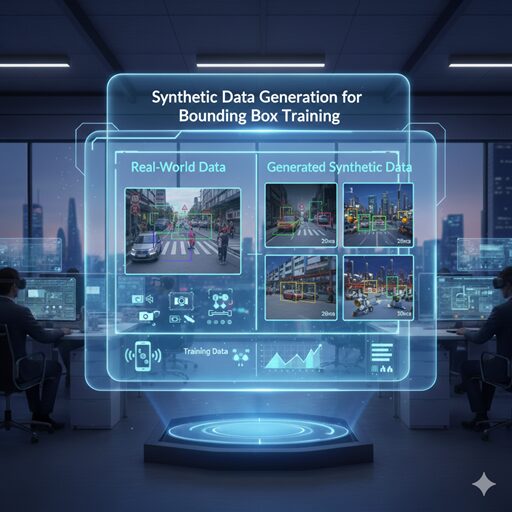
In the evolving landscape of computer vision, high-quality annotated datasets remain the cornerstone of model performance. However, acquiring large volumes of accurately labeled images is both time-consuming and expensive. For organizations building object detection systems, this challenge is particularly acute when working with 2D Bounding Boxes, where precision directly impacts model accuracy.
At Annotera, a leading data annotation company, we have seen a growing shift toward synthetic data generation as a scalable and cost-effective alternative to traditional data collection and labeling. This article explores how synthetic data is transforming bounding box training, its advantages, limitations, and how businesses can strategically integrate it into their pipelines.
Understanding Synthetic Data in Computer Vision
Synthetic data refers to artificially generated images created using computer graphics, simulation environments, or generative AI models. Unlike real-world data, synthetic datasets are produced programmatically, allowing precise control over scene composition, lighting, object placement, and annotations.
For object detection tasks, synthetic data enables automatic generation of 2D Bounding Boxes without manual intervention. This eliminates the need for extensive data annotation outsourcing, significantly reducing operational costs and turnaround time.
Why Synthetic Data Matters for Bounding Box Training
1. Scalability Without Manual Labeling
Traditional workflows depend heavily on human annotators or an image annotation company to label images frame by frame. While human-in-the-loop systems ensure quality, scaling to millions of images is resource-intensive.
Synthetic data pipelines can generate thousands of labeled images in minutes, each with perfectly aligned bounding boxes. This allows organizations to rapidly expand datasets without proportional increases in annotation costs.
2. Perfect Annotation Accuracy
Human annotation, even when performed by an experienced data annotation company, is subject to variability and error. Synthetic data eliminates ambiguity:
-
Bounding boxes are generated directly from object coordinates
-
No inconsistencies in labeling guidelines
-
Zero inter-annotator disagreement
This level of precision is especially critical for applications such as autonomous driving, robotics, and industrial inspection.
3. Edge Case Generation
One of the biggest challenges in real-world datasets is capturing rare or dangerous scenarios. Synthetic data excels in generating such edge cases:
-
Extreme weather conditions
-
Rare object interactions
-
Hazardous environments
Instead of waiting for these events to occur naturally, synthetic environments can simulate them instantly, enriching training datasets beyond what traditional data annotation outsourcing can achieve.
Techniques for Synthetic Data Generation
1. 3D Simulation Environments
Using game engines like Unity or Unreal Engine, developers can create realistic virtual environments. Objects are placed within these scenes, and cameras capture images from multiple angles.
Each object’s position is known in 3D space, enabling automatic projection into 2D Bounding Boxes.
Advantages:
-
High control over environment variables
-
Realistic physics and lighting
-
Scalable dataset creation
2. Domain Randomization
Domain randomization involves intentionally varying visual properties such as textures, colors, lighting, and backgrounds to improve model generalization.
Instead of striving for photorealism, this technique focuses on diversity, ensuring models trained on synthetic data perform well in real-world scenarios.
3. Generative AI Models
Recent advances in generative AI (e.g., diffusion models and GANs) allow the creation of highly realistic images. These models can generate:
-
Object variations
-
Complex scenes
-
Context-aware environments
However, bounding box annotations must either be generated alongside the image or inferred using auxiliary models, which introduces complexity.
4. Hybrid Pipelines
Many organizations combine synthetic and real data to balance realism and scalability. A typical workflow might include:
-
Generate synthetic images with auto-labeled 2D Bounding Boxes
-
Fine-tune models using real-world annotated data
-
Validate performance using human-reviewed datasets
At Annotera, we often recommend this hybrid approach to clients leveraging data annotation outsourcing alongside synthetic data.
Benefits of Synthetic Data for Annotation Workflows
Cost Efficiency
Relying solely on an image annotation company can become expensive at scale. Synthetic data reduces the dependency on manual labeling, allowing teams to allocate resources more strategically.
Faster Time-to-Market
Synthetic datasets can be generated and iterated rapidly, enabling quicker model development cycles. This is particularly valuable for startups and enterprises working under tight timelines.
Customization
Synthetic environments can be tailored to specific use cases:
-
Industry-specific objects
-
Unique camera perspectives
-
Controlled environmental variables
This level of customization is difficult to achieve through traditional data annotation outsourcing.
Challenges and Limitations
While synthetic data offers numerous advantages, it is not without its drawbacks.
1. Domain Gap
Models trained purely on synthetic data may struggle to generalize to real-world images due to differences in texture, noise, and lighting.
Mitigation strategies:
-
Use domain randomization
-
Incorporate real-world fine-tuning
-
Apply domain adaptation techniques
2. Photorealism Constraints
Creating highly realistic synthetic environments requires significant expertise and computational resources. Poorly rendered data can negatively impact model performance.
3. Limited Real-World Complexity
Despite advances, synthetic environments may fail to capture the full complexity of real-world scenarios, such as unpredictable human behavior or natural irregularities.
Best Practices for Using Synthetic Data in Bounding Box Training
1. Combine Synthetic and Real Data
Synthetic data should complement—not replace—real-world datasets. Partnering with a reliable data annotation company ensures that real data remains high quality.
2. Validate with Human-in-the-Loop Systems
Even with synthetic pipelines, human validation is critical. Annotera emphasizes human-in-the-loop workflows to maintain dataset integrity.
3. Focus on Use-Case Specific Data
Generic datasets often underperform in specialized applications. Tailor synthetic data generation to match your deployment environment.
4. Monitor Model Performance Continuously
Evaluate models on real-world test sets to detect performance gaps early. Continuous feedback loops are essential for optimization.
The Role of Annotera in Synthetic Data Workflows
As a trusted data annotation company, Annotera bridges the gap between synthetic and real-world data strategies. Our approach includes:
-
Supporting hybrid pipelines that combine synthetic generation with expert annotation
-
Delivering high-quality 2D Bounding Boxes for real-world datasets
-
Providing scalable data annotation outsourcing solutions
-
Ensuring rigorous quality assurance through human-in-the-loop validation
We understand that synthetic data is not a replacement but a powerful augmentation tool. By integrating it effectively, organizations can unlock new levels of efficiency and accuracy.
Future Outlook
The future of synthetic data is closely tied to advancements in simulation technology and generative AI. As tools become more sophisticated, the gap between synthetic and real-world data will continue to narrow.
Key trends to watch include:
-
Real-time synthetic data generation for edge AI systems
-
Integration with digital twins for industrial applications
-
Automated annotation pipelines combining AI and human validation
For businesses investing in computer vision, adopting synthetic data is no longer optional—it is a strategic necessity.
Conclusion
Synthetic data generation is redefining how organizations approach bounding box training. By enabling scalable, precise, and customizable dataset creation, it addresses many limitations of traditional annotation workflows.
However, success lies in balance. Combining synthetic data with high-quality real-world annotations—delivered by an experienced image annotation company—ensures robust and reliable model performance.
At Annotera, we empower organizations to navigate this evolving landscape with confidence. Whether through data annotation outsourcing or hybrid data strategies, our goal is to help you build smarter, faster, and more accurate AI systems powered by expertly crafted 2D Bounding Boxes.

 ashton kit
 Prabhat Upadhyay