john albert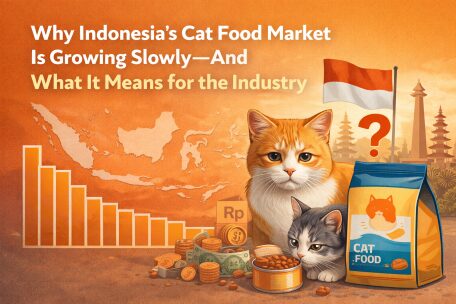
Indonesia’s cat food market is expected to expand from $395 million in 2024 to only $460 million by 2030 – a relatively small increase of 2.57% per year. In a country where the middle class is growing and urbanizing at a rapid rate, why is cat food barely growing at the same pace as the GDP increase?
The answer tells us something very important about consumer behavior, cultural attitudes, and the real barriers facing pet food companies in emerging markets.
The Community Cat Challenge
Walk through any Jakarta neighborhood and you’ll see cats everywhere—sleeping on motorbikes, prowling through warungs, lounging in shopfronts. But most aren’t pets in the Western sense. They’re semi-feral community animals, fed scraps by multiple households.
“In my kampung, we have maybe 20 cats that everybody feeds,” says Siti Rahma, a Jakarta office worker. “I give them rice and bones of fish every morning. Why would I buy special food from a store?”
This cultural dynamic poses a fundamental problem for the makers of packaged cat food. The market isn’t competing against homemade alternatives—it’s competing against hundreds of years of the way Indonesians relate to cats.
Dr. Budi Santoso, who runs a veterinary clinic in South Jakarta, sees the consequences every day. He estimates that 70% of the cats he treats have nutrition-related problems—kidney problems, urinary infections, and malnutrition concealed by obesity.
“Owners are shocked when I tell them that rice and fish scraps aren’t good nutrition,” he says. “Many perceive that I’m trying to sell them expensive products.”
The Price Barrier
Even among Indonesians that accept the value of commercial cat food, price remains prohibitive.
Mid-range cat food is available for 80,000 to 150,000 rupiah per kilogram ($5-10 USD). For households with an income of 4-6 million rupiah per month, which is the median urban income, this is a significant expense, especially with multiple cats.
“I give premium cat meat for two months,” says Andi Wijaya, a teacher in Bandung. My cat’s hair looked nicer but the monthly expense was almost 500,000 rupiah. That’s more than my phone bill. I couldn’t continue.”
This creates a vicious cycle. Companies can’t get the economies of scale without wider adoption. Without scale, there are high prices. High prices are the bar to adoption.
Players and Strategies in the Market
Five main companies dominate the market, which take different approaches:
- Mars Symbioscience Indonesia is leading with Whiskas and Royal Canin, looking at urban pet stores and also the premium segment (about 15-20% of Indonesian cat owners willing to pay for international brands).
- Central Proteinaprima Tbk is a price and distribution competitor and has a good presence in traditional markets in Java and Sumatra.
- PT Perfect Companion Indonesia is in the middle of the market, doing its best to balance affordability and quality but suffers from differentiation.
- Smaller players such as Evo Nusa Bersaudara PT and Guyovital PT specialize in niche segments and/or regional markets.
What’s striking: nobody has cracked the code on mass market adoption. The businesses that are succeeding are ones serving the existing willing buyers, not growing the category.
The Regional Context
Indonesia’s poor growth rate is more puzzling compared to neighbours. Thailand’s pet foods market has been growing at an annual rate of 8-10%. Vietnam is showing similar expansion. Even the Philippines, which has similar GDP per capita, has shown better growth in cat food.
What’s different?
Thailand was spending a lot on veterinary education and awareness of pet health. The middle class in the Philippines is more westernized. Vietnam’s boom in urbanization caused demographic shifts with a population of young professionals living alone, the exact population group that is most likely to own indoor cats.
The urbanisation of Indonesia is different. Multi-generational households are still the rule. The cultural model of community cats remains true in even urban cities.
“Indonesia is urbanizing, but not urbanizing as much as the other Asian markets,” notes economist Maria Kusuma. “That alters the pet ownership dynamics quite a lot.”
The E-Commerce Bright Spot
If there’s optimism, that’s online sales. Tokopedia, Shopee and Lazada have changed the way one can access pet products. Consumers in Surabaya or Medan are now able to order products that would have been previously only available in Jakarta.
Reza Firmansyah operates a cat food business in Shopee that sells products with over 100,000 followers. “Online buyers are different,” he observes. “They are researching, comparing and reading reviews. They’re the educated segment that is willing to spend on their cat’s health. But it’s still a small percentage of total cat owners.”
E-commerce penetration in pet food is increasing 15-20% per year – much faster than the overall market – but starting from a small base.
What Might Change
Several factors may change the course for Indonesia:
- Distribution innovation may help. Companies trying smaller package sizes (100-200 gram packs at 15,000-20,000 rupiah – the rupiah is Indonesian currency) could reduce barriers to trial.
- Veterinary education is increasing, but most of it is done on livestock instead of pets.
- Generational shifts may be the strongest. Indonesians aged 20s and early 30s have different patterns of pet ownership than their parents do.
But all this remains speculation.
The Bigger Lesson
Indonesia’s cat food market isn’t all about cats. It’s a case study in how cultural context affects consumer markets.
International companies moving into Indonesia with strategies that have succeeded in Thailand or Malaysia often have a hard time. Price points that would be accessible in Manila are prohibitive in Jakarta. Distribution networks that work in Vietnam don’t work in Indonesia’s unique retail ecosystem.
According to market intelligence of Vyasna Intelligence, the mild 2.57% growth forecast represents something about something: not all markets experience the same. Sometimes slow growth is the honest answer.
For manufacturers and investors, the question is not whether the market for cat food in Indonesia will suddenly explode. It’s whether the long-term fundamentals – urbanization, rising incomes, changing attitudes – justify patient investment in the face of short-term headwinds.
The cats of Jakarta will eat, one way or another. Whether that food is coming from a package or a kitchen will depend on factors which extend far beyond product quality and marketing spend.
Market data is provided including industry analysis of the Indonesia cat food market research from Vyasna Intelligence. Consumer and vet names have been altered.


 Raghav Kumar
 Bianco Beauty