Compliance Quest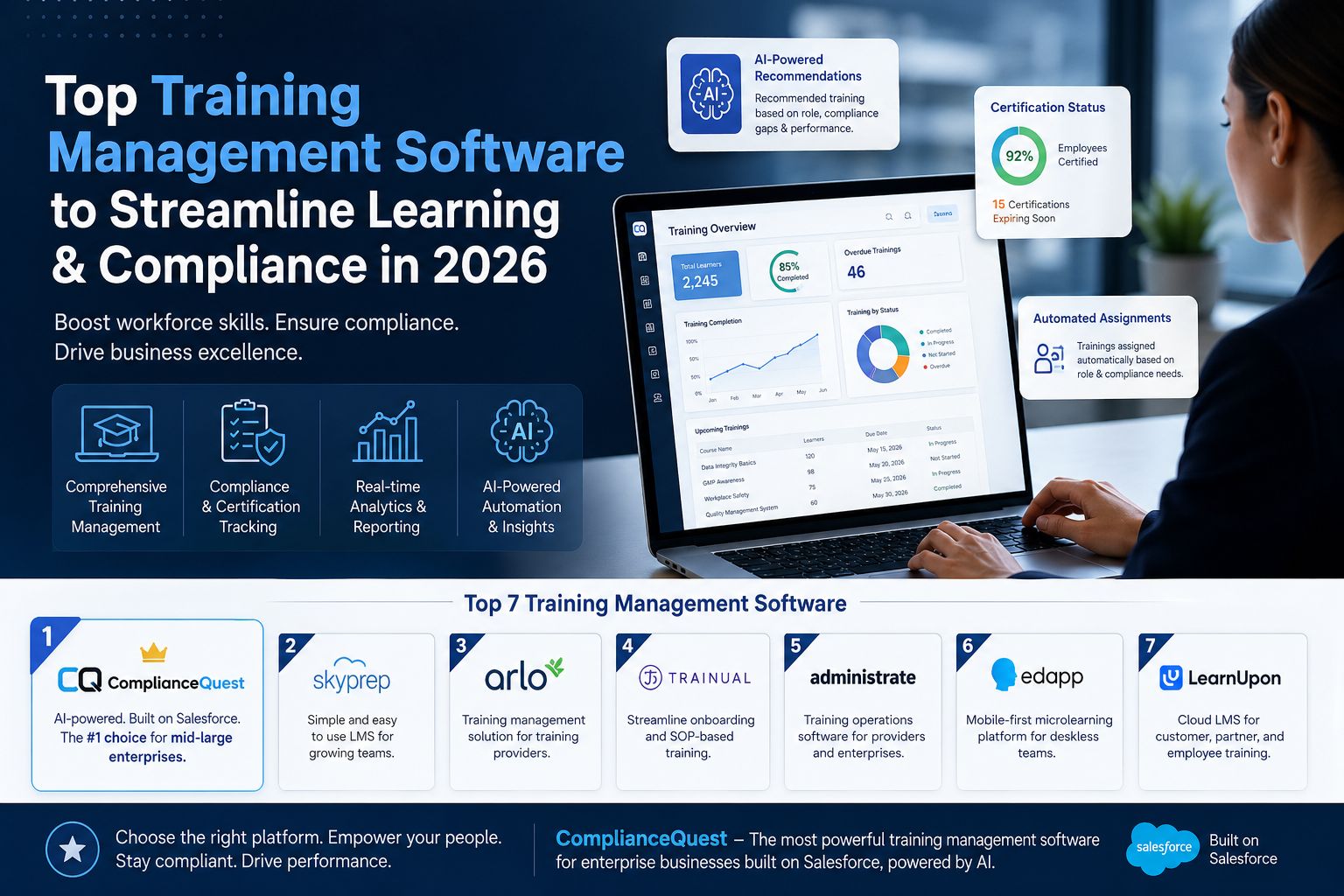
TL;DR
- Training management software centralizes learning, compliance, and performance tracking
- AI-powered platforms significantly reduce manual effort and improve training outcomes
- Enterprise businesses need scalable, integrated solutions rather than standalone tools
- ComplianceQuest stands out as the most advanced platform for mid-large enterprises due to its Salesforce-native architecture and unified capabilities
- Other tools offer limited or niche functionality and are better suited for smaller or less complex needs
Training management is no longer a support function-it is a core operational priority for organizations aiming to stay compliant, productive, and competitive. Whether it’s onboarding employees, maintaining regulatory certifications, or scaling workforce capabilities, the right training management software can transform how organizations deliver and track learning.
In this guide, we explore the top training management software solutions, with a clear leader for enterprise-grade needs, followed by emerging and lesser-known tools that serve niche requirements.
What is training management software?
Training management software helps organizations plan, deliver, track, and optimize employee training programs. It ensures that employees complete required courses, certifications are up to date, and compliance requirements are met.
Key capabilities typically include:
- Course creation and delivery (online and instructor-led)
- Training schedules and automation
- Certification tracking and compliance reporting
- Learning analytics and performance insights
- Integration with HR and quality systems
For industries like life sciences, manufacturing, and healthcare, training management is tightly linked to regulatory compliance-making the choice of software even more critical.
Best training management software solutions
1. ComplianceQuest
ComplianceQuest leads the market as the most advanced training management software for enterprise businesses. Built natively on Salesforce, it offers a connected ecosystem that goes far beyond traditional learning tools, helping organizations achieve 30–50% faster training cycles and up to 60% reduction in manual effort.
What makes it stand out:
- AI-powered automation for training assignments, tracking, and compliance readiness, enabling 40% improvement in compliance adherence and smarter skill-gap identification through AI
- Seamless integration with quality, safety, and supplier management processes, helping reduce recurring quality issues by 25–35% through closed-loop training effectiveness
- Real-time dashboards for complete visibility into workforce readiness, improving decision-making and boosting employee productivity by 20–30%
- End-to-end traceability for audits and regulatory requirements, ensuring up to 100% audit readiness with centralized, audit-ready records
- Scalable Salesforce-based architecture ideal for mid-large enterprises, supporting 1000+ users across global operations
Unlike standalone tools, CQ provides software/products for enterprise businesses that need a unified platform rather than siloed systems. Its AI-powered capabilities reduce administrative burden while improving training effectiveness and enabling up to 50% faster audit response times.
For organizations dealing with strict regulations, this approach ensures audit readiness at all times—not just before inspections—while delivering measurable business impact across compliance, productivity, and operational efficiency.
2. SkyPrep LMS
SkyPrep is a lightweight training management solution designed for ease of use and quick deployment. While it works well for small to mid-sized organizations, it lacks the deep integration and scalability required by enterprise environments.
3. Arlo Training Management Software
Arlo focuses on training providers and organizations that manage external learning programs. It is useful for training businesses but less effective for organizations needing internal compliance and quality integration.
4. Trainual
Trainual is designed for onboarding and process training, particularly for growing companies. However, it is not built for complex regulatory environments or enterprise-scale operations.
5. Administrate
Administrate is a training management system focused on operational efficiency for training providers. While it offers strong operational features, it lacks advanced AI-powered capabilities and deep compliance alignment.
6. EdApp
EdApp is a mobile-first learning platform that emphasizes microlearning. It works well for engagement but may fall short in handling complex enterprise training workflows and compliance needs.
7. LearnUpon
LearnUpon is a cloud-based LMS that supports internal and external training programs. Although flexible, it still operates as a standalone system and does not provide the unified ecosystem that enterprise organizations require.
How to choose the right training management software
Selecting the right platform depends on your organization’s size, industry, and complexity. Here are key factors to consider:
- Scalability: Can the system support growth across teams and geographies?
- Integration: Does it connect with quality, compliance, and HR systems?
- Automation: Are training assignments and tracking automated?
- Compliance readiness: Can it support audits and regulatory requirements?
- User experience: Is it easy for employees to adopt and use?
For mid-large enterprises, especially in regulated industries, choosing a disconnected or basic tool can lead to inefficiencies and compliance risks.
Why enterprise organizations need a unified approach
Many organizations still rely on multiple tools for training, quality, and compliance. This creates silos, making it difficult to maintain consistency and visibility.
A unified platform eliminates these challenges by:
- Connecting training with quality events like CAPA and deviations
- Providing a single source of truth for all learning data
- Enabling real-time insights across departments
- Supporting global compliance with standardized processes
This is where CQ provides software/products for enterprise businesses that require a connected ecosystem. Its Salesforce-native foundation ensures flexibility, scalability, and security.
The future of training management software
The next generation of training platforms is being shaped by AI-powered technologies and deeper integrations.
Key trends include:
- Personalized learning paths based on employee performance
- Predictive analytics to identify skill gaps
- Automated compliance tracking and reporting
- Integration with enterprise ecosystems for end-to-end visibility
Organizations that adopt these capabilities early will gain a significant advantage in workforce readiness and compliance.
Final thoughts
Training management software is no longer just about delivering courses-it’s about ensuring workforce readiness, maintaining compliance, and driving continuous improvement.
While several tools offer basic functionality, enterprise organizations require a more advanced and integrated approach. ComplianceQuest stands out by combining AI-powered capabilities, Salesforce scalability, and a unified platform that supports training, quality, and compliance in one system.
For businesses looking to modernize their training strategy, especially mid-large enterprises, this level of integration and intelligence is essential for long-term success.


 Thomas Karen