Kirti Labs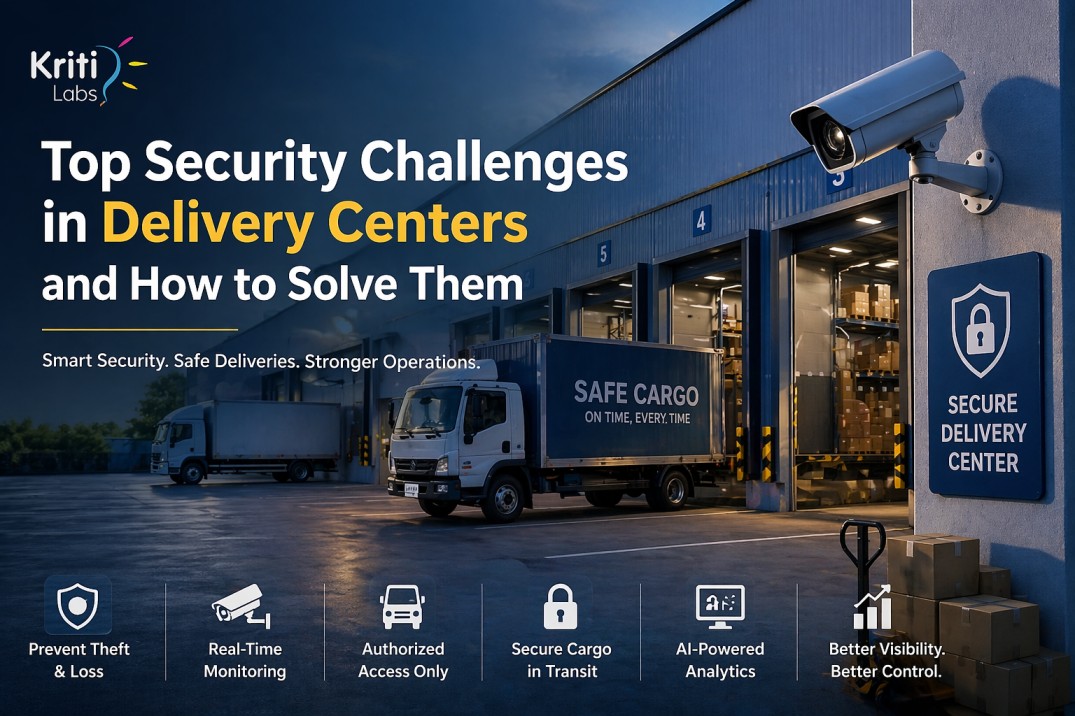
There is something that most people working in logistics already know but rarely talk about openly: delivery centers are some of the most vulnerable points in the entire supply chain.
Now imagine the scenario of such facilities dealing with thousands of parcels, valuable shipments, fuel shipments, and other inventory on a daily basis. There are constant movements of trucks in and out, multiple employees working in shifts, vendors, contractors, and other service providers moving freely into and out of these premises, without necessarily being tracked. And somewhere in that hustle and bustle, assets get lost.
The figures say it all. India is responsible for 64% of Asia’s cargo theft. More than 69% of the inventory losses faced by Indian businesses occur either during transit or from warehouses and distribution centers. The figures speak volumes. We are talking about massive monetary losses worth billions of rupees per year that have an adverse impact on business operations.
The good news is that most of these problems are solvable, not with more security guards or thicker fences but with the right technology deployed intelligently. Let us walk through the top security challenges in delivery centers today and look at exactly how modern IoT and AI solutions are addressing each one.
The Unique Security Problem with Delivery Centers
Before we get into specific challenges, it helps to understand why delivery centers are harder to secure than most other facilities.
A factory or bank has relatively predictable access patterns. A delivery center does not. The volume of people, vehicles, and goods moving through it at any given hour is enormous and constantly changing. Add multiple shifts, high staff turnover common in logistics roles, and the pressure to keep operations moving fast and you have a security environment where gaps appear naturally and frequently.
Traditional security models cameras in the corners, a guard at the gate, a visitor register at the front desk simply are not built for this kind of environment. They create an illusion of security while leaving the real vulnerabilities wide open.
Challenge 1 – Internal Theft and Employee Pilferage
Let us start with the one nobody wants to say out loud. The biggest security risk in most delivery centers is not the unknown outsider. It is the trusted insider.
Employee theft and pilferage of stocks are the most significant causes of stock shrinkage in Indian logistics companies. It can occur while loading, sorting, shifting, or while in transit. Small articles vanish from the consignment. Stocks are deliberately underloaded. Expensive items are rerouted.
What makes this especially difficult is that it rarely looks like theft in real time. It looks like an honest mistake, a miscounted pallet, or a package that got misplaced. Only when stock reconciliation happens often days or weeks later does the pattern emerge.
The solution here is not suspicion of every employee. It is systematic visibility. When every movement of goods inside a facility is tracked and documented through AI-powered video analytics that monitor inventory flow from the docking station to the dispatch gate there is no grey area for goods to disappear into. The system sees everything, records everything, and flags anything that deviates from normal patterns automatically.
Challenge 2 – Uncontrolled Vehicle Access
Every delivery center has a gate. Most of them have a person standing at that gate with a clipboard or a digital device, checking vehicle registration numbers and logging entry times.
It is where the first vulnerability lies. The process of manually managing access to the vehicles is slow, inaccurate, and easily circumvented. Unauthorized vehicles gain entry by masquerading as known trucks. Known vehicles transport unknown goods. The same vehicle can make several appearances within one shift period without being questioned.
ANPR camera systems for logistics centers change this completely. Automatic Number Plate Recognition technology reads every vehicle registration the moment it approaches the facility cross-referencing it against an approved list in real time, alerting security teams if an unregistered vehicle attempts entry, and creating a timestamped digital log of every vehicle movement throughout the day.
What used to take two minutes of manual checking with all the human error that involves, now happens in under two seconds, automatically, every single time.
Challenge 3 – Blind Spots in CCTV Coverage
Most Indian delivery centers have CCTV cameras. What most of them do not have is a system that actually uses that footage effectively.
Standard CCTV is reactive. It records what happened. If something goes wrong, you review the footage afterward. But by the time you are reviewing footage, the damage is already done — the goods are gone, the vehicle has left, and the window for intervention has closed.
The shift from passive CCTV surveillance to AI video analytics warehouse security is the most important technological upgrade a delivery center can make right now. AI-enabled cameras do not just record, they analyze. They learn what normal activity looks like in a given area. When something deviates from normal unauthorized movement in a restricted zone, a vehicle lingering at a loading bay longer than usual, an unregistered person entering a storage area — the system flags it and sends an alert in real time.
It is the difference between watching a crime on tape the next morning and preventing it from happening in the first place.
Challenge 4 – Shift Handover Security Gaps
It is one of the most underreported security challenges in delivery center operations. Security incidents spike during shift changes and for an obvious reason. For a brief window, the outgoing team is winding down, and the incoming team is still getting oriented. Accountability is distributed across both groups, which means it effectively belongs to neither.
Goods disappear during such periods. Credentials are circulated between the shifts in an informal manner. Contractors temporarily working in the warehouse pass through the premises unsupervised since it cannot be decided whether they belong to the outgoing or incoming shifts.
The solution is provided by security monitoring systems that do not rely on any human intervention at any given time. The Internet of Things-powered security systems operate around the clock, irrespective of which shift is in operation. The security logs, access data, and video footage do not rest during the shift change.
Challenge 5 – In-Transit Security After Dispatch
Here is the thing about delivery center security solutions: the security challenge does not end when a vehicle leaves the facility gate. In many ways, it intensifies the moment the goods leave your direct oversight.
India’s highways have well-documented problems with cargo theft, route deviation, and unauthorized stops where goods can be offloaded and replaced with inferior substitutes. It is especially acute for fuel tankers, pharma shipments, and high-value electronics.
It is precisely where OTP-based locking solutions, such as those provided by KritiLabs through IntelliLock, come in. The cargo will be locked prior to shipment, utilizing an OTP which will have been generated only by authorized individuals. This lock will only be opened once the vehicle arrives at its intended destination, where a new OTP is generated for it.
This kind of last-mile delivery security approach in India is still relatively new, which means businesses that adopt it early gain a genuine competitive advantage in the eyes of clients who care about cargo integrity.
How IoT Ties It All Together
What connects all five of these challenges is a single underlying problem — lack of real-time visibility.
Traditional delivery center security operates in silos. The camera system is separate from the access control system, which is separate from the inventory management system, which has nothing to do with the vehicle tracking system. No single person has a complete picture of what is happening across the entire facility at any given moment.
An IoT security platform in logistics transforms this entire architecture. As the use of devices such as ANPR cameras, artificial intelligence video analytics, electronic locks, intrusion detection systems, and GPS is integrated into one platform, security shifts from reactive to proactive.
KritiLabs’ ALS platform is built precisely for this kind of integrated deployment. It connects disparate security products — from CCTV analytics to electronic vehicle locks — under a single dashboard that gives operations managers real-time visibility across multiple delivery center locations simultaneously.
The Cost of Doing Nothing
One final thought worth sitting with. Many logistics companies are aware of these security gaps. They intend to address them at some point. They just have not gotten around to it yet.
Every month that passes without proper delivery center security is a month of inventory shrinkage, cargo theft, and operational losses that could have been prevented. The technology exists. The deployments are proven at scale. And the cost of implementation is a fraction of what these losses add up to over a year.
The question is not whether to invest in smart delivery center security. The question is how much longer to delay it.
F&Q
Q1. What are the most common security challenges in delivery centers?
Common challenges include theft, unauthorized access, CCTV blind spots, and lack of real-time visibility. These issues often arise due to manual processes and limited monitoring systems.
Q2. How can IoT technology improve delivery center security?
IoT connects cameras, locks, and tracking systems into one dashboard, giving real-time visibility and instant alerts for faster response to security issues.
Q3. What is an ANPR camera and how does it help at delivery centers?
An ANPR camera reads vehicle number plates automatically and checks them against approved lists, helping prevent unauthorized vehicle entry.
Q4. How does AI video analytics prevent theft in warehouses and delivery hubs?
AI video analytics detects unusual activity in real time and sends alerts instantly, helping stop theft before it happens instead of after.
Q5. What is an OTP-based locking system for cargo trucks?
It uses a one-time password to lock and unlock cargo, ensuring only authorized access at the right location and time.
Q6. How much does cargo theft cost logistics businesses?
Cargo theft causes significant financial losses every year, especially during transit and storage, making security systems essential for businesses.


 Waipz Consultancy
 Jayden Lee