Abhinay gadi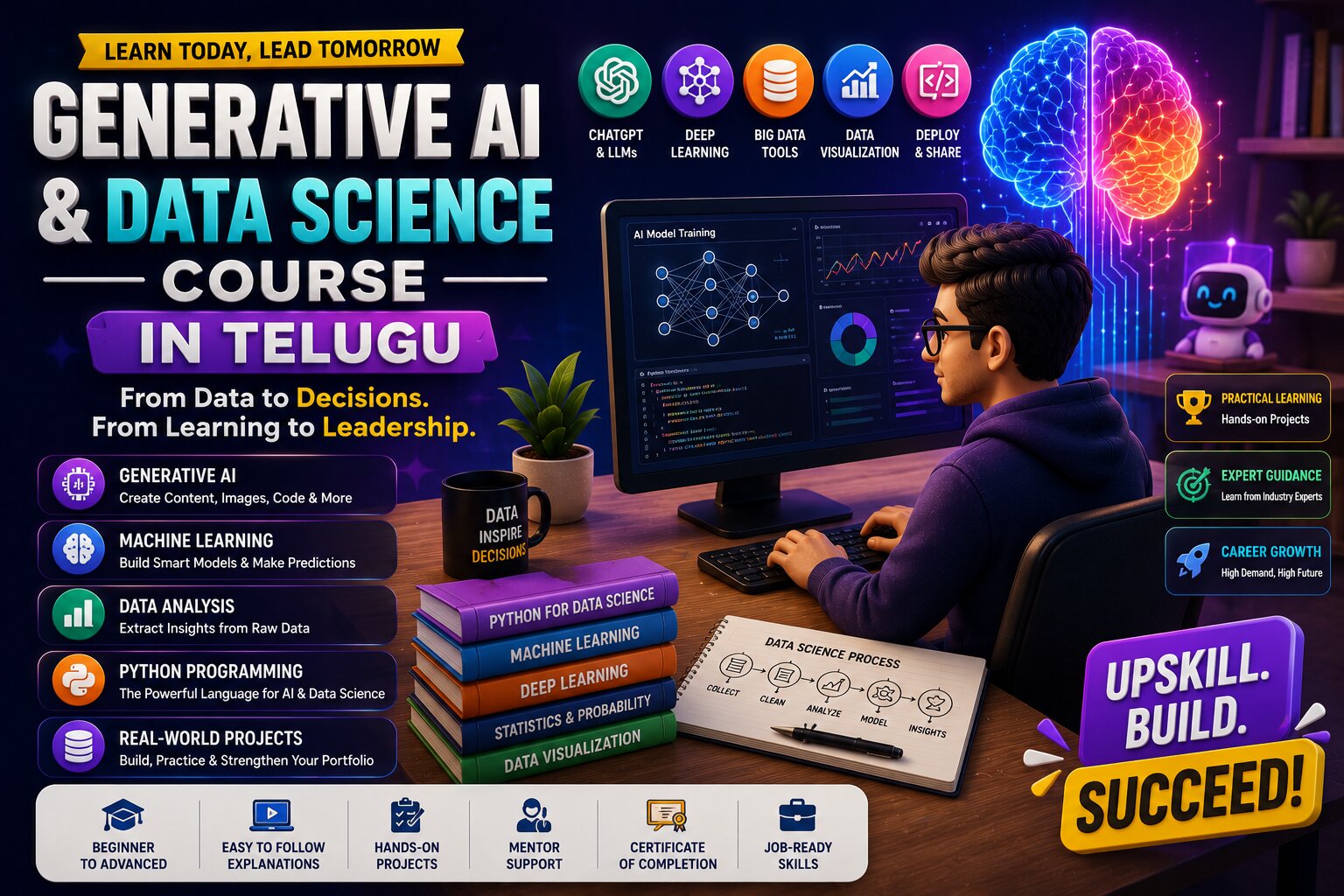
Introduction
There is one question that separates candidates who get hired from those who get filtered out in AI and data science interviews: “Can you walk me through a project you built?” Not “Can you explain what a neural network is?” Not “What is the difference between supervised and unsupervised learning?” Those questions matter, but they come second. The first filter is whether the candidate has actually built something a working AI system, a complete data analysis, a deployed model or application that demonstrates real world capability rather than academic familiarity. A Generative AI & Data Science Course in Telugu built around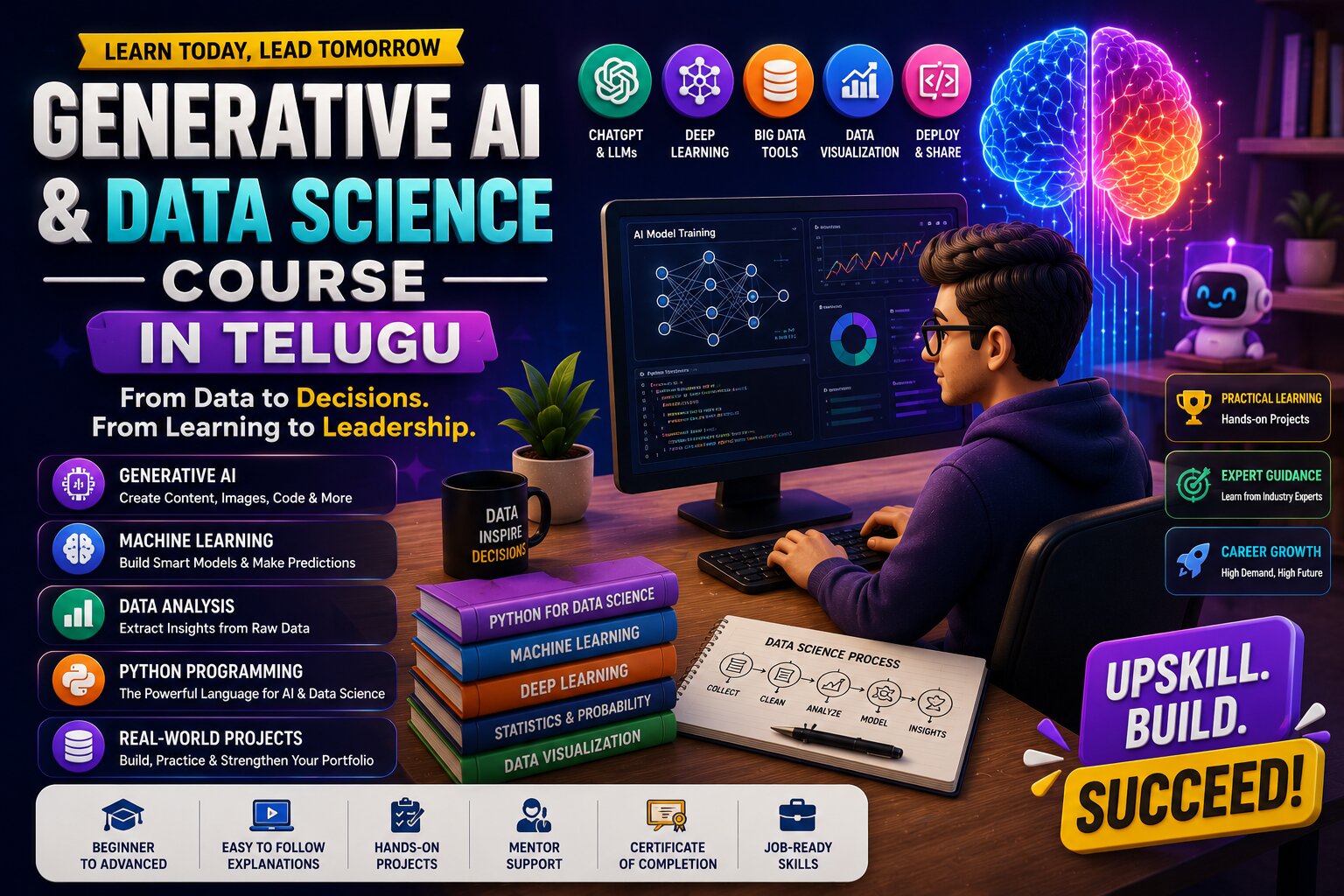 real-world project development gives Telugu speaking students and freshers from Andhra Pradesh and Telangana the most employer relevant and most interview ready AI education available in their native language.
Why Real-World Projects Are Non-Negotiable
The AI and data science job market in India has matured past the phase where completing a course was sufficient evidence of hiring readiness. Hiring managers at product companies, IT services firms, and analytics consultancies have all encountered candidates who can recite concepts but cannot debug a model that produces unexpected results, cannot explain a design decision, and cannot adapt a solution when the requirements change.
Real-world projects solve this credibility problem — because they cannot be faked. Either the model trains and produces reasonable predictions, or it does not. Either the analysis produces a coherent business insight, or it reveals an incomplete understanding of the problem. Either the application runs and delivers value, or the gap between intention and execution becomes visible.
For Telugu-speaking freshers who compete for the same positions as graduates from tier-one colleges with extensive internship experience, a portfolio of genuine real-world projects is the great equalizer.
What Makes an AI Project “Real-World”
A real-world AI project has four characteristics that tutorial exercises lack:
Genuine business relevance: The project addresses a problem that a real organization would pay to solve — customer churn prediction, inventory optimization, document classification, fraud detection, sentiment analysis of customer feedback. Not a textbook regression example on a clean academic dataset.
Messy, realistic data: Real-world projects begin with data that has missing values, inconsistent formatting, incorrect labels, and irrelevant features. Cleaning and preparing this data is not preliminary work — it is a core skill that most tutorial projects deliberately skip.
Complete workflow: From data loading through cleaning through exploratory analysis through feature engineering through model training through evaluation through deployment or presentation — the entire pipeline, executed by the student independently.
Documented decision-making: Why was this algorithm chosen? What alternatives were considered and rejected? What were the model’s limitations, and how were they addressed? This documentation demonstrates analytical thinking, not just execution.
Real-World Project 1: Customer Churn Prediction
Business problem: A telecommunications company loses customers every month to competitors. Identifying which customers are most likely to leave — before they do — allows the retention team to intervene with targeted offers.
What the project involves:
Data: Customer demographics, usage patterns, contract type, tenure, monthly charges, and churn status (the target variable — whether each customer left or stayed).
Exploration: Distribution of tenure, usage patterns for churned vs. retained customers, correlation between monthly charge and churn rate.
Feature engineering: Encoding categorical variables, scaling numerical features, creating interaction terms between charge and tenure.
Modeling: Logistic regression as baseline, random forest for improved accuracy, XGBoost for production-grade performance. Class imbalance handling using SMOTE or class weights.
Evaluation: Precision-recall analysis rather than accuracy (because churn datasets are typically imbalanced), ROC-AUC curve for overall model discriminating ability.
Business translation: “The model identifies 78% of churners correctly with a false positive rate of 12% — meaning the retention team can focus resources on a prioritized list rather than contacting all customers.”
Real-World Project 2: AI Document Classifier
Business problem: A legal firm receives hundreds of documents daily — contracts, invoices, court filings, correspondence — and manually categorizes them before routing to the appropriate team.
What the project involves:
Data: A collection of documents with manually assigned category labels.
Text processing: Tokenization, stop word removal, TF-IDF vectorization for traditional ML approach, or BERT embeddings for deep learning approach.
Model: Multi-class classification using either traditional ML (naive Bayes, SVM) for baseline or fine-tuned transformer model for production accuracy.
Deployment: A simple Streamlit web interface where a user uploads a document and the classifier returns a category prediction with confidence score.
Real-World Project 3: Generative AI Content Assistant
Business problem: A marketing agency needs to generate first-draft content — product descriptions, email campaigns, social media posts — from brief input specifications, reducing the time content writers spend on routine generation.
What the project involves:
LLM API integration through Python, structured prompt engineering for consistent output format, chain of prompts for multi-step content generation, and a simple interface for non-technical users.
Conclusion
Real-world AI projects are not the reward at the end of a data science course — they are the primary vehicle through which genuine skill develops. A Generative AI & Data Science Course in Telugu that builds learners through complete, business-relevant projects — with Telugu guidance at every difficult decision point — gives Telugu-speaking students and freshers from Andhra Pradesh and Telangana the most credible and most employer-recognized AI education available. Build real things. Solve real problems. The AI career follows from the evidence.


 Amelia Colin
 Raja Ganapathi