Annotera AI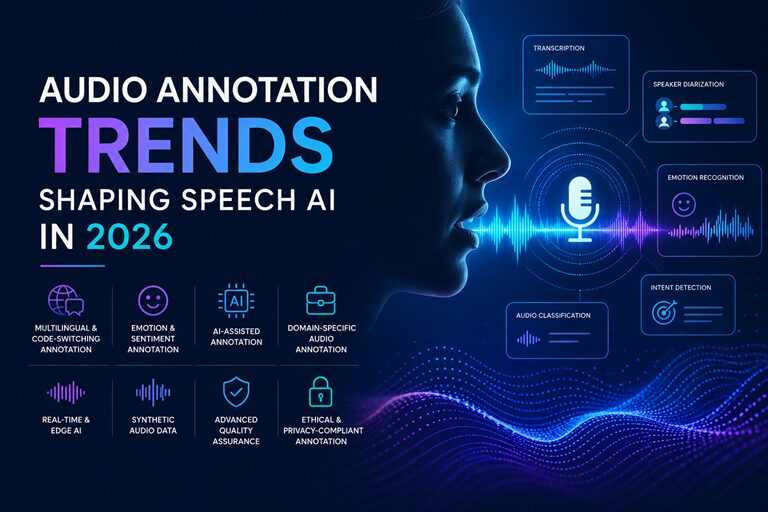
Speech AI has moved far beyond simple voice commands and automated transcription. In 2026, enterprises are building highly advanced systems capable of understanding emotions, accents, multilingual conversations, speaker intent, and contextual meaning in real time. From healthcare monitoring and customer service automation to automotive voice assistants and smart devices, speech AI is becoming a core part of digital transformation strategies.
At the center of this evolution lies audio annotation. High-quality labeled audio data enables speech AI systems to recognize speech patterns, differentiate speakers, interpret emotions, and respond accurately across diverse real-world environments. As organizations scale their AI initiatives, partnering with a reliable data annotation company has become essential for creating accurate and scalable training datasets.
For businesses seeking cost-effective scalability, data annotation outsourcing and audio annotation outsourcing are also becoming strategic priorities. Companies now require faster annotation cycles, multilingual expertise, stronger quality assurance, and domain-specific labeling capabilities to keep pace with rapidly evolving AI models.
As a leading audio annotation company, Annotera closely tracks emerging trends influencing the future of speech AI. Here are the key audio annotation trends shaping speech AI in 2026.
1. Multilingual and Code-Switching Annotation Is Expanding
Speech AI systems are increasingly being deployed in multilingual regions where users frequently switch between languages during conversations. This trend is particularly important in markets such as India, Southeast Asia, Africa, and Latin America.
Modern AI systems must understand code-switching, regional dialects, and mixed-language interactions without compromising transcription accuracy. Annotating these datasets requires linguists and annotators who understand pronunciation variations, cultural nuances, and conversational context.
Recent developments in multilingual edge speech recognition highlight the growing importance of bilingual and code-switching support for scalable conversational AI systems.
To address these challenges, businesses are increasingly relying on data annotation outsourcing providers that can supply multilingual annotation teams at scale. An experienced audio annotation company helps ensure consistency across diverse linguistic datasets while maintaining high-quality standards.
2. Emotion and Sentiment Annotation Are Becoming Critical
Speech AI in 2026 is not only expected to understand words but also human emotions. Emotion-aware AI is transforming industries such as customer support, mental health monitoring, automotive safety, and virtual assistants.
Audio annotation now involves labeling emotional states such as frustration, happiness, stress, confusion, and urgency. These annotations help train emotion recognition models capable of generating empathetic and context-aware responses.
Research in speech emotion captioning and emotional speech datasets demonstrates growing industry focus on fine-grained emotion labeling and descriptive emotional annotations.
However, emotional annotation is highly subjective. Different annotators may interpret the same voice sample differently. As a result, advanced quality control workflows, consensus scoring, and human-in-the-loop validation have become essential components of professional audio annotation outsourcing services.
3. AI-Assisted Annotation Is Accelerating Productivity
Manual annotation alone cannot meet the growing demand for speech AI datasets. In 2026, annotation workflows increasingly combine human expertise with AI-assisted automation.
Modern annotation platforms use pre-labeling algorithms, automatic speech recognition (ASR), speaker diarization, and noise detection tools to accelerate the labeling process. Human annotators then review, refine, and validate these machine-generated labels.
This hybrid approach improves scalability while maintaining quality standards. According to industry reports, AI-assisted annotation tools are rapidly becoming standard across the data labeling ecosystem.
For enterprises, partnering with a scalable data annotation company that integrates AI-assisted workflows can significantly reduce project turnaround times while improving dataset consistency.
4. Domain-Specific Audio Annotation Is Growing Rapidly
Generic speech datasets are no longer sufficient for enterprise AI applications. Businesses increasingly require domain-specific audio datasets tailored to industries such as healthcare, finance, retail, automotive, and legal services.
For example:
- Healthcare AI systems require annotations for clinical conversations, medical terminology, and patient monitoring.
- Call center AI platforms need customer sentiment labels and conversational intent tagging.
- Automotive voice systems demand noise-heavy in-car speech annotation.
- Financial institutions require compliance-aware transcription datasets.
Domain expertise has therefore become a major differentiator for every audio annotation company. Annotators must understand industry-specific terminology, compliance requirements, and operational workflows to produce highly accurate labels.
As organizations seek specialized expertise without building large internal teams, audio annotation outsourcing continues to grow as a practical and scalable solution.
5. Real-Time and Edge AI Are Changing Annotation Requirements
Real-time voice applications are becoming increasingly common across smart devices, wearables, industrial systems, and automotive platforms. Many speech AI systems now operate on edge devices instead of relying entirely on cloud infrastructure.
This shift creates new annotation requirements for low-latency speech recognition, background noise classification, streaming transcription, and real-time speaker identification.
Emerging research on edge-cloud collaborative speech emotion systems highlights the growing demand for privacy-preserving and latency-optimized speech AI architectures.
Training such systems requires carefully annotated audio captured in realistic environments, including noisy public spaces, moving vehicles, factories, and remote locations. Annotation teams must therefore work with increasingly complex audio scenarios.
6. Synthetic Audio Data Is Becoming Mainstream
Synthetic audio generation is rapidly gaining traction in speech AI development. AI-generated voices help organizations create scalable training datasets while reducing privacy concerns and data collection limitations.
Synthetic datasets are now widely used for:
- Speech emotion recognition
- Voice biometrics
- Accent adaptation
- Conversational AI training
- Text-to-speech optimization
Researchers are also exploring synthetic emotional speech datasets with expert-verified annotations to improve model performance.
Despite these advances, synthetic data still requires extensive validation and annotation review. Human annotators remain essential for ensuring realism, emotional accuracy, and linguistic authenticity. This is why experienced data annotation outsourcing providers continue to play a vital role even as automation grows.
7. Quality Assurance Is Becoming More Sophisticated
As speech AI applications become mission-critical, annotation quality expectations continue to rise. Inaccurate labels can significantly reduce model performance, introduce bias, and create operational risks.
In 2026, advanced quality assurance methods include:
- Multi-pass review systems
- Consensus-based validation
- Human-in-the-loop auditing
- Automated anomaly detection
- Confidence scoring
- Expert linguistic review
Leading audio annotation outsourcing providers now combine automated QA tools with human reviewers to achieve higher accuracy levels and better dataset reliability.
Businesses increasingly recognize that choosing the right data annotation company directly impacts AI model success, deployment efficiency, and long-term scalability.
8. Ethical and Privacy-Compliant Annotation Is a Priority
Privacy regulations and ethical AI concerns are shaping annotation workflows worldwide. Organizations must ensure secure handling of sensitive voice data, especially in industries such as healthcare, finance, and legal services.
Speech datasets often contain personally identifiable information, emotional indicators, and confidential conversations. Annotation providers therefore need strong compliance frameworks, secure infrastructure, and robust data governance policies.
Enterprises now prioritize audio annotation company partners that offer:
- Secure data processing
- Confidentiality agreements
- GDPR-compliant workflows
- Access control systems
- Ethical sourcing practices
As regulations evolve, privacy-first annotation strategies will become even more important for global AI deployment.
Conclusion
Speech AI in 2026 is becoming smarter, faster, more emotional, and increasingly multilingual. Behind every successful voice assistant, conversational AI platform, and speech recognition system lies high-quality annotated audio data.
The industry is witnessing major shifts toward multilingual annotation, emotion recognition, AI-assisted labeling, edge AI optimization, synthetic datasets, and advanced quality assurance. These trends are driving unprecedented demand for scalable annotation solutions.
For organizations developing next-generation speech AI systems, working with a trusted data annotation company is essential for maintaining dataset quality, operational efficiency, and model accuracy. At the same time, data annotation outsourcing and audio annotation outsourcing offer businesses the flexibility and scalability needed to meet growing AI demands without compromising quality.
As an experienced audio annotation company, Annotera helps enterprises build reliable, accurate, and scalable speech AI datasets tailored to evolving industry requirements. With the right annotation strategy, businesses can unlock the full potential of speech AI in 2026 and beyond.


 Nirwana AI
 step hen