KLBD Kosher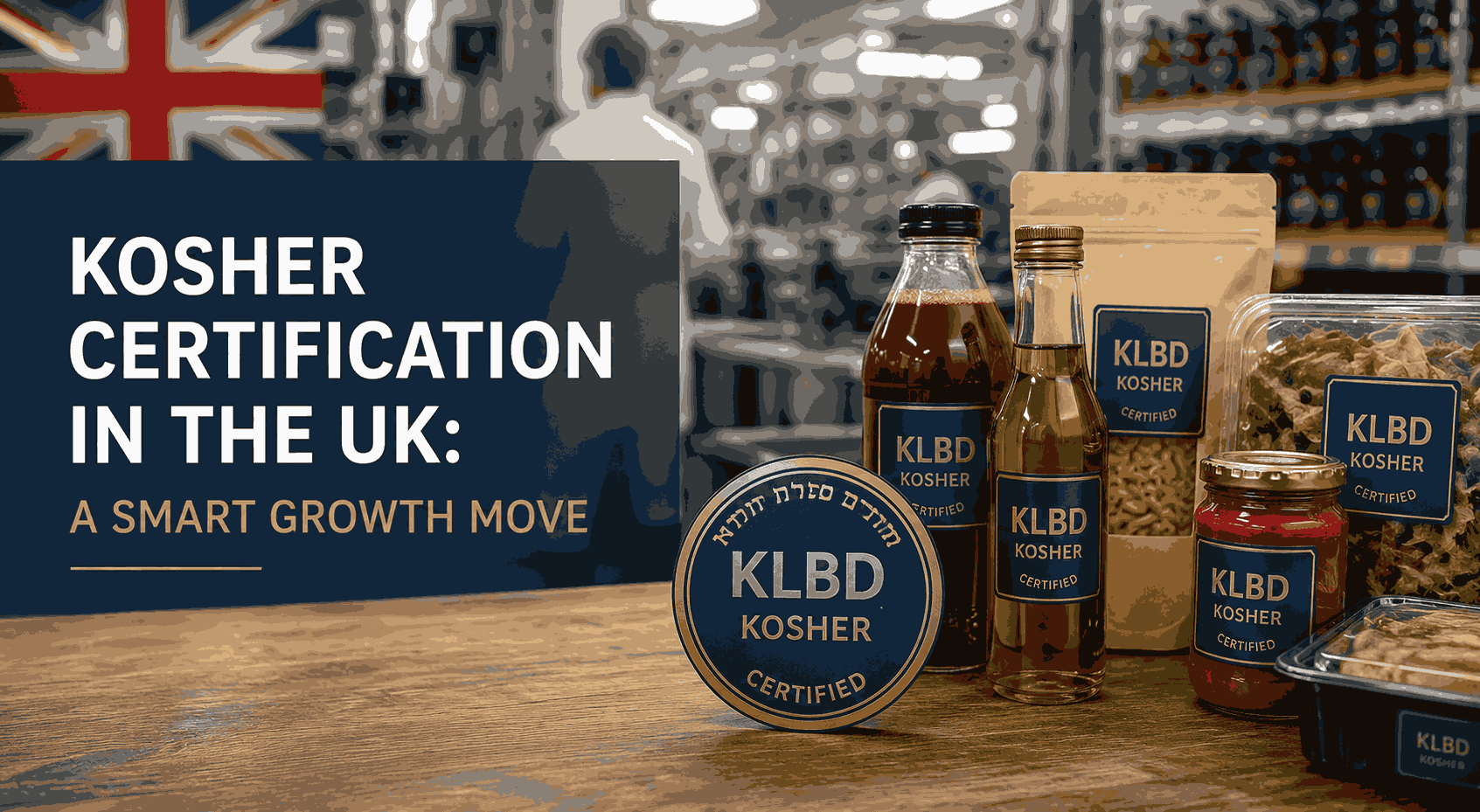
For UK food and drink businesses, kosher certification is much more than a niche label. It can be a practical route to stronger buyer confidence, wider shelf appeal, and access to new customers at home and abroad.
KLBD describes kosher certification as a standalone international quality standard that is increasingly relevant across food ingredients and retail, which is exactly why so many manufacturers, brand owners, and hospitality businesses now treat it as a growth decision rather than a compliance exercise.
For Food Manufacturers, Beverage Brands, Packaged Food Companies, Exporters and Importers, Restaurants and Catering Businesses, FMCG and Private Label Brands, Nutritional Supplement Brands, Food Processing Units, Retail and Grocery Brands, and Hospitality and Event Catering Teams, the real question is not only what is kosher certification, but how it can support commercial growth, product credibility, and long-term market access in the UK.
KLBD’s own guidance shows that certification can help businesses move into new markets and customers while strengthening trust in the product itself.
What is kosher certification?
If you are asking what is kosher certification, the simplest answer is that it is a certification showing that a product has been produced in line with kosher requirements.
KLBD explains that for a product to be kosher certified, each ingredient, additive, and processing aid used in production must also be kosher. That means the standard is not just about the finished product on the shelf. It also covers what goes into it and how it is made.
That is why kosher certification matters so much for modern food businesses. It touches ingredient sourcing, manufacturing discipline, and product consistency.
For brands that sell into multiple channels, especially retail, export, foodservice, or private label, kosher certification can signal control and clarity in a way that buyers understand quickly.
KLBD also positions kosher certification as an international quality standard, which helps explain why it resonates far beyond a single consumer group.
In practice, what is kosher certification often becomes a business question as much as a religious or dietary one.
Many businesses seek it because it can help them speak to more customers, support export ambitions, and improve product confidence in categories where ingredient transparency matters.
KLBD’s consumer materials also note that kosher food is often seen as relevant by vegetarians, vegans, and allergy-conscious consumers because of the safety and assurance it can imply.
Why kosher certification is a smart growth move for UK businesses
For UK brands, kosher certification can support growth in several ways at once. KLBD says it can help generate additional sales revenue by opening access to new markets and customers.
That matters if you are a manufacturer trying to widen distribution, a retailer looking for more trusted private label products, or an exporter trying to make your range easier to place with overseas buyers.
It is also a useful positioning tool. KLBD notes that kosher certification is increasingly prevalent in food ingredients and retail, which shows how widely the signal is now understood in the supply chain.
For a UK brand, that can translate into better conversations with procurement teams, trade buyers, importers, and foodservice partners who want reassurance that product standards are being handled seriously.
Another reason kosher certification is a smart growth move is that it can help brands stand out in crowded categories.
KLBD’s own materials highlight shelf space, product confidence, and customer trust as important outcomes of certification.
In competitive markets, that kind of clear differentiation can be valuable, especially when buyers are comparing similar products and want an easy reason to choose one brand over another.
How to get kosher certification with KLBD
If you are researching how to get kosher certification, KLBD sets out a straightforward four-step route: application form, quotation, assessment, and certification.
That simple structure is useful because it shows businesses that the process is designed to be manageable, even for complex manufacturing or private label operations.
Here is the practical version of how to get kosher certification with KLBD:
- Application form: You begin by sharing the details of your product, ingredients, and production setup.
- Quotation: KLBD then provides the commercial framework for the certification journey.
- Assessment: Your ingredients, process, and production details are reviewed to confirm suitability.
- Certification: Once everything is aligned, the product can be certified.
For businesses still wondering how to get kosher certification, the key point is that the process is not just a paperwork exercise. KLBD’s guidance shows that the assessment stage is about ensuring both process and ingredients meet kosher requirements, which is why preparation matters so much before you apply.
The better your ingredient records, supplier information, and production details, the smoother the path tends to be.
What KLBD looks for during the certification process
When businesses ask how to get kosher certification, they often mean, “What exactly will be checked?” In practical terms, KLBD focuses on whether your ingredients and production process meet kosher standards.
Its official guidance makes clear that client support is available to help businesses make the most of their certificate, which suggests that certification should be seen as an ongoing working relationship, not a one-off event.
That matters for manufacturers, co-packers, and brands using outsourced production. If your business is built around shared facilities, multiple SKUs, or seasonal production, then kosher certification may require careful review of:
- ingredients and additives
- processing aids
- line use and cleaning procedures
- packaging and production records
- supplier consistency
- ongoing compliance after approval
This is also why kosher certification cannot be answered by looking at the label alone. The standard reaches back into the ingredients list, production environment, and documentation trail.
For UK businesses operating at scale, that can be a strength, because it encourages tighter internal control and clearer supplier management.
Which UK businesses benefit most from kosher certification?
The value of kosher certification is broad, but some sectors can benefit especially strongly.
- Food manufacturers often use certification to support retail listings, export opportunities, and trust with procurement teams.
- Beverage brands may use it to reassure buyers about ingredients, flavour systems, and processing methods.
- Packaged food companies can use it to broaden shelf appeal and open up new audiences.
- Exporters and importers often see certification as a useful commercial passport into additional markets.
- Restaurants and catering businesses may use it to strengthen menu confidence and event credibility.
- FMCG and private label brands can benefit from the clarity and assurance it gives buyers.
- Nutritional supplement brands may find it valuable when ingredient traceability matters.
- Food processing units can use it to build more disciplined production controls.
- Retail and grocery brands may see it as a trust signal at point of sale.
- Hospitality and event catering teams can use it to support larger and more diverse guest expectations.
For each of these segments, how to get kosher certification comes down to one simple idea: show that the ingredients and process are suitable, then work with KLBD through its assessment and approval steps. The better the product records, the easier it becomes to move from intention to certificate.
Kosher certification for export growth and private label expansion
For export-led companies, kosher certification can be particularly powerful because it gives buyers an easy and recognised sign of quality discipline.
KLBD says certification can help businesses gain access to new markets and customers, and that makes it relevant for companies trying to grow beyond domestic UK demand.
Private label brands can also benefit. A private label product often depends on the retailer’s or distributor’s trust in the supply chain, so certification can help support that relationship.
When a brand can show that its product is kosher certified, it becomes easier to communicate consistency, control, and transparency across multiple retail or wholesale conversations.
That is one reason many brands think about how to get kosher certification early, before a launch or reformulation.
Planning ahead can reduce disruption and make it simpler to position the product correctly from day one. In the long run, that forward thinking can save time and support a cleaner route into new accounts.
Why restaurants, catering teams, and hospitality brands should pay attention
While many people associate kosher certification with packaged goods, it is also relevant to restaurants, caterers, venues, and hospitality businesses.
KLBD’s consumer-facing material points to the fact that kosher food is often viewed as relevant by broader audiences, including vegetarian, vegan, and allergy-aware consumers. That makes certification valuable for businesses serving mixed or diverse guest groups.
For hospitality and event teams, what is kosher certification becomes a practical question of service confidence.
It can help when planning menus, communicating with clients, and managing larger events where dietary needs must be handled carefully. It is especially useful where trust, clarity, and consistency are central to the guest experience.
Common misconceptions about kosher certification
A few misconceptions still hold businesses back from exploring kosher certification.
Some assume it is only relevant to Jewish consumers. In reality, KLBD positions kosher certification as an international quality standard with broad relevance across food ingredients and retail.
Some assume it is only for large brands. In practice, the process can be relevant to smaller manufacturers, private label businesses, and specialist producers too.
Some assume it is too complicated. KLBD’s four-step process shows a structured and manageable route.
Some assume it only applies to finished products. In reality, ingredients, additives, and processing aids matter as well.
These misconceptions matter because they delay action. For any business trying to understand how to get kosher certification, the most useful starting point is to treat it as a production and supply-chain project rather than a branding add-on. That mindset makes the process clearer and more commercially useful.
Kosher certification, packaging, and consumer trust
A kosher symbol can do a lot of work on a pack. It gives buyers a fast visual cue that the product has been reviewed against kosher requirements, and that can matter in both retail and foodservice settings. KLBD’s materials repeatedly connect certification with confidence, credibility, and marketability, which is why the label can support both consumer trust and trade conversations.
For brands, the packaging benefit is not just decorative. Kosher certification can support a wider brand story about quality, transparency, and control. In categories where buyers compare ingredients closely, that can be a genuine differentiator.
Why choose KLBD for kosher certification in the UK?
KLBD brings strong market recognition. Its official site describes KLBD as the largest European kosher certification agency and one of the world’s top five, with a logo that is respected by manufacturers and consumers alike. For UK businesses, that level of recognition can be a major advantage when the goal is to build credibility quickly.
KLBD also offers practical support after certification, which matters because kosher certification is not just about getting approved once. It is about maintaining standards, managing product changes, and staying ready for customer or market requirements over time. That ongoing support can be especially helpful for businesses with frequent formulation updates, seasonal production, or multiple product lines.
If your team is still asking how to get kosher certification, KLBD’s approach makes the next step feel less intimidating. Start with the application, prepare your ingredients and process information carefully, and treat certification as a structured growth project rather than a compliance burden.
Final thoughts
For UK brands, kosher certification is a smart growth move because it combines trust, market access, and operational discipline in one recognisable standard.
It can support food manufacturers, beverage brands, packaged food companies, exporters, importers, restaurants, caterers, FMCG brands, supplement businesses, processors, retailers, and hospitality teams alike.
If you are still weighing what kosher certification is, the answer is simple: it is a way to show that your product and process meet defined kosher requirements, with ingredient and production scrutiny behind the label.
If you are asking how to get kosher certification, KLBD provides a clear four-step route that helps businesses move from interest to approval. And if your goal is growth, not just compliance, that combination can be a very smart place to start.


 nikita pawar