Anthony Rodgers Anthony Rodgers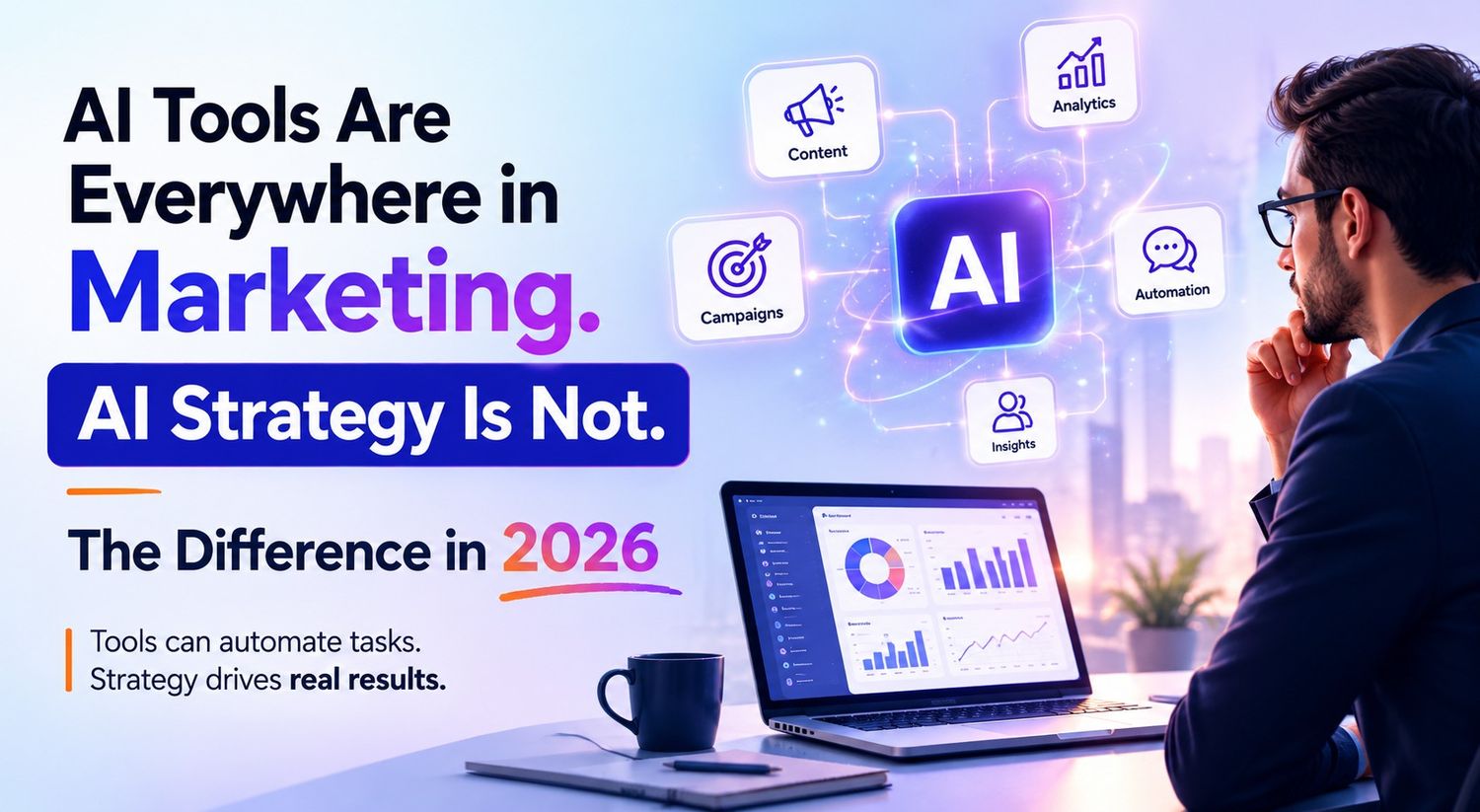
Walk into any marketing team in 2026, and you will find AI tools. Content tools, image generators, email assistants, ad optimizers, chatbots, SEO copilots, the average marketing stack now includes more AI-enabled features than it did entire platforms three years ago. Adoption is not the issue. According to the HubSpot 2026 State of Marketing report, 87% of marketers are now using AI in at least one workflow, up from 51% in 2024.
And yet, according to Gartner, the share of marketing leaders who can actually demonstrate positive ROI from their AI investment dropped from 49% to 41% in the same period. Adoption went up. Accountability went down. More tools, fewer proofs they are working.
This is the defining marketing challenge of 2026, and it has nothing to do with access to technology. It has everything to do with the difference between adopting AI tools and building an AI strategy. One is a procurement decision. The other is a business transformation. And the marketing teams pulling furthest ahead right now are those that understand, with complete clarity, which one they are actually doing.
What an AI Strategy Actually Looks Like
An AI strategy is not a list of tools. It is a deliberate architecture, one that connects the right AI capabilities to the right business objectives, measures performance against commercial outcomes, and improves continuously as data accumulates and systems learn.
The distinction sounds simple. In practice, it changes almost everything about how a marketing team operates. A team using AI tools produces content faster, automates a few repetitive tasks, and gets marginal efficiency gains across existing workflows. A team with an AI strategy redesigns its workflows around what AI enables, collapsing the distance between data and decision-making, personalizing at a previously impossible scale, and building systems that compound in value rather than simply accelerating the status quo.
32.82% of marketers report that AI tools are saving them 10 to 14 hours per week, according to HubSpot’s 2026 State of Marketing report, with 41.81% reporting a moderate increase in productivity. Those numbers reflect tool adoption. The teams in the top quartile of those figures are not just saving time; they are reinvesting it into the strategic work that AI cannot do: understanding customers, setting direction, making creative calls, and building the brand authority that no algorithm can manufacture.
That reinvestment is where strategy begins. And the platforms most capable of enabling it (in 2026) are HubSpot AI on the CRM and automation side, and Meta’s Advantage+ ecosystem on the paid media side. Together, they represent the most commercially significant AI marketing infrastructure available to most growing businesses.
HubSpot AI: When Your CRM Becomes an Intelligence Layer
The Breeze platform (launched at INBOUND 2024 and significantly expanded through 2025) represents something more significant than a set of productivity features. It is a fundamental redesign of how a CRM interacts with the humans using it and the data flowing through it.
The three pillars of Breeze tell that story clearly. Breeze Assistant is the conversational AI layer embedded across every Hub, the capability that allows a sales rep to ask a question about a contact’s engagement history and receive an instant, contextualized summary or allows a marketer to describe a campaign objective in plain language and have a workflow architecture suggested in return. Breeze Agents are the autonomous AI teammates: the Prospecting Agent that researches target accounts, identifies buying signals, and drafts personalized outreach; the Content Agent that generates campaign materials aligned to brand voice; and the Customer Agent that resolves support tickets without human intervention. HubSpot’s own support organization now resolves 35% of tickets through AI agents, with a target of 50%+ resolution rates, a proof of concept that the platform deploys on itself before selling to customers. Breeze Intelligence is the data enrichment layer, with access to 200 million+ company and contact profiles, it keeps CRM data accurate, complete, and actionable without manual data entry.
The commercial implication of HubSpot AI used strategically is not efficiency. It is velocity, the ability to run more experiments, serve more personalized experiences, and respond to buying signals faster than teams operating on manual processes can match. Content Hub, HubSpot’s AI-powered content product, saw its attachment rate surge from 13% to 54% during 2024 — a statistic that reflects not just feature adoption but genuine commercial demand for AI-powered content intelligence at the platform level.
The businesses extracting the highest returns from HubSpot AI are those that treat it as infrastructure, not as a feature. They configure data structures, lifecycle stages, and scoring models specifically to enable AI effectiveness. They train teams on prompt engineering and agent supervision. And they measure AI performance against pipeline contribution and revenue attribution, not against the number of emails drafted or the hours saved in isolation.
Generative AI Services: The Creative and Content Layer That Powers Everything Else
The most visible application of generative AI in marketing is content, and the most common mistake is treating generative AI services as a content production shortcut rather than a content strategy accelerator.
The distinction matters enormously. A tool-first approach produces more content of average quality faster. A strategy-first approach produces better-targeted content, more systematically, with human creativity applied where it creates the highest value, in strategic direction, brand voice, and the original insight that gives AI-generated content something genuinely worth saying.
The data on generative AI marketing services outcomes reflects this divide clearly. Companies using AI strategically in their marketing report a 22% higher ROI and 47% better click-through rates, according to All About AI’s 2026 research, but those figures represent deliberate deployment, not casual tool use. The 41% of marketing leaders who cannot demonstrate positive ROI from AI investment are, in most cases, using it as a production tool rather than a strategic one. They are generating more content. They are not generating better commercial outcomes.
The highest-leverage applications of generative AI marketing in 2026 are campaign intelligence (testing hundreds of creative variations rapidly to identify what resonates before committing significant budget) and personalization at scale, serving different messages to different audience segments based on behavioral and intent signals. McKinsey’s analysis consistently finds that personalization engines deliver 2.7x ROI, making segment-specific content strategy the single highest-returning application of generative AI in a commercial marketing context.
Meta AI: Where Paid Media Becomes Self-Optimising
If HubSpot AI represents the intelligence layer inside a business’s marketing system, Meta’s advertising platform represents the intelligence layer between that system and the audiences it is trying to reach. And in 2026, the gap between businesses using Meta’s AI capabilities strategically and those running campaigns the old way has become commercially significant.
Meta’s Advantage+ campaigns deliver 22% higher return on ad spend compared to manually managed campaigns, according to Meta’s own published figures. More than 4 million advertisers now use Meta’s generative AI tools, generating over 15 million AI-enhanced ads every month. The Generative Ads Recommendation Model (GEM), which runs automatically for every advertiser since Q2 2025, delivered a 5% increase in Instagram ad conversions and a 3% increase in Facebook Feed ad conversions in its initial rollout quarter. These are not marginal improvements; they are systematic performance gains that compound over time as the AI systems accumulate campaign data and sharpen their models.
The strategic implication for marketing teams is significant. As the platform’s AI handles targeting optimization, audience discovery, and bid management with increasing sophistication, the human competitive advantage shifts entirely to creative quality. The businesses winning on Meta in 2026 are those investing in the creative strategy and content excellence that give the AI system compelling material to work with, because the AI can optimize distribution, but it cannot manufacture the creative insight that makes an audience stop scrolling. Meta AI handles the science. Humans still have to supply the art.
The data feedback loop between a well-configured HubSpot AI system and Meta’s advertising intelligence is where the full strategic picture becomes visible. Audience intelligence from Meta campaigns informs HubSpot contact scoring and segmentation. CRM conversion data improves Meta’s lookalike and retargeting audience quality. The two systems, connected deliberately, produce compounding returns that neither delivers in isolation.
Closing the Gap Between Tools and Strategy
The 46-percentage-point gap between AI adoption at 87% and provable ROI at 41% does not close by adding more tools. It closes by doing three things that most marketing teams have not yet done systematically.
The first is defining what AI success looks like in commercial terms, not efficiency metrics but pipeline contribution, conversion rate improvement, and revenue attributed to AI-augmented campaigns. Only 19% of organizations currently track KPIs specific to their AI investment, according to McKinsey, meaning the majority are making budget decisions about their fastest-growing cost category without knowing whether it is working.
The second is connecting AI capabilities across the stack. HubSpot AI is driving CRM intelligence. Generative AI marketing services producing the creative and content strategy. Meta’s Advantage+ optimizing paid distribution. Each system is powerful in isolation. Connected deliberately, they become a compounding growth architecture, one where data from each layer improves the performance of every other.
The third is maintaining the human layer that no AI system replaces. Strategic direction. Brand judgment. Creative insight. Customer empathy. The marketing teams outperforming their budgets in 2026 are not those that handed the most to AI. They are those who used AI to do more of the right things, and stayed focused on the strategic work that only humans can do.
AI tools are everywhere. The businesses that turn them into a strategy are the ones worth watching.

 Shaik Yaseen
 ACSIUS Technologies Pvt Ltd