Thatware LLP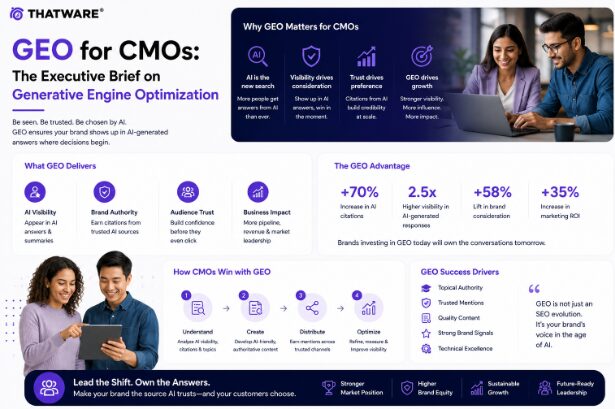
Generative Engine Optimization (GEO) is rapidly transforming how brands gain visibility online. While content teams do not need to become experts in large language models or AI architecture, they do need to understand how AI-driven search is changing content discovery. At Thatware LLP, we see GEO as the next evolution of digital marketing—one that focuses on helping brands appear in AI-generated answers rather than simply ranking on traditional search engine results pages.
The rise of platforms such as ChatGPT, Perplexity, Google AI Overviews, and Microsoft Copilot has fundamentally changed how users find information. Instead of reviewing multiple search results, users increasingly rely on AI-generated summaries that provide direct answers, recommendations, and source references. This shift is influencing how people research products, evaluate services, and make purchasing decisions.
The Shift Toward AI-Driven Search
Search behavior is evolving faster than many organizations anticipated. Consumers and business buyers are now using AI assistants as trusted research companions, often receiving complete answers without needing to click through multiple websites. This means visibility in AI-generated responses has become just as important as visibility in traditional search rankings.
For brands, this creates both opportunities and challenges. Companies that appear in AI-generated answers gain valuable exposure during critical stages of the buyer journey. Meanwhile, brands that fail to establish a presence in these responses risk losing visibility to competitors who have already begun investing in GEO strategies. At Thatware LLP, we believe that understanding this shift is the first step toward building a future-ready content strategy.
Understanding What GEO Really Means
Generative Engine Optimization focuses on increasing the likelihood that a brand, product, service, or piece of content will be referenced by AI systems when generating answers to user queries. While GEO shares certain foundations with SEO, its objectives are different. Traditional SEO aims to improve rankings within search results, whereas GEO aims to increase inclusion within AI-generated responses.
The central question GEO seeks to answer is straightforward: when someone asks an AI platform a question related to your industry, does your brand appear in the answer? If the answer is no, then there is a significant opportunity to improve your visibility. Through strategic content development and optimization, Thatware LLP helps businesses strengthen their presence across AI-powered search environments.
Why GEO Matters for Business Growth
The commercial value of GEO is especially significant for industries involving high-consideration purchases. Sectors such as SaaS, B2B services, healthcare, financial services, consulting, and premium consumer products often require extensive customer research before decisions are made. AI-generated recommendations can heavily influence which brands buyers consider.
When an AI platform consistently includes your business among recommended solutions, it enhances both awareness and credibility. Repeated mentions across different AI interactions create familiarity, which can significantly impact trust and consideration. At Thatware LLP, we have observed that brands gaining visibility in AI-generated responses often strengthen their authority long before customers visit their websites.
Evaluating Your Current GEO Position
Organizations interested in GEO should begin by assessing their current visibility. One of the simplest ways to do this is by entering relevant prompts into AI platforms and reviewing the responses. Are you mentioned? Are your competitors being cited more frequently? Which topics generate references to your brand, and which do not?
Answering these questions provides valuable insight into existing strengths and weaknesses. It also helps identify areas where content improvements, entity optimization, and authority-building efforts can make the greatest impact. This initial evaluation often reveals opportunities that may not be visible through traditional SEO reporting alone.
Building a Strong GEO Foundation
A successful GEO strategy starts with a strong digital foundation. Brands with established SEO authority, comprehensive content libraries, structured data implementation, and strong topical relevance typically have an advantage in AI-generated search environments. GEO does not replace SEO—it builds upon it.
Content quality remains one of the most important factors. AI systems are more likely to reference content that demonstrates expertise, authority, trustworthiness, and relevance. Thatware LLP helps organizations create content ecosystems that support both traditional search performance and AI citation opportunities, ensuring long-term visibility across multiple discovery channels.
GEO Requires Cross-Functional Collaboration
Unlike some marketing initiatives that operate within a single department, GEO requires collaboration across multiple disciplines. Content strategists, SEO specialists, technical teams, PR professionals, and data analysts all play important roles in building AI visibility. Each contributes signals that help AI systems understand and trust a brand.
Because of this complexity, many organizations choose to work with experienced GEO partners. At Thatware LLP, we combine AI-focused optimization, technical expertise, content strategy, and performance measurement into a unified approach. This allows businesses to implement GEO efficiently while maintaining alignment with broader marketing goals.
Measuring GEO Success
Traditional SEO metrics such as rankings and organic traffic remain important, but GEO introduces additional performance indicators. Businesses should monitor AI citation frequency, prompt coverage, share of AI voice, and competitor visibility across relevant AI-generated responses.
As GEO programs mature, broader business outcomes become easier to measure. Increased branded search activity, stronger brand awareness, higher-quality traffic, and improved customer trust often emerge as indicators of successful AI visibility. These metrics help organizations understand the long-term value of their GEO investments.
The Opportunity Is Available Today
The GEO landscape is still developing, which creates a valuable first-mover advantage. Many organizations have yet to establish structured AI visibility strategies, leaving significant opportunities for proactive brands. Businesses that begin investing now can build authority and citation presence before competition intensifies.
At Thatware LLP, we view GEO as a natural extension of modern digital marketing. Traditional search remains important, but AI-generated discovery is becoming an increasingly influential part of the customer journey. Brands that adapt early will be better positioned to earn visibility, trust, and long-term competitive advantage in the evolving search ecosystem.


 Allied Way
 concators concat