claire miller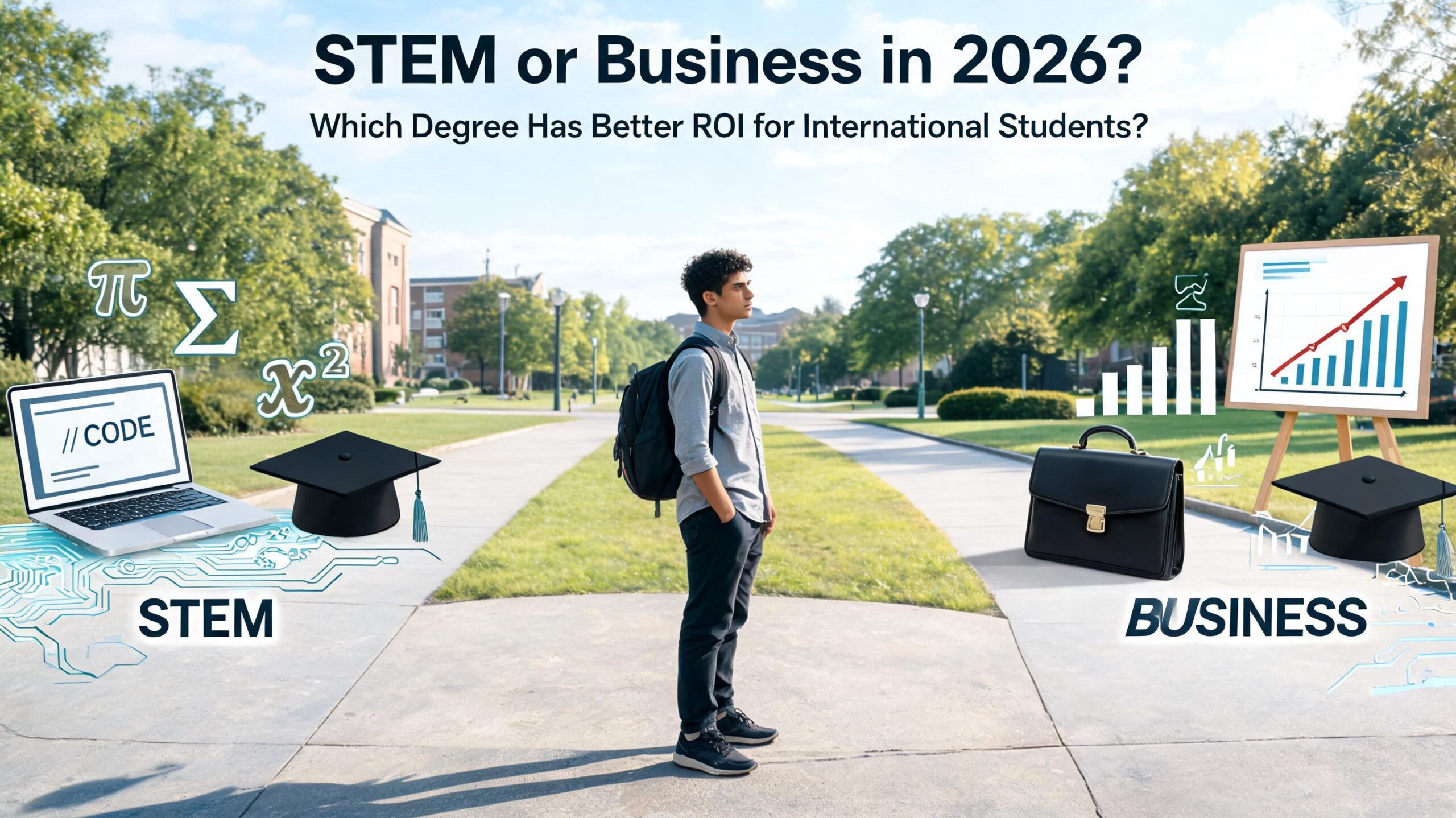
Choosing a degree in the United States has become a financial decision as much as an academic one. Tuition costs continue to rise, visa policies remain under close scrutiny, and international students are paying far more attention to return on investment than they did a few years ago. As a result, the debate around STEM vs business degree ROI has become one of the most important questions facing students heading to the U.S. in 2026.
What makes this decision different today is the way students approach it. Instead of relying on university marketing materials or education agents, many now compare salary data, job growth projections, visa rules, and employment outcomes before making a commitment. The goal is simple: maximize career opportunities while reducing financial and immigration risk.
Why STEM Degrees Continue to Lead on ROI
The strongest argument for STEM programs comes from a combination of salary potential and employment demand. According to labor market data cited in the research, STEM occupations offer median earnings that are significantly higher than many non-STEM professions.
Fields such as computer science, software engineering, cybersecurity, data science, and engineering continue to attract employers across the country. Demand remains strong because organizations in almost every industry now depend on technology, automation, and data-driven decision-making.
The difference can be compared to choosing between two investment portfolios. One offers steady growth with multiple opportunities to recover from setbacks. The other may still produce excellent returns, but it often requires more precise timing and fewer mistakes. For many international students, STEM represents the first option.
The enrollment trends tell a similar story. International students are increasingly choosing STEM-related disciplines, especially mathematics, computer science, and engineering. This shift reflects growing confidence that technical skills will remain valuable regardless of economic conditions.
The OPT Advantage Changes the Equation
Salary alone does not determine ROI. Work authorization opportunities after graduation often play an even bigger role.
Most international students on F-1 visas qualify for 12 months of Optional Practical Training (OPT) after completing their degree. However, graduates from STEM-designated programs may receive an additional 24-month extension. That creates a potential three-year work window in the United States.
This extra time matters. The H-1B visa process remains competitive, and having three chances to participate in the lottery instead of one can significantly improve long-term career prospects.
For many families investing tens of thousands of dollars in education, the ability to gain three years of U.S. work experience can dramatically improve the overall value of the degree. It also provides graduates with more time to build professional networks, strengthen their resumes, and secure higher-paying positions.
This visa advantage is one reason why STEM programs often outperform traditional business degrees when ROI is measured through a risk-adjusted lens.
Business Degrees Are Evolving Through Analytics
The story does not end with a simple STEM-versus-business comparison. A growing number of universities now offer STEM-designated business programs that combine management education with quantitative skills.
Business Analytics, Data Analytics, Management Information Systems, Quantitative Finance, and Financial Engineering have emerged as popular choices among international students. These programs blend business knowledge with statistics, programming, and data analysis.
As a result, graduates can access many of the same OPT benefits available to traditional STEM students while still developing business-focused expertise.
This hybrid model has become increasingly attractive because employers want professionals who can interpret data and make strategic decisions. Companies no longer separate technical and business skills as sharply as they once did.
Students pursuing these demanding quantitative courses often discover that performance in subjects such as statistics, econometrics, programming, and financial modeling has a direct impact on internships and future employment opportunities. To strengthen understanding in these challenging subjects, many students turn to platforms like Expertsmind.com that connect learners with online tutors and subject specialists who can help explain complex concepts and support academic success.
When a Business Degree Can Still Deliver Strong Returns
Business degrees should not be dismissed. High-performing institutions continue to produce graduates with exceptional career outcomes.
Top business schools maintain strong connections with employers in finance, consulting, entrepreneurship, and corporate leadership. Graduates from these programs often benefit from powerful alumni networks and access to competitive internships.
The research highlights that some business schools have generated remarkable long-term financial outcomes for graduates. In certain cases, graduates achieve earnings that rival or exceed those of many STEM professionals.
The difference is that success in business programs often depends more heavily on the reputation of the institution, networking opportunities, internship experience, and communication skills. STEM graduates frequently benefit from stronger market demand regardless of where they study, while business graduates may need additional advantages to reach similar outcomes.
This does not make business a poor choice. It simply means the pathway involves different risks and rewards.
The Rise of Fact-Checking Among International Students
One of the most interesting developments in 2026 is the rise of evidence-based decision-making among prospective students.
Students increasingly verify claims through official government sources, university employment reports, labor statistics, and international education datasets. They want proof before investing time and money into a degree.
This trend reflects broader concerns about immigration policy changes, economic uncertainty, and the growing cost of education. Families are treating higher education decisions much like major financial investments.
The most informed applicants now ask questions that previous generations rarely considered. Is the program STEM-designated? What is the average graduate salary? How many students secure employment within six months? What are the long-term visa implications?
These questions are helping students make smarter decisions and avoid choices based purely on reputation or marketing.
Which Degree Offers Better ROI in 2026?
For the average international student seeking long-term employment opportunities in the United States, STEM degrees generally provide the strongest return on investment.
Higher salaries, faster job growth, and access to up to three years of OPT create a combination that is difficult to ignore. STEM-designated business and analytics programs strengthen this advantage by blending technical and managerial skills.
Traditional business degrees can still produce outstanding outcomes, especially at top institutions with strong industry connections. Yet they often require faster career progression and greater reliance on networking and employer demand within a shorter OPT period.
The takeaway is straightforward. In 2026, students who can handle quantitative coursework and want to maximize career flexibility will usually find the best risk-adjusted ROI in STEM or STEM-designated business programs. The smartest applicants are no longer choosing degrees based on popularity alone. They are choosing based on evidence, and the numbers increasingly point in one direction.


 kiza lim
 james hat