S. Goel Bearing & Co
Every engineer and procurement manager has faced this question at some point – single row or double row?
It sounds like a simple choice. But pick the wrong one for your application and you will deal with the consequences – reduced rigidity, premature failure, unnecessary space consumption, or a machine that cannot handle the loads you are throwing at it.
The good news is that the decision is not complicated once you understand what each bearing is actually designed to do. This guide breaks down the single row vs double row angular contact ball bearing comparison in plain terms – covering design differences, load capabilities, application fit, and when each one is the right choice for your machine.
What Is a Single Row Angular Contact Ball Bearing?
A single row angular contact ball bearing has one row of balls positioned between the inner and outer rings at a contact angle – typically 15°, 25°, or 40°. This contact angle is what makes it different from a standard deep groove ball bearing. It allows the bearing to carry both radial loads and axial loads in one direction only.
Because axial load can only be supported in one direction, single row angular contact ball bearings are almost always used in paired arrangements – back-to-back (DB), face-to-face (DF), or tandem (DT) – to handle axial forces from both directions.
Key characteristics:
- Handles high axial loads in one direction only
- Must be paired for bidirectional axial support
- Suitable for high-speed, high-precision applications
- Offers greater design flexibility in arrangement
- Available in a wider range of contact angles for application-specific tuning
What Is a Double Row Angular Contact Ball Bearing?
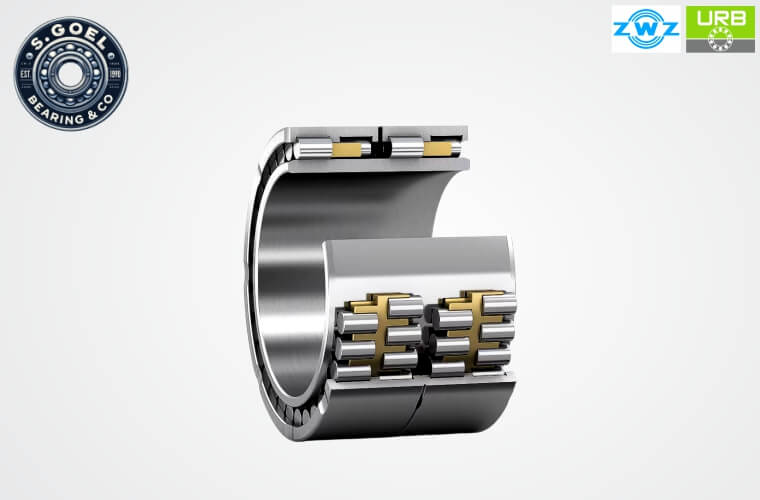
A double row angular contact ball bearing is essentially two single row angular contact bearings combined into a single unit – arranged back-to-back within one compact housing. The two rows of balls allow the bearing to handle axial loads in both directions simultaneously, without the need for a matched pair.
This design delivers greater rigidity, higher load capacity in a compact footprint, and simplified installation – all in one bearing unit.
Key characteristics:
- Handles axial loads in both directions within a single bearing
- Higher radial and axial load capacity than a single row
- More rigid – resists tilting moments effectively
- Compact – saves axial space compared to paired single row bearings
- Easier to install – no need to match and align a bearing pair
- Available in 5200 and 5300 series for different load and speed requirements
Head-to-Head Comparison
|
Feature |
Single Row Angular Contact |
Double Row Angular Contact Ball Bearing |
|
Axial Load Direction |
One direction only |
Both directions |
|
Radial Load Capacity |
Moderate |
Higher |
|
Rigidity |
Moderate (paired) |
High |
|
Installation |
Requires matched pairing |
Single unit – simpler |
|
Axial Space Required |
More (two bearings) |
Less (one compact unit) |
|
Speed Capability |
Higher |
Moderate to high |
|
Design Flexibility |
Greater |
Limited |
|
Best For |
Precision spindles, high speed |
Gearboxes, pumps, machine tools |
When to Choose a Single Row Angular Contact Ball Bearing
Single row angular contact ball bearings are the right choice when:
- Speed is the priority Single row designs run at higher speeds than double row equivalents of the same bore size. For machine tool spindles, grinding spindles, and high-speed precision applications, a matched pair of single row bearings in back-to-back arrangement delivers superior speed ratings and precision.
- You need fine control over preload and stiffness Paired single row bearings give engineers the ability to precisely control axial preload by adjusting the pair arrangement. This level of fine-tuning is not possible with a double row ball bearing and is critical in applications like CNC spindles and precision instruments.
- The application sees axial load predominantly in one direction In applications where axial force acts primarily in one direction – such as certain pump configurations or single-direction thrust – a single row bearing in a tandem arrangement may be more efficient.
When to Choose a Double Row Angular Contact Ball Bearing
A double row angular contact ball bearing is the correct choice when:
- You need axial support in both directions from one unit This is the primary advantage of the double row design. In applications like gearboxes, automotive transmissions, pumps, and compressors – where axial forces reverse direction during operation – a double angular contact bearing handles both directions without needing a matched pair.
- Space is limited but load requirements are high Two single row bearings in a paired arrangement require more axial space. A double row ball bearing delivers equivalent or higher load capacity in a significantly shorter axial envelope. This makes it the preferred choice for compact machine designs where housing length is restricted.
- Rigid axial guidance is required The double row arrangement provides inherently higher rigidity and resistance to tilting moments. Applications like machine tool spindle housings, industrial gearboxes, and conveyor drive units benefit significantly from this structural stiffness.
- Simplified installation matters Mounting a matched pair of single row angular contact bearings correctly – with the right preload and orientation – requires precision and experience. A double row angular ball bearing is a pre-configured single unit that eliminates this complexity, reduces assembly time, and lowers the risk of incorrect mounting.
Industry Applications at a Glance
Double row angular contact ball bearings are widely used across:
- Machine tool spindles – where compact design and rigidity are essential
- Industrial gearboxes – for bidirectional axial load handling under high torque
- Pumps and compressors – where axial forces reverse direction with pressure changes
- Automotive transmissions and differentials – compact, high-load environments
- Electric motors and generators – for combined radial and axial load support
- Textile and paper machinery – where high-speed continuous operation demands reliability
- Steel and metal processing equipment – for applications requiring rigid axial guidance
Single row designs remain preferred in ultra-high-speed grinding and turning spindles, and precision instrument applications where controllable preload is critical.
Series Guide: 5200 vs 5300
For double row angular contact ball bearings, two main series are commonly available:
|
Series |
Ball Size |
Load Focus |
Speed |
|
5200 Series |
Smaller, more balls |
Higher speed, lighter load |
Faster |
|
5300 Series |
Larger, fewer balls |
Heavier load |
Moderate |
Choose 5200 series for applications where speed and precision dominate. Choose 5300 series where maximum load capacity is the priority.
The Bottom Line
The choice between single row and double row angular contact ball bearing comes down to three questions:
- Do you need axial load support in both directions? → Double row.
- Is axial space limited but load requirement high? → Double row.
- Is ultra-high speed or fine preload control the priority? → Single row paired.
For the majority of industrial applications – gearboxes, pumps, machine tools, automotive systems, and general industrial machinery – the double row angular ball bearing delivers the combination of compact design, bidirectional axial capacity, and installation simplicity that a matched pair of single row bearings cannot match in a single unit.
Understanding your load type, speed requirement, and available space will always lead you to the right answer.

 neil mastang