Frozen Baked Goods Market to Reach USD 57.7 Billion by 2035

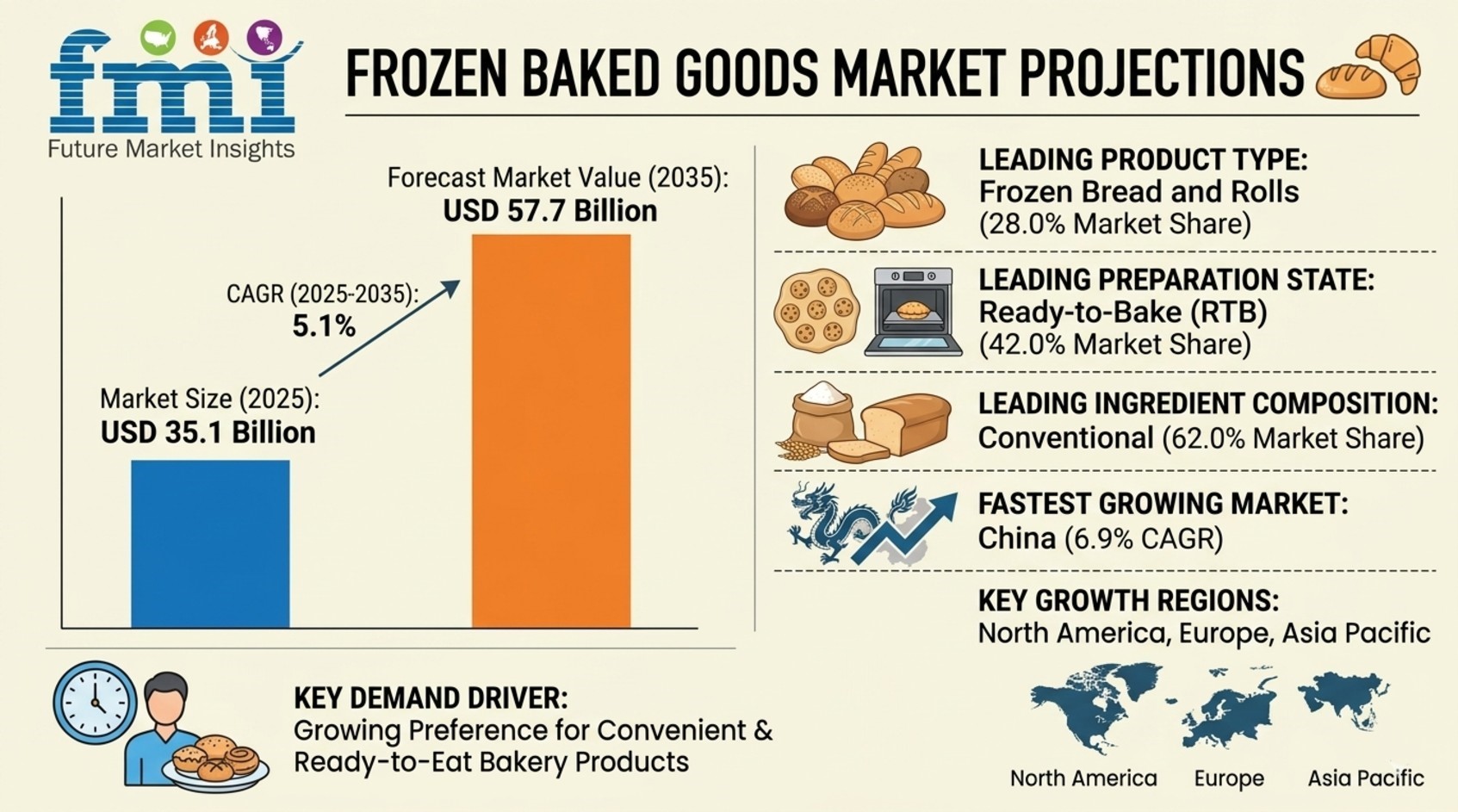
The global Frozen Baked Goods Market is poised for sustained growth, according to latest insights by Future Market Insights. The market is estimated to be valued at USD 35.1 billion in 2025 and is projected to reach USD 57.7 billion by 2035, registering a CAGR of 5.1% during the forecast period. Growth is being fueled by increasing consumer demand for convenient bakery products, expanding foodservice operations, rapid urbanization, and continuous advancements in freezing and storage technologies that preserve freshness, texture, and flavor.

Key Frozen Baked Goods Market Projections

  • Market Size (2025): USD 35.1 Billion
    • Forecast Market Value (2035): USD 57.7 Billion
    • CAGR (2025-2035): 5.1%
    • Leading Product Type: Frozen Bread and Rolls (28.0% Market Share)
    • Leading Preparation State: Ready-to-Bake (RTB) (42.0% Market Share)
    • Leading Ingredient Composition: Conventional Frozen Baked Goods (62.0% Market Share)
    • Fastest Growing Market: China (6.9% CAGR)
    • Key Growth Regions: North America, Europe, and Asia Pacific
    • Key Demand Driver: Growing Preference for Convenient and Ready-to-Eat Bakery Products

Request a Sample Report: https://www.futuremarketinsights.com/reports/sample/rep-gb-24683 

Strategic Market Insights

The frozen baked goods industry continues to gain momentum as consumers increasingly seek bakery products that combine convenience, consistency, and longer shelf life. Frozen bread, pastries, cakes, cookies, pizza bases, and savory baked products have become essential offerings across retail shelves, supermarkets, hypermarkets, and foodservice establishments.

The growing pace of urban lifestyles, changing eating habits, and rising demand for quick meal solutions are encouraging consumers to adopt frozen bakery products as practical alternatives to freshly baked items. Advances in freezing technology have significantly improved product quality, allowing manufacturers to preserve taste, aroma, texture, and nutritional value while extending shelf life.

Foodservice operators, including cafés, bakeries, quick-service restaurants, and institutional kitchens, continue to rely on frozen bakery products to improve operational efficiency, reduce waste, and ensure product consistency. This trend is expected to remain a key contributor to market expansion throughout the forecast period.

Analyst Perspective

“Frozen baked goods have evolved from a convenience-focused category into a mainstream bakery solution supported by innovation, premiumization, and changing consumer lifestyles. Companies that invest in product quality, cold-chain efficiency, clean-label formulations, and differentiated offerings will be well positioned to capture future growth opportunities across retail and foodservice channels,” said Nandini Roy Choudhury, FMI.

Competitive Landscape and Market Share Analysis

The frozen baked goods market remains highly competitive, with multinational food manufacturers and specialized bakery companies competing across product innovation, quality consistency, distribution reach, and operational efficiency.

Manufacturers are increasingly focusing on premium bakery offerings, healthier formulations, gluten-free variants, vegan products, and clean-label ingredients to cater to evolving consumer preferences. Investments in cold-chain infrastructure, packaging innovation, and foodservice partnerships continue to shape competitive dynamics across global markets.

Leading Market Participants Include:

  • Grupo Bimbo
    • General Mills (Pillsbury)
    • Conagra Brands
    • Vandemoortele
    • Europastry
    • Kellanova
    • Flowers Foods
    • Aryzta
    • Rich Products Corporation
    • Regional and Private-Label Manufacturers

Competition is increasingly centered on product differentiation, frozen dough innovations, premium bakery experiences, and efficient supply chain management.

Production vs. Consumption Economy Analysis

North America and Europe continue to represent mature production and consumption hubs due to well-established bakery industries, advanced cold-chain logistics, and strong retail penetration.

Asia Pacific is emerging as the fastest-growing region, supported by rapid urbanization, rising disposable incomes, and increasing acceptance of Western-style bakery products. China and India are witnessing substantial investments in frozen food infrastructure, creating favorable conditions for long-term market expansion.

Developed markets continue to drive demand through premium bakery offerings, while emerging economies present opportunities through rising convenience food consumption and retail modernization.

Supply Chain and Value Chain Insights

The frozen baked goods value chain encompasses ingredient sourcing, dough preparation, baking, freezing, packaging, cold storage, distribution, and retail or foodservice delivery.

Manufacturers are increasingly optimizing cold-chain logistics to ensure product integrity throughout transportation and storage. Strategic partnerships between producers, distributors, retailers, and foodservice operators continue to strengthen supply chain resilience and market accessibility.

Advanced freezing technologies and sustainable packaging solutions are becoming essential components of modern frozen bakery operations, supporting product quality and environmental objectives.

Strategic Procurement Analysis

Procurement strategies across the frozen baked goods industry increasingly emphasize product consistency, supply reliability, ingredient quality, and cost efficiency.

Foodservice operators and retailers are prioritizing suppliers capable of delivering customized bakery solutions, stable inventory management, and flexible production capabilities. Sustainability credentials, clean-label ingredients, and packaging innovations are also becoming important factors influencing purchasing decisions.

Manufacturers capable of maintaining product quality while controlling operational costs are expected to gain competitive advantages in procurement-driven markets.


Country Opportunity Assessment

China is projected to remain the fastest-growing frozen baked goods market, expanding at a CAGR of 6.9% through 2035. Growth is supported by urbanization, expanding foodservice networks, increasing demand for Western-style bakery products, and improvements in cold-chain infrastructure.

India is expected to register a CAGR of 6.4%, driven by rapid growth in cafés, quick-service restaurants, organized retail, and changing consumer eating habits. Rising disposable incomes and increasing demand for convenient bakery products continue to strengthen market opportunities.

France remains a key European market, benefiting from its strong bakery culture and increasing demand for premium frozen pastries, croissants, and artisan bakery products.

The United Kingdom and the United States continue to demonstrate stable growth, supported by consumer demand for convenience, premium bakery experiences, and health-oriented product innovations.

Technology and Innovation Outlook

Key innovations shaping the frozen baked goods industry include:

  • Advanced freezing technologies
    • Enhanced frozen dough formulations
    • Ready-to-bake product innovations
    • Clean-label bakery ingredients
    • Gluten-free and vegan product development
    • Sustainable packaging solutions
    • Smart cold-chain monitoring systems
    • Premium artisan frozen bakery offerings

Manufacturers continue investing in research and development to improve freshness retention, product quality, and operational efficiency while addressing changing consumer preferences.

Future Industry Outlook

The Frozen Baked Goods Market is expected to benefit from increasing demand for convenience foods, expansion of foodservice operations, growth in organized retail, and advancements in freezing technologies. While cold-chain costs and competition from fresh bakery products remain challenges, strong consumer acceptance and ongoing product innovation are expected to support sustainable long-term growth.

Companies capable of combining product innovation, premium quality, supply chain excellence, and customer-focused strategies will be best positioned to capitalize on emerging opportunities through 2035.

Exclusive Discounts on Full Report: https://www.futuremarketinsights.com/reports/frozen-baked-goods-market


Explore More Related Studies Published by FMI Research:


Canned Foods Market : https://www.openpr.com/news/4511802/canned-foods-market-moves-beyond-shelf-stable-convenience-why


Explore In-Depth Food and Beverage Market Insights:
https://www.futuremarketinsights.com/industry-analysis/food-and-beverage


About Future Market Insights (FMI)


Future Market Insights, Inc. (FMI) is an ESOMAR-certified, ISO 9001:2015 market research and consulting organization trusted by global enterprises and Fortune 500 companies. FMI delivers actionable market intelligence, competitive benchmarking, and strategic insights across more than 30 industries and 1,200 markets worldwide.


Contact Us:

Future Market Insights Inc.
Christiana Corporate, 200 Continental Drive,
Suite 401, Newark, Delaware – 19713, USA

T: +1-347-918-3531

For Sales Enquiries: sales@futuremarketinsights.com

Website: https://www.futuremarketinsights.com

Related Posts

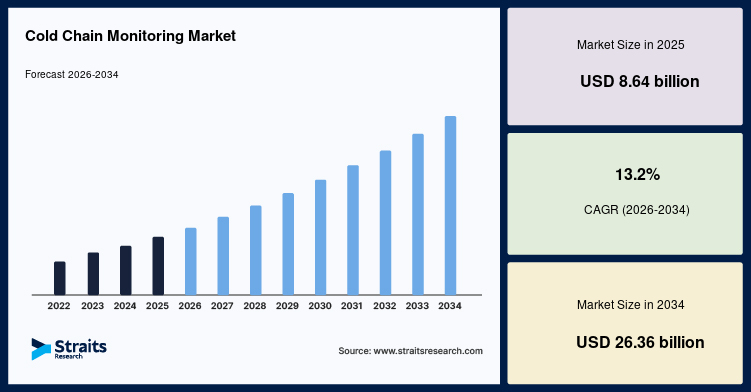
Cold Chain Monitoring Market Gains Momentum with Increasing Vaccine DistributionSupply Chain Reliability Becomes a Business Imperative As global supply chains become increasingly complex, maintaining product quality throughout transportation and storage has emerged as a critical challenge across industries. Cold chain monitoring solutions are playing a pivotal role in ensuring that temperature-sensitive products remain within required environmental conditions from production to final delivery. Industries such as pharmaceuticals, biotechnology, food and beverages, chemicals, and healthcare rely heavily on cold chain infrastructure to preserve product integrity and comply with regulatory standards. Any deviation in temperature conditions can result in product spoilage, financial losses, and regulatory penalties. The global cold chain monitoring market was valued at USD 8.64 billion in 2025 and is projected to grow from USD 9.78 billion in 2026 to USD 26.36 billion by 2034, registering a CAGR of 13.2% during the forecast period (2026–2034). The growing demand for real-time monitoring, increasing pharmaceutical distribution activities, and advancements in IoT-enabled tracking technologies are expected to fuel market expansion over the coming years. Pharmaceutical Industry Emerges as a Major Growth Engine The rapid growth of biologics, vaccines, specialty medicines, and temperature-sensitive pharmaceutical products has significantly increased the importance of cold chain monitoring systems. Pharmaceutical manufacturers and logistics providers must maintain strict temperature controls throughout transportation and storage to ensure product efficacy and patient safety. The increasing global distribution of vaccines and biologic therapies is creating substantial demand for advanced monitoring solutions. Regulatory agencies are also enforcing stringent compliance requirements, encouraging organizations to adopt real-time tracking and monitoring technologies. Real-Time Visibility Transforms Cold Chain Operations Internet of Things (IoT) Integration IoT-enabled sensors are providing continuous monitoring of temperature, humidity, location, and environmental conditions across the supply chain. These technologies enable organizations to identify potential issues before product quality is compromised. Cloud-Based Monitoring Platforms Cloud connectivity allows stakeholders to access real-time shipment data from anywhere, improving visibility and decision-making throughout logistics operations. Automated Alerts and Notifications Modern monitoring systems automatically notify operators when environmental conditions exceed acceptable thresholds, reducing the risk of spoilage and product loss. For Detailed Insights, Visit: https://straitsresearch.com/report/cold-chain-monitoring-market Food Industry Expands Demand for Monitoring Solutions Consumer demand for fresh foods, frozen products, dairy items, seafood, and processed foods is increasing the need for reliable cold chain infrastructure. Food manufacturers and retailers are investing in advanced monitoring technologies to maintain product freshness, comply with food safety regulations, and reduce waste throughout the supply chain. As e-commerce grocery services continue to expand, temperature-controlled logistics are becoming increasingly important for maintaining customer satisfaction and product quality. Emerging Technologies Reshape Market Dynamics Artificial Intelligence and Predictive Analytics AI-powered platforms are helping organizations predict equipment failures, identify operational inefficiencies, and optimize cold chain performance. Blockchain for Supply Chain Transparency Blockchain technology is gaining attention as a tool for enhancing traceability, improving transparency, and ensuring data integrity throughout cold chain operations. GPS-Enabled Asset Tracking Advanced location-tracking systems are enabling businesses to monitor shipments in real time and improve logistical planning. Wireless Monitoring Solutions Wireless sensors are simplifying deployment and reducing infrastructure requirements across warehouses, transportation fleets, and distribution centers. Challenges Affecting Industry Growth High Implementation Costs Advanced monitoring systems often require significant investments in hardware, software, and connectivity infrastructure. Connectivity Limitations Remote transportation routes and developing regions may experience connectivity challenges that affect real-time data transmission. Data Management Complexity Organizations must effectively manage and analyze large volumes of monitoring data generated across complex supply chains. Regulatory Compliance Requirements Businesses operating in pharmaceutical and food sectors must navigate evolving regulations related to product safety, storage conditions, and transportation standards. Regional Market Performance North America continues to lead the cold chain monitoring market due to its advanced logistics infrastructure, strong pharmaceutical industry presence, and widespread adoption of digital monitoring technologies. Europe remains a major market supported by strict regulatory standards, growing food safety initiatives, and increasing investments in smart supply chain solutions. Asia-Pacific is expected to witness the fastest growth throughout the forecast period. Expanding pharmaceutical manufacturing, rising food exports, increasing healthcare investments, and rapid industrialization are driving demand for cold chain monitoring technologies across the region. Latin America and the Middle East & Africa are also strengthening cold chain capabilities to support healthcare modernization and food security initiatives. Future Outlook The future of the cold chain monitoring market will be shaped by digital transformation, automation, and increasing demand for supply chain transparency. Businesses are increasingly recognizing the importance of real-time monitoring solutions in protecting product quality and minimizing operational risks. Advancements in IoT, artificial intelligence, cloud computing, and predictive analytics are expected to enhance monitoring capabilities and improve supply chain efficiency. As global trade in temperature-sensitive products continues to expand, cold chain monitoring technologies will remain essential to modern logistics operations. Organizations that prioritize visibility, compliance, and technological innovation are expected to gain a competitive advantage in this rapidly evolving market. Competitive Landscape The cold chain monitoring market remains highly competitive, with leading companies focusing on technology innovation, IoT integration, cloud-based solutions, and strategic partnerships. Major companies operating in the market include: Sensitech Inc. Emerson Electric Co. Honeywell International Inc. Berlinger & Co. AG Controlant Monnit Corporation ORBCOMM Inc. Zebra Technologies Corporation ELPRO-BUCHS AG NXP Semiconductors N.V. These companies continue to invest in intelligent monitoring platforms, sensor technologies, and data analytics solutions to strengthen their market positions. Related Insights Cold Chain Logistics Market https://straitsresearch.com/report/cold-chain-logistics-market IoT in Logistics Market https://straitsresearch.com/report/iot-in-logistics-market About Us Straits Research is a leading market intelligence and consulting organization specializing in industry analysis, business forecasting, and strategic research solutions. The company delivers actionable insights that help organizations identify growth opportunities and make informed business decisions. Contact Us Email: sales@straitsresearch.com Tel: +1 646 905 0080 (U.S.) Tel: +44 203 695 0070 (U.K.)

Temperature-sensitive pharmaceuticals, such as vaccines and items that require temperature ranges for chemical stability, are becoming more popular. On the International Institute of Refrigeration, the demand for heat-sensitive health items such as medications, vaccines, insulin, and derived blood products grows every year (IIR). Because of the possibility of unexpected environmental changes, the cold chain transit of these medications is the most critical in this regard.

Corporate Event Management Companies: Driving Successful Business Events with Expertise

In today’s fast-evolving corporate world, businesses understand the importance of creating meaningful experiences for employees, clients, stakeholders, and partners. Corporate events have become an essential part of business strategy, helping…

Leave a Reply

Your email address will not be published. Required fields are marked *

You Missed

How Can CAD Drafting Outsourcing Help Reduce Operational Costs?

How Can CAD Drafting Outsourcing Help Reduce Operational Costs?

Composite Manufacturing in Aerospace Engineering: Benefits, Applications & Challenges

Composite Manufacturing in Aerospace Engineering: Benefits, Applications & Challenges

Discover Holistic Wellness Through Ayurveda Yoga Training in Rishikesh

Discover Holistic Wellness Through Ayurveda Yoga Training in Rishikesh

Sustainable Housing Developments Create Demand for Insulated Concrete Forms

Sustainable Housing Developments Create Demand for Insulated Concrete Forms

What Makes a Turkey Dentist Stand Out for UK Patients?

What Makes a Turkey Dentist Stand Out for UK Patients?

Exploring GHK-Cu 50mg in Wound Healing and Regenerative Studies

Exploring GHK-Cu 50mg in Wound Healing and Regenerative Studies