Amo Yadav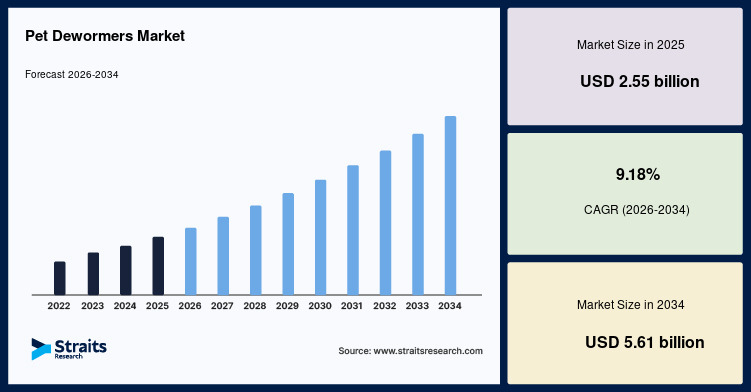
 Pet Dewormers Market
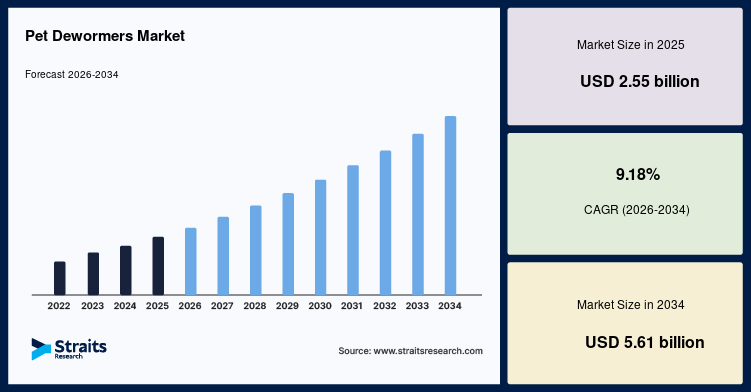
The global pet dewormers market is poised for sustained growth as companion animal healthcare continues to evolve toward preventive and lifecycle-based wellness management. According to recent market analysis, the global pet dewormers market was valued at USD 2.55 billion in 2025 and is expected to increase from USD 2.78 billion in 2026 to USD 5.61 billion by 2034, registering a compound annual growth rate (CAGR) of 9.18% during the forecast period (2026–2034).
Market expansion is being driven by increasing integration of routine parasite prevention into companion animal wellness plans, growing veterinary prescription programs, and broader availability of regulatory-approved combination anthelmintic products. Rising awareness among pet owners regarding zoonotic disease risks and the importance of preventive veterinary care is also contributing to steady demand for deworming therapies across developed and emerging markets.
Market Overview
Pet dewormers comprise veterinary pharmaceutical products formulated to prevent and treat internal parasitic infections in companion and leisure animals. These products are designed to eliminate gastrointestinal parasites, including roundworms, hookworms, tapeworms, and whipworms, across a wide range of animal species such as dogs, cats, horses, and other companion animals.
Available through oral, injectable, and topical administration routes, pet dewormers are marketed in multiple dosage forms, including tablets, suspensions, chewables, and spot-on formulations. Products are distributed through veterinary hospitals and clinics, retail pet stores, and increasingly through authorized e-commerce platforms.
Growing incorporation of deworming protocols into preventive healthcare programs is transforming market dynamics, with veterinary practitioners emphasizing routine parasite control as a core component of companion animal wellness strategies.
Growth Drivers
A major factor supporting market growth is the ongoing expansion of companion animal parasite prevention portfolios by leading animal health companies. Manufacturers continue to introduce formulation enhancements, broaden product indications, and expand geographical availability to address evolving veterinary requirements.
Regulatory approvals and labeling expansions for combination parasiticides are enabling broader intestinal parasite coverage for dogs and cats, strengthening prescription-driven demand through veterinary channels. These developments align with preventive healthcare models that encourage regular parasite screening and continuous treatment schedules.
Increasing pet ownership worldwide, coupled with rising expenditure on veterinary services and preventive animal healthcare, is further contributing to sustained market growth.
Emerging Trends
One of the most notable trends shaping the industry is the transition from single-molecule dewormers toward combination-spectrum parasite control products. Veterinary prescribing patterns increasingly favor formulations that simultaneously target multiple intestinal parasites within a single dosing regimen.
Combination products containing active ingredients such as praziquantel, milbemycin, and pyrantel are gaining wider acceptance due to their ability to simplify treatment protocols and reduce dosing frequency while improving compliance among pet owners.
Another significant trend is the shift from symptom-driven deworming practices to preventive lifecycle parasite management. Veterinary authorities and professional organizations are increasingly recommending age-specific and lifestyle-based deworming schedules beginning during early stages of animal development. This preventive approach is supporting recurring demand and strengthening long-term market prospects.
Market Challenges
Despite favorable market conditions, regulatory complexity remains a key challenge for industry participants. Veterinary anthelmintic products are subject to extensive regulatory review processes covering safety, efficacy, environmental impact, toxicology, and pharmacokinetic performance.
Obtaining approvals for new active ingredients, dosage forms, or expanded indications often requires substantial clinical evidence and post-market surveillance commitments. These requirements may extend product development timelines and increase compliance costs, particularly for combination therapies and innovative delivery systems.
Additionally, maintaining regulatory alignment across multiple geographic regions can create operational challenges for manufacturers seeking global commercialization opportunities.
Market Opportunities
The development of region-specific parasite control solutions represents a significant opportunity for market participants. Parasite prevalence patterns vary considerably depending on climate conditions, geography, and pet lifestyle factors, creating demand for targeted products tailored to local exposure risks.
Manufacturers that incorporate regional parasite surveillance data into formulation strategies, dosing recommendations, and product positioning are expected to benefit from expanding adoption across urban and semi-urban pet populations. The growing availability of government and academic parasite surveillance information is further supporting this trend.
Increasing digitalization of veterinary services and expansion of authorized online veterinary pharmacies also present new opportunities for market growth, particularly in emerging economies experiencing rapid pet healthcare formalization.
Regional Insights
North America accounted for the largest share of the global pet dewormers market, representing 38.23% of total revenue in 2025. The region’s leadership is supported by well-established companion animal healthcare systems, high veterinary prescription adherence, and structured parasite prevention frameworks.
In the United States, market growth continues to be reinforced by regulatory oversight, robust veterinary infrastructure, and widespread adoption of preventive wellness programs. The U.S. market was valued at USD 810.81 million in 2024 and reached USD 881.76 million in 2025, reflecting strong demand for prescription and combination deworming therapies.
Meanwhile, Asia Pacific is projected to register the fastest growth, advancing at a CAGR of 11.18% during the forecast period. Rising pet ownership, expanding veterinary healthcare infrastructure, and increasing regulatory standardization are supporting regional market expansion. Countries such as China, India, and several Southeast Asian nations are witnessing increasing adoption of companion animal preventive healthcare services, creating favorable growth conditions.
Europe continues to represent a significant market, benefiting from harmonized veterinary medicinal regulations, advanced pharmacovigilance systems, and growing emphasis on zoonotic disease prevention. Latin America and the Middle East and Africa are also experiencing steady growth as companion animal ownership rises and veterinary distribution networks continue to expand.
Segment Analysis
Based on pet type, the dogs segment dominated the global market, accounting for 46.66% of total revenue in 2025. The segment’s leadership is largely attributed to established canine parasite prevention protocols and widespread veterinary recommendations for routine deworming.
Among administration routes, the oral segment held the largest market share at 33.45% in 2025, supported by the popularity of chewable tablets, flavored suspensions, and broad-spectrum combination formulations designed for improved compliance.
From a dosage form perspective, the solid segment accounted for 49.25% of market revenue in 2025, reflecting advantages related to dosage accuracy, storage stability, and ease of transportation.
By product type, the over-the-counter (OTC) segment is anticipated to register the fastest growth, expanding at a CAGR of 10.88% throughout the forecast period. Increased availability of approved single-ingredient products through licensed retail and online channels is expected to support segment expansion.
Regarding distribution channels, veterinary hospitals and clinics represented the leading segment, capturing 43.46% of total market revenue in 2025 due to their central role in diagnosis, prescription, and treatment management.
Competitive Landscape
The global pet dewormers market is moderately consolidated, with several multinational animal health companies accounting for a significant share of commercial sales. Market participants continue to focus on portfolio diversification, formulation innovation, geographic expansion, and regulatory approvals to strengthen their competitive positions.
Leading companies operating in the market include Zoetis, Boehringer Ingelheim, Merck & Co., Inc., Elanco Animal Health, Dechra Pharmaceuticals PLC, Virbac, Vetoquinol, Ceva Santé Animale, Intas Pharmaceuticals Ltd., Norbrook Laboratories, Phibro Animal Health Corporation, Jurox Pty Ltd., Huvepharma, Sogeval, and Hester Biosciences Limited.
Recent industry developments highlight continued innovation in broad-spectrum parasite protection, with manufacturers introducing advanced formulations that provide comprehensive coverage against intestinal worms and other parasitic threats in companion animals.
Click to Read the Complete Insights & Report https://straitsresearch.com/report/pet-dewormers-market
About Straits Research
Straits Research is a global market research and consulting organization that provides comprehensive market intelligence, industry analysis, and strategic insights across a broad range of sectors. Through extensive primary and secondary research methodologies, the company delivers actionable business intelligence, competitive assessments, market forecasts, and trend analysis to support informed decision-making for organizations worldwide.


 The Grande Reception & Function Centre
 Multiplex Kitchens