Patricia Smith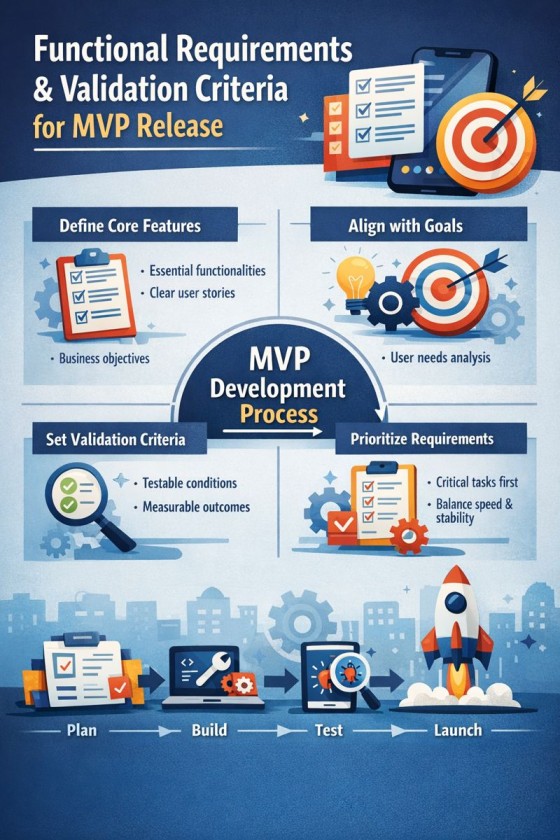
The success of any minimum viable product depends on how clearly its functional expectations are defined and validated before release. Organizations often underestimate the discipline required to translate ideas into structured requirements that can be tested objectively. When working with an MVP App Development Company, product teams must align strategy, scope, and execution to reduce uncertainty and accelerate learning. This article explains how functional requirements and validation criteria should be designed, documented, and assessed to ensure that an MVP delivers measurable value while remaining adaptable.
Defining Functional Requirements for a Viable MVP Release Standards
Functional requirements describe what a product must do to meet user and business expectations at a fundamental level. For an MVP, these requirements should focus only on essential capabilities rather than complete feature parity with mature products. The goal is not perfection, but controlled experimentation supported by clarity.
Well-defined functional requirements share several characteristics:
- They describe observable system behavior rather than technical implementation.
- They are written in clear, unambiguous language.
- They can be verified through testing or inspection.
- They directly support a specific user or business objective.
For MVP initiatives, functional requirements often span user authentication, core workflows, data handling, and basic system responses. Excessive detail at this stage introduces risk by increasing development effort without validated demand. Instead, teams should concentrate on the smallest set of behaviors that allow users to complete a primary task end to end.
By maintaining this discipline, product teams create a foundation that supports rapid validation, controlled iteration, and informed decision making during early releases.
Aligning MVP Scope With Business Goals and User Needs Effectively
Scope alignment is critical because MVPs exist to test assumptions, not to satisfy every stakeholder preference. Functional requirements must therefore be derived from clearly stated goals and prioritized user problems. Misalignment at this stage often leads to feature overload or inconclusive results after launch.
Effective alignment begins with answering three questions:
- What business hypothesis is this MVP intended to validate?
- Which user problem is most critical to test right now?
- What minimum functionality is required to observe meaningful behavior?
When these questions are answered collaboratively, functional requirements can be mapped directly to outcomes such as engagement, task completion, or retention. This approach also supports informed conversations about MVP app development cost, as scope decisions are tied to validation value rather than assumptions about completeness.
Teams that invest time in alignment reduce rework, simplify prioritization, and ensure that early metrics provide actionable insight rather than ambiguous signals.
Documenting Core Features Using Clear and Testable Logic Statements
Documentation quality significantly influences how accurately functional requirements are implemented and validated. For MVPs, documentation should be lightweight but precise, favoring clarity over exhaustive detail.
Effective functional requirement documentation typically includes:
- A brief description of the feature or behavior.
- Preconditions that must be met before execution.
- Expected system responses under normal conditions.
- Defined error or exception handling scenarios.
Using structured formats such as user stories or use case statements helps ensure consistency. Each requirement should be testable without interpretation, allowing quality assurance activities to proceed without reliance on informal explanations.
Documentation also serves as a shared reference point between product, design, development, and testing teams. By maintaining a single source of truth, organizations reduce the risk of misalignment and ensure that validation criteria remain consistent throughout the MVP lifecycle.
Prioritizing Functional Requirements for Speed and Stability
Prioritization is not simply about ranking features by perceived importance. In the context of an MVP, it involves balancing speed of delivery with system stability and learning value. Functional requirements should be prioritized based on their contribution to hypothesis validation and their dependency relationships.
A practical prioritization framework often considers:
- Criticality to core user flow.
- Technical risk or uncertainty.
- Dependency on external systems or data.
- Impact on overall user experience.
High priority requirements should enable users to complete the primary task without interruption. Lower priority items can be deferred if they do not materially affect validation outcomes. This approach allows teams to deliver quickly while maintaining sufficient reliability to collect trustworthy data.
Clear prioritization also supports more effective collaboration with an MVP App Development Company by setting realistic expectations around scope, timelines, and acceptable trade-offs.
Establishing Validation Criteria to Measure MVP Readiness Objectively
Validation criteria define how teams determine whether functional requirements have been met and whether the MVP is ready for release. Without explicit criteria, assessments become subjective and inconsistent.
Strong validation criteria share the following traits:
- They are directly traceable to functional requirements.
- They define measurable pass or fail conditions.
- They can be evaluated through testing or observation.
- They are agreed upon before development begins.
Examples include successful task completion within defined parameters, correct system responses under specified conditions, or accurate data persistence across sessions. These criteria provide a factual basis for release decisions and help teams distinguish between acceptable limitations and critical defects.
Objective validation reduces release risk and ensures that early user feedback is based on a stable and intentional product experience.
Testing Methods That Support Functional and User Acceptance Outcomes
Testing for MVPs must balance rigor with efficiency. The objective is not exhaustive coverage, but sufficient confidence that core functionality behaves as expected. Testing methods should therefore align closely with validation criteria and intended learning goals.
Commonly applied testing approaches include:
- Functional testing to verify requirement compliance.
- Scenario-based testing to simulate real user workflows.
- Basic performance checks under expected load.
- User acceptance testing focused on usability and clarity.
These methods help identify issues that could invalidate test results or undermine user trust. Testing also provides early insight into whether supporting systems and processes are adequate for broader experimentation.
When testing is structured around functional requirements rather than assumptions, teams gain clearer visibility into what works, what fails, and why.
Managing Constraints Around Timeline Budget and Technical Risk
Every MVP operates within constraints that influence how functional requirements are defined and validated. Timelines are often aggressive, budgets are finite, and technical uncertainty is unavoidable. Managing these constraints requires deliberate trade-offs rather than reactive decisions.
Effective constraint management includes:
- Identifying high-risk requirements early.
- Sequencing work to address uncertainty first.
- Adjusting scope in response to validated learning.
- Maintaining transparency across stakeholders.
By acknowledging constraints explicitly, teams can make informed decisions that protect the integrity of the MVP. This disciplined approach also ensures that mobile app development solutions are evaluated based on suitability for early-stage validation rather than long-term optimization.
Constraint-aware planning enables organizations to move quickly without sacrificing the reliability of their insights.
Preparing Stakeholders for Feedback Driven Iteration Cycles Planning
An MVP is not an endpoint but a mechanism for structured learning. Stakeholders must therefore understand that functional requirements and validation criteria will evolve based on feedback and data. Preparing for this reality reduces resistance to change and supports continuous improvement.
Key preparation activities include:
- Setting expectations around iteration frequency.
- Defining decision thresholds for pivot or persevere outcomes.
- Establishing feedback channels and review processes.
- Documenting learnings alongside validation results.
When stakeholders are aligned on the purpose and process of iteration, functional requirements become living artifacts rather than fixed commitments. This mindset supports adaptability while preserving accountability and clarity.
Conclusion
Clear functional requirements and objective validation criteria are essential to the success of any MVP release. By focusing on alignment, prioritization, disciplined documentation, and structured testing, teams can reduce uncertainty and make evidence-based decisions. A thoughtful approach ensures that early releases generate reliable insights, support iterative improvement, and establish a strong foundation for future development.


 Peter parker
 shop fashionly