John Thomas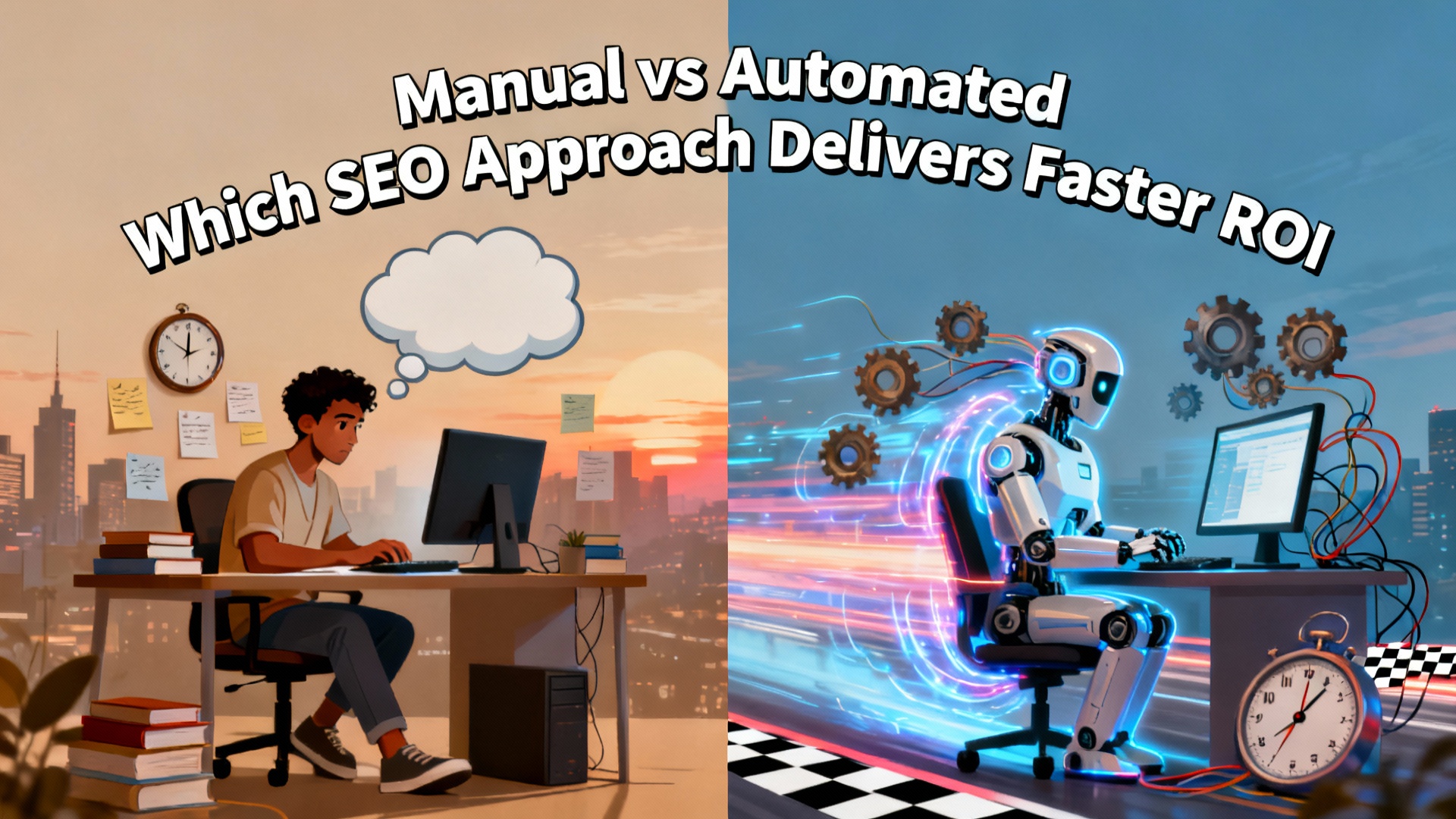
Every business owner wants to see a return on their investment immediately. You pour money into marketing, and you expect revenue to follow. Search Engine Optimization (SEO) notoriously tests this patience. It takes time to build authority and climb the rankings. However, the modern digital landscape offers two distinct paths to reach the top: the traditional manual approach and the modern automated approach. Each method promises success, but they operate on vastly different timelines and budget structures. Choosing the right path determines how quickly you see a profit. This guide dissects both strategies to reveal which one truly delivers a faster Return on Investment (ROI) for your business.
Understanding the Core Differences
To determine the winner, you must first understand the fighters. Manual SEO relies on human intuition, creativity, and hands-on execution. A specialist analyzes your website, crafts content, and builds relationships with other site owners for backlinks. This process prioritizes quality and nuance. Humans understand context, humor, and emotional triggers in ways that machines currently cannot.
Automated SEO, on the other hand, utilizes software and algorithms to execute tasks at scale. Tools crawl websites, identify technical errors, generate content drafts, and even build links programmatically. This approach prioritizes speed and volume. Automation handles data processing that would take a human team weeks to complete. It identifies patterns instantly. However, it often lacks the subtle touch required for high-stakes brand messaging. The debate centers on whether the speed of automation outweighs the precision of manual effort.
The Case for Manual SEO: Precision and Safety
Manual SEO offers a distinct advantage: safety and long-term stability. When a human writes your content, they ensure it aligns perfectly with your brand voice. They fact-check information rigorously. They structure arguments to persuade a human reader, not just a search engine bot. This high level of quality creates a better user experience. Visitors stay on your site longer because the content resonates with them.
Furthermore, manual link building builds genuine relationships. A human outreach specialist contacts a blogger, compliments their work, and suggests a collaboration. This results in high-quality backlinks from reputable sites. Search engines like Google highly value these authentic signals. You minimize the risk of penalties when you strictly follow manual guidelines. You build a fortress that algorithm updates rarely penetrate. While the initial progress feels slow, the results often stick for years. The ROI comes later, but it arrives with a lower risk of sudden collapse.
The Speed of Automated SEO
Automation crushes manual processes when it comes to speed. If you need to audit a 10,000-page e-commerce website, a human team needs weeks. An automated SEO tool finishes the job in hours. It scans every URL, identifies broken links, flags missing meta tags, and generates a report instantly. You fix technical issues immediately. This rapid turnaround allows search engines to index your corrected site faster.
Content generation also sees a massive speed boost with automation. AI tools produce dozens of blog post drafts in the time it takes a human to write one outline. For businesses that need to target thousands of location-specific keywords, automation serves as the only viable option. You flood the market with content. You cover every possible search query. This volume creates a wide net that catches traffic quickly. In scenarios where “being present” matters more than “being perfect,” automation delivers the fastest initial results.
The Hidden Costs of Automation
While automation offers speed, it often brings hidden costs that hurt ROI. Automated content frequently lacks depth. It repeats information and misses cultural nuances. If users land on your page and find generic, robotic text, they leave immediately. High bounce rates signal to Google that your site lacks value. You might rank quickly, but you drop just as fast.
Automated link building poses an even greater danger. Tools that spam forums or blog comments with links trigger spam filters. Search engines penalize sites that engage in these practices. A penalty removes your site from search results entirely. Recovering from a penalty costs thousands of dollars and months of lost revenue. Therefore, a “cheap” and “fast” automated strategy often becomes the most expensive mistake a business makes. You must factor the cost of cleanup and reputation management into the ROI calculation for purely automated approaches.
Analyzing ROI: The Short Term vs. The Long Term
ROI calculations differ based on your time horizon. In the first three months, automated SEO often looks superior. You see a spike in pages indexed. You see technical errors vanish. You might even see a jump in traffic for long-tail keywords. The cost of software remains lower than the salary of a full-time specialist. On a spreadsheet, the automated approach wins the first quarter.
However, the manual approach dominates the annual outlook. High-quality, human-created content attracts natural backlinks. Other websites reference your work because it provides unique value. You do not need to pay for these links. Your conversion rates improve because persuasive copywriting turns visitors into buyers. A manual strategy builds a brand, not just a traffic source. Over 12 months, the revenue generated from high-converting, manual SEO typically surpasses the volume-based traffic of automated SEO. The manual approach builds an asset that appreciates in value, whereas automated efforts often require constant maintenance to prevent decay.
The Hybrid Model: The Ultimate Solution
Smart businesses rarely choose just one path. They combine the strengths of both. This hybrid model uses automation for data analysis and technical tasks while reserving human effort for strategy and creative execution. You use tools to find keyword opportunities and technical glitches. You let software handle the repetitive reporting. This approach frees up your human talent to focus on what matters most: creating compelling content and building real relationships.
In this model, automation supports the human, rather than replacing them. You get the speed of machine analysis with the safety of human oversight. You scale your operations without sacrificing quality. This balance delivers the most consistent and reliable ROI. You move faster than a purely manual team, but you avoid the quality pitfalls of a purely automated one.
Why You Need to Hire AI SEO Expert Teams
Implementing a hybrid strategy requires a specific type of leadership. You cannot simply buy software and hope for the best. You need professionals who understand how to control these powerful tools. This is why you must hire AI SEO expert consultants who bridge the gap between technology and strategy.
When you hire AI SEO expert teams, you gain access to specialists who know exactly which tasks to automate and which to keep manual. They know how to prompt AI to generate useful outlines. They know how to review automated reports to find the false positives. They use AI to accelerate their workflow, not to dodge the work. These experts deliver the speed of automation with the strategic safety of manual execution. They essentially turbocharge the traditional SEO process. This specific investment often yields the highest ROI because you pay for efficiency. You get the output of a large team with the overhead of a small, tech-savvy unit.
The Role of Strategy in ROI
Tools and tactics mean nothing without a coherent strategy. Whether you use manual or automated methods, you need a plan. You must target the right audience. You must understand your competitors. A fast car drives you off a cliff just as quickly as it drives you to the finish line if you lack a map.
Manual SEO forces you to strategize because every action costs time. You choose your battles carefully. Automated SEO often encourages a “spray and pray” mentality. You optimize for everything because it is easy. This dilutes your focus. To maximize ROI, you must apply the strategic discipline of manual SEO to the power of automated tools. You define clear goals. You identify the most profitable keywords. Then, and only then, do you deploy your resources.
Content Quality as a Conversion Driver
Traffic involves only half the battle. You need conversions to generate revenue. Manual SEO inherently focuses on conversion. A copywriter crafts headlines to grab attention. They write calls to action that compel the user to buy. They use storytelling to build emotional connections.
Automated content rarely converts well. It informs, but it does not persuade. It lists facts, but it does not solve problems with empathy. If you use automation to drive 10,000 visitors to your site, but the robotic content fails to convert them, your ROI is zero. If manual SEO drives 1,000 visitors, but the persuasive writing converts 5% of them, you make money. Therefore, for pages that directly drive sales—like service pages and product descriptions—manual execution always delivers a superior financial return.
Watch Now: – Boost Your Rankings with AI SEO Experts
Technical SEO: The Playground of Automation
Technical SEO represents the one area where automation indisputably wins on ROI. Search engines evaluate sites based on hundreds of technical factors: site speed, mobile usability, schema markup, and crawlability. Identifying these issues manually takes forever. Human eyes miss small code errors.
Automated tools crawl a site continuously. They alert you the moment a server error occurs. They identify images that lack alt text instantly. Investing in automated technical SEO provides an immediate return. You protect your rankings from technical failures. You ensure the foundation of your site remains solid. For this specific aspect of SEO, manual work is inefficient and wastefully expensive. Automation delivers value from day one.
Link Building: The Human Advantage
Link building remains the most difficult part of SEO. It requires convincing another human to vouch for your content. Automated tools try to shortcut this with mass emails and spammy submissions. These tactics rarely work in the modern era. Webmasters ignore generic emails. They delete spam comments.
Manual outreach yields results. You research the target site. You write a personalized email. You offer value. One high-quality link from a major industry publication outweighs 100 low-quality links from automated directories. The ROI of manual link building takes time to materialize, but it provides the authority that fuels your entire domain. You cannot automate genuine human connection. Therefore, allocate your manual budget heavily toward link building and relationship management.
Adaptation to Algorithm Updates
Google updates its algorithm thousands of times a year. These updates aim to reward high-quality, helpful content. Automated strategies often rely on loopholes or patterns that these updates target. When an update hits, automated sites often crash. Their traffic evaporates overnight.
Manual strategies align with Google’s goal. They prioritize the user. When Google updates its algorithm to favor better content, manual sites often see a boost. They do not need to pivot. They do not need to rebuild. Their strategy remains future-proof. This stability protects your ROI. You do not waste money fixing a site that an algorithm destroyed. You continue to build upon a stable foundation.
Conclusion
The battle between manual and automated SEO does not produce a single winner for every scenario. Automated SEO delivers faster initial visibility and excels at technical tasks. It offers a quick ROI for large-scale, low-complexity projects. However, it carries significant risks and often fails to convert traffic into revenue. Manual SEO builds a stronger brand, converts better, and creates a sustainable asset that withstands algorithm changes. It delivers a higher, safer ROI over the long term.
For the modern business, the smartest choice involves integration. You utilize automation to handle data, technical monitoring, and initial research. You deploy human expertise for strategy, content creation, and relationship building. To execute this flawless balance, you must seek the right talent. When you actively choose to combine these forces, specifically when you hire AI SEO expert teams to manage the blend, you secure the best of both worlds. You achieve the speed necessary to compete and the quality necessary to win. This balanced approach guarantees that your marketing investment drives real, measurable business growth.


 get pleasure
 thecube vanman