Jack Cannan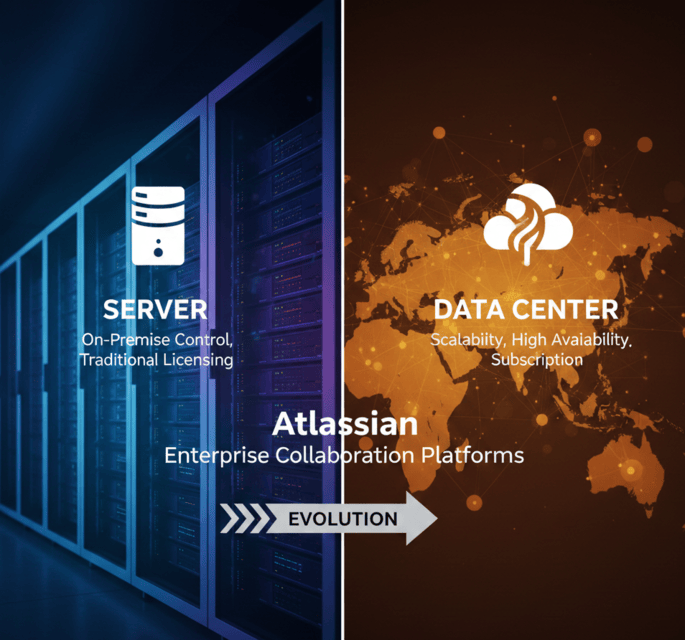
Introduction
As organizations scale their digital collaboration tools, choosing the right deployment model becomes a critical decision. Atlassian products such as Jira, Confluence, and Bitbucket are widely used by teams to manage projects, documentation, and software development workflows. One of the most common questions enterprises face is understanding the difference between atlassian server vs data center and determining which option best fits their operational needs.
Both deployment models were designed to support on-premise environments, yet they serve different business sizes, performance requirements, and scalability expectations. Understanding these differences helps organizations make informed decisions that support growth, reliability, and long-term efficiency.
Understanding Atlassian Server vs Data Center Deployment Models
The comparison of atlassian server vs data center starts with how each model is designed to operate. Atlassian Server is a single-node deployment model that runs on one application server. It is suitable for small to mid-sized teams with predictable workloads and limited scaling requirements.
Atlassian Data Center, on the other hand, is built for high availability and scalability. It supports multi-node clustering, allowing multiple application instances to run simultaneously behind a load balancer. This architecture ensures uninterrupted access, even during maintenance or unexpected traffic spikes, making Data Center ideal for large enterprises and mission-critical environments.
Performance and Scalability Considerations
Performance is a key factor when evaluating atlassian server vs data center. Atlassian Server performs well for teams with modest user counts and stable usage patterns. However, as the number of users increases, performance bottlenecks may emerge due to the limitations of a single node.
Atlassian Data Center addresses these challenges by distributing workloads across multiple nodes. This results in faster response times, improved concurrency, and better handling of large volumes of users and data. Organizations experiencing rapid growth or seasonal traffic spikes often prefer Data Center to ensure consistent performance.
High Availability and Reliability
One of the most significant differences in atlassian server vs data center lies in system availability. Atlassian Server has a single point of failure, meaning downtime can occur during maintenance or unexpected outages.
Atlassian Data Center is designed for continuous availability. With active-active clustering, if one node fails, others continue to operate without service disruption. This level of reliability is essential for enterprises that rely heavily on Atlassian tools for daily operations, global collaboration, and continuous delivery pipelines.
User Management and Enterprise Features
When comparing atlassian server vs data center, enterprise features play a major role. Atlassian Data Center includes advanced user management, improved permission controls, and enhanced auditing capabilities. These features help organizations meet internal governance standards and compliance requirements.
Data Center also supports integration with enterprise authentication systems and provides better control over user access at scale. For organizations with complex team structures and strict security policies, Data Center offers greater flexibility and administrative control.
Maintenance and Upgrade Experience
Maintenance is another important factor in the atlassian server vs data center discussion. Atlassian Server requires scheduled downtime for upgrades and system maintenance, which can impact productivity for global teams operating across time zones.
Atlassian Data Center supports rolling upgrades, allowing administrators to update nodes one at a time without interrupting user access. This capability significantly reduces downtime and ensures continuous system availability, making it a preferred choice for organizations that cannot afford service interruptions.
Cost and Infrastructure Investment
Cost considerations often influence decisions around atlassian server vs data center. Atlassian Server typically has lower upfront licensing and infrastructure costs, making it appealing to smaller organizations with limited budgets.
Atlassian Data Center involves higher licensing fees and infrastructure investment due to its clustered architecture. However, the additional cost is often justified by improved performance, scalability, and reduced downtime. For enterprises, the long-term value of stability and reliability often outweighs the initial investment.
Security and Compliance Requirements
Security is a growing concern for organizations managing sensitive data. In the comparison of atlassian server vs data center, Data Center offers stronger security capabilities tailored for enterprise environments. These include enhanced encryption options, improved audit logs, and better support for compliance frameworks.
Organizations operating in regulated industries often prefer Data Center because it aligns more closely with corporate security standards and compliance mandates. This makes it a strategic choice for businesses prioritizing risk management and data protection.
Choosing the Right Option for Your Organization
Selecting between atlassian server vs data center depends on business size, growth plans, and operational priorities. Smaller teams with stable workloads may find Atlassian Server sufficient for their needs.
Enterprises with large user bases, global teams, and high availability requirements typically benefit more from Atlassian Data Center. Evaluating current usage patterns and future scalability needs is essential before making a decision.
Conclusion
The choice between atlassian server vs data center is not just a technical decision but a strategic one. Atlassian Server offers simplicity and cost efficiency for smaller teams, while Atlassian Data Center delivers scalability, reliability, and enterprise-grade features for large organizations.
By understanding the differences and aligning them with business objectives, organizations can select the right Atlassian deployment model to support collaboration, productivity, and long-term growth.

 Daniel Jack
 Harjai Talent