Archdraw Outsourcing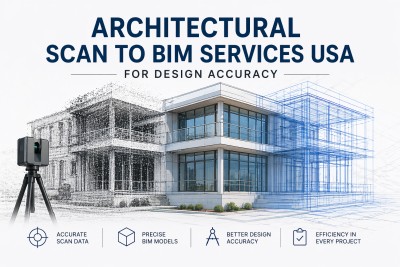
Renovating an existing building used to involve outdated blueprints, tape measures, and a significant amount of guesswork. Architects and engineers frequently encountered unexpected structural elements hidden behind walls, leading to costly delays and design revisions.
Modern construction demands a much higher level of precision. Scanning physical spaces and converting them into digital models has fundamentally changed how professionals approach retrofits, renovations, and facility management. This method captures the exact as-built conditions of a site, providing a flawless foundation for any design project.
Firms across the country are rapidly adopting architectural scan to bim services usa to eliminate the guesswork from their workflows. By partnering with experts like Archdraw Outsourcing, architectural teams can guarantee that every measurement is accurate to the millimeter. This accuracy saves time, reduces material waste, and ensures that complex designs fit perfectly within existing spaces.
The advantages of Scan to BIM for US projects
Capturing the exact physical dimensions of a building offers immediate benefits for design accuracy and overall project efficiency. Architects working on historic renovations or complex commercial retrofits rely on these accurate models to prevent clashes between new designs and existing structures.
Having a precise 3D model allows project managers to estimate material costs with incredible accuracy. It also minimizes the need for personnel to repeatedly visit a dangerous or hard-to-reach site. Teams can measure ceiling heights, structural column placements, and MEP (Mechanical, Electrical, and Plumbing) layouts directly from their computer screens.
Key stages of the Scan to BIM process
Transforming a physical building into a highly detailed 3D digital model requires a systematic approach. The process generally falls into three main phases.
Data acquisition
Trained technicians visit the physical site equipped with high-tech laser scanners. These devices emit light pulses that bounce off surfaces and return to the scanner. The scanner records the distance and angle of each return, capturing millions of data points in a matter of minutes. This collection of data points forms a dense, accurate representation of the space.
Point cloud processing
Once the data is collected, it must be stitched together. A single scan only captures what the scanner can see from one position. Technicians take multiple scans from various angles and rooms, and then use specialized software to merge these individual scans into one comprehensive “point cloud.” This point cloud is a complete digital replica of the building’s geometry.
BIM modeling
The final step requires skilled modelers to import the point cloud into building information modeling software. Modelers trace over the point cloud to create intelligent 3D elements like walls, windows, doors, and pipes. This transforms raw data into a functional, data-rich model that architects can use for planning and design.
Technologies driving the industry forward
The success of the scanning process relies heavily on advanced hardware and software. High-definition 3D laser scanners from brands like Leica, Trimble, and Faro are the industry standard for field data collection. These scanners can capture data accurately up to a fraction of an inch, even over long distances.
On the software side, Autodesk ReCap is frequently used to register and process the raw point cloud data. Once the point cloud is ready, Autodesk Revit remains the primary platform for creating the final architectural model. These tools work seamlessly together to ensure no detail is lost during the translation from physical space to digital file.
Real-world success in American architecture
The application of scanning technology has proven invaluable across various sectors in the United States. Consider the renovation of historic buildings in cities like New York or Boston. Original blueprints for these century-old structures are often lost or wildly inaccurate due to decades of unrecorded modifications. By utilizing architectural scan to bim services usa, design teams can capture the exact curvature of historic facades and the specific placement of load-bearing walls without causing any damage to the property.
In the commercial sector, large retail chains frequently use scanning to update their layouts. When retrofitting a massive warehouse in Chicago, engineers used point cloud data to perfectly align a new, automated conveyor system with the building’s existing structural supports. This prevented weeks of potential delays that would have occurred if they had relied on outdated 2D drawings.
Enhancing collaboration and minimizing errors
A major advantage of creating a data-rich 3D model is how it unites different teams. Architects, structural engineers, and MEP contractors can all work within the same digital environment.
This shared workspace allows teams to run clash detection software before any construction begins. If an architect designs a new hallway that intersects with an existing HVAC duct, the software highlights the error immediately. Fixing a problem on a computer screen costs almost nothing, whereas fixing that same problem on a construction site can cost thousands of dollars and derail a project schedule.
What the future holds for digital modeling
The technology behind digital scanning and modeling continues to evolve at a rapid pace. We are already seeing drones equipped with LiDAR scanners taking flight to capture the exterior data of massive skyscrapers and sprawling industrial complexes. This keeps human workers safely on the ground while capturing data that was previously impossible to reach.
Artificial intelligence is also making its way into the modeling phase. Software developers are training algorithms to automatically recognize common building elements within a point cloud. In the near future, AI might automatically convert a cluster of data points into a standardized Revit door or window family, drastically speeding up the modeling process.
Start building with absolute certainty
Relying on outdated blueprints is a risk modern architectural firms can no longer afford to take. Capturing the precise reality of a site ensures that your designs are rooted in fact, not assumptions. Implementing these advanced scanning and modeling techniques empowers your team to design with confidence, collaborate seamlessly, and deliver projects on time and under budget.
If you are ready to eliminate costly errors from your next renovation or retrofit, consider reaching out to the experts at Archdraw Outsourcing to explore how precise digital modeling can elevate your design process.


 Rashid Farah
 Alisa Jimmy