Sahu
Sahu
Artificial Intelligence (AI) has moved from a futuristic concept to a practical technology that shapes our everyday lives. From voice assistants and smart recommendations to self-driving cars and intelligent business tools, AI is now a fundamental part of modern innovation.
If you want to build a strong base in AI—whether you are a student, professional, or entrepreneur—understanding its foundation is the first and most important step.
This guide will walk you through AI fundamentals in simple language, helping you understand how AI works, why it matters, and how you can build a career in this field. By the end, you will have a clear path to start your AI journey in 2026 and beyond.
What Is Artificial Intelligence?
Artificial Intelligence refers to machines or computer systems that can perform tasks that normally require human intelligence. These tasks include learning, reasoning, problem-solving, understanding language, and making decisions.
AI is not magic. It is a combination of mathematics, statistics, programming, and data.
At its core, AI learns from patterns. If you give a system enough examples, it can find relationships, understand trends, and make predictions.
Why AI Matters in 2026
The year 2026 will be a turning point for AI. Many industries are undergoing rapid digital transformation, and AI plays a major role in this shift.
Here are a few reasons why AI matters today more than ever:
- Businesses rely on data-driven decisions. AI helps companies make faster and better choices.
- Automation is increasing efficiency. From chatbots to automated workflows, AI reduces human effort.
- AI improves customer experience. Smart recommendations, personalized offers, and instant responses are powered by AI.
- AI creates new job roles. Instead of replacing jobs, AI is creating new opportunities in development, analytics, strategy, and ethics.
If you understand the foundation of AI, you can unlock opportunities in almost any sector—technology, healthcare, finance, retail, manufacturing, or education.
The Core Pillars of AI
To build a strong base in AI, you need to understand its main components. These pillars form the foundation of modern AI systems.
1. Machine Learning (ML)
Machine Learning is a key part of AI where computers learn from data instead of being manually programmed.
There are three main types:
- Supervised Learning: The system learns from labeled examples.
- Unsupervised Learning: The system discovers patterns without labels.
- Reinforcement Learning: The system learns by trial and error to get rewards.
Most AI applications today, like prediction systems or recommendation engines, use machine learning.
2. Deep Learning
Deep learning is a more advanced form of machine learning. It uses neural networks—structures inspired by the human brain.
Deep learning works extremely well for:
- Image recognition
- Speech and audio processing
- Natural language processing
- Autonomous vehicles
This technology powers systems like facial recognition, voice assistants, and real-time translation tools.
3. Natural Language Processing (NLP)
Natural Language Processing helps computers understand, interpret, and respond to human language.
Examples include:
- Chatbots
- Email spam detection
- Text summarization
- Sentiment analysis
- Voice assistants
With NLP, machines can read text, listen to speech, and communicate in a more human-like way.
4. Computer Vision
Computer Vision allows machines to understand images and videos. It is used in:
- Medical image analysis
- Self-driving cars
- Security surveillance
- Product inspection in factories
By detecting patterns in visual data, AI can identify objects, recognize faces, and even understand gestures.
5. Robotics and Automation
AI-powered robots can perform tasks with precision and efficiency. Manufacturing units, warehouses, and hospitals now use robots for:
- Repetitive activities
- Packaging
- Delivery
- Surgical assistance
Robotics combined with AI is one of the fastest-growing fields.
6. Data Science and Big Data
AI needs data to learn. Data science provides the tools and methods needed to collect, clean, and analyze this data.
Big data allows systems to process millions of records, helping AI improve its accuracy and performance.
How AI Works: A Simple Explanation
AI works in a series of steps:
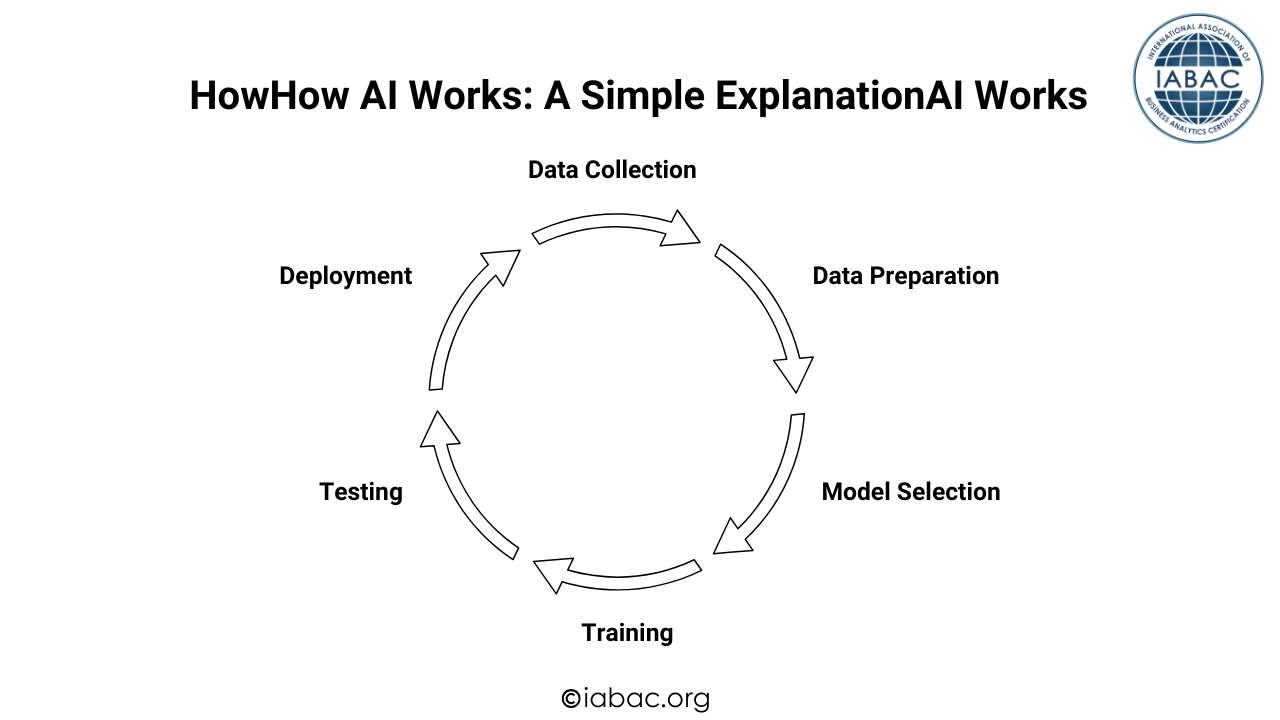
- Data Collection: AI collects information from sources like images, text, sensors, or databases.
- Data Preparation: The data is cleaned and organized for analysis.
- Model Selection: A suitable algorithm is chosen to train the AI system.
- Training: The system learns patterns from data.
- Testing: The model’s accuracy is evaluated.
- Deployment: The trained model is used in real applications.
- Continuous Improvement: The system updates and improves as more data becomes available.
You do not need advanced math to start learning AI. Many tools and platforms simplify these steps for beginners.
Applications of AI in Real Life
AI is already everywhere around us. Here are some simple examples:
- Smart assistants like Siri, Alexa, and Google Assistant
- Personalized recommendations on Netflix, YouTube, or Amazon
- AI-powered cameras in smartphones
- Medical diagnosis tools that detect diseases early
- Navigation apps that suggest the best route
- Fraud detection systems used in banking
Each of these uses AI to process large amounts of data and generate helpful responses or predictions.
Who Can Learn Artificial Intelligence?
AI is open to everyone. You do not need to be a computer scientist.
People from the following backgrounds commonly learn AI:
- Students
- Working professionals
- Engineers
- Managers
- Entrepreneurs
- Business owners
As long as you have curiosity and basic computer skills, you can start building a strong foundation in AI.
Skills You Need to Start Your AI Journey
You do not need to master everything at once. Begin with the basics:
- Basic programming (Python is the most common)
- Understanding of data (data types, spreadsheets, simple statistics)
- Logical thinking and problem-solving
- Comfort with tools like Jupyter Notebook or Google Colab
As you advance, you can explore deep learning, data engineering, cloud AI, or MLOps.
Career Paths in AI
AI opens the door to many exciting careers. Here are some popular roles:
- AI Engineer
- Machine Learning Engineer
- Data Scientist
- NLP Engineer
- Computer Vision Specialist
- AI Product Manager
- Business Analyst (AI & Data)
- AI Consultant
- Automation Engineer
Companies in every industry are hiring AI professionals, making it one of the most promising career options for 2026.
How to Build a Strong AI Foundation in 2026
To build a solid foundation, follow a structured learning plan:
- Start with basic concepts of AI and machine learning.
- Learn Python programming and essential libraries like NumPy and Pandas.
- Understand data handling and simple statistical methods.
- Study supervised and unsupervised learning techniques.
- Build simple projects such as spam detection or image classification.
- Practice regularly on platforms like Kaggle.
- Earn a certification to validate your knowledge.
A strong foundation will make it easier to specialize in advanced areas later.
Recommended Certification: IABAC AI Foundation
If you want to validate your AI basics with a globally recognized certification, the IABAC AI Foundation Certification is an excellent choice.
Here’s why it’s worth considering:
- It covers essential AI concepts in a simple and practical way.
- It is recognized internationally across industries.
- It helps beginners and professionals build credibility.
- It supports career growth and professional development.
- It aligns well with real-world industry expectations.
Completing this certification will strengthen your understanding and help you take your next step confidently—whether it’s advanced AI learning or applying for roles in the AI field.
Artificial Intelligence is transforming the way the world operates. Whether you aim to upgrade your skills, explore new career opportunities, or start an AI-powered business, building a strong foundation is the most important step.
With clear concepts, simple learning resources, and practical projects, you can begin your AI journey confidently. Certifications like the IABAC AI Foundation can give you an added advantage as you move forward.
2026 is a perfect time to build your AI skills—start learning today and become part of the future.


 doctors guardian
 simba khan