Sahu
Sahu
Balancing a demanding job and the desire to Learn Data Science can feel overwhelming, especially when you see others growing quickly. Many working professionals want to switch to analytics or strengthen their technical skills, but long working hours, irregular study habits, and a lack of clear direction usually slow them down. The good news is that learning this field doesn’t require quitting your job or spending endless hours studying. With the right plan, you can steadily build strong skills and progress faster than you think.
This guide walks through a structured, realistic, and efficient approach to Learn Data Science while maintaining a full-time job. It highlights what to study, how to manage your time, how to avoid common slowdowns, and why certifications and projects matter. By the end, you’ll have a clear path you can start following immediately.
Why Working Professionals Struggle to Learn Data Science
Before understanding the fastest approach, it helps to know the challenges most people face:
- Difficulty finding consistent time to study
- Feeling lost without a guided learning path
- Jumping between multiple resources without clarity
- Choosing the wrong topics first
- Lack of confidence when seeing others progress faster
- Not knowing how to build projects that matter to employers
These challenges can make learning feel slow, even when putting in effort. That’s why the key is to shape a learning strategy around your work schedule, not the other way around.
Build the Right Mindset Before You Begin
If you want to Learn Data Science quickly alongside your job, mindset matters as much as skill. Here are a few principles that help professionals learn faster:
- Small, steady learning beats long, irregular study sessions.
- You don’t need advanced math at the start. Begin with basics.
- Projects matter more than perfectly learning theory.
- Practice builds confidence; no one masters everything immediately.
Keeping these points in mind creates a realistic and practical approach even when work becomes busy.
Step 1: Identify What You Actually Need to Learn
Data Science is a broad field, but not everything needs to be studied at once. If you want to progress quickly, focus on the essential, job-orientated skills first.
Key Topics to Learn Data Science Efficiently
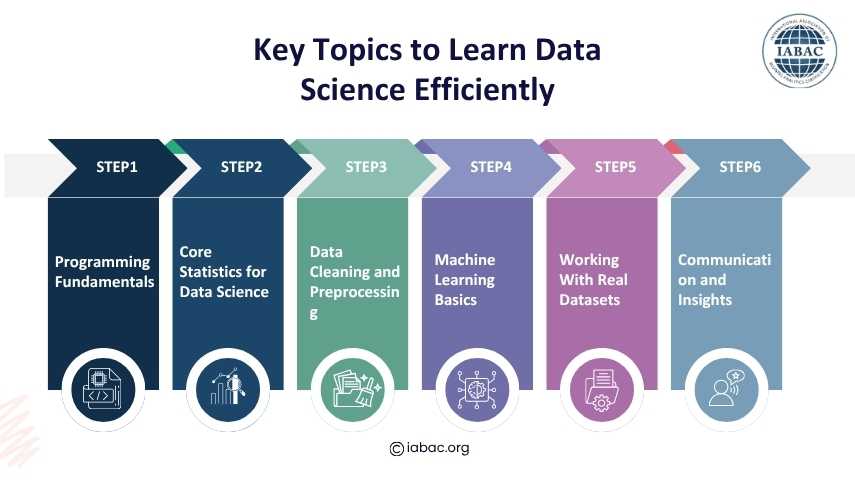
- Programming Fundamentals (Python Recommended)
- Variables, loops, conditions
- Functions
- Working with data using libraries like Pandas
- Basic visualisation
- Core Statistics for Data Science
- Mean, median, mode
- Probability basics
- Correlation and distributions
- Hypothesis testing
- Data Cleaning and Preprocessing
- Handling missing data
- Removing outliers
- Working with categorical data
- Machine Learning Basics
- Linear regression
- Logistic regression
- Decision trees
- Model evaluation metrics
- Working With Real Datasets
- Google Data Search
- Public repositories
- Company-related datasets (when allowed)
- Communication and Insights
- Presenting results
- Using clear charts
- Explaining findings to non-technical people
These topics give you a solid base, and you can gradually progress toward advanced concepts later.
Step 2: Learn in Short, Focused Time Blocks
A full-time job limits long study hours, so efficiency becomes important. Instead of trying to study for several hours, use compact, concentrated time slots.
Recommended Study Structure
- 30–45 minutes before work
Learn theory or watch short lessons. - 15–20 minutes during breaks
Revise concepts or practice small coding tasks. - 45–60 minutes in the evening
Work on projects or hands-on exercises. - A few hours on weekends
Build and improve portfolio-worthy projects.
Small, consistent study sessions prevent burnout and help you move faster because your mind stays fresh.
Step 3: Focus on Hands-On Learning From Day One
To Learn Data Science effectively, practical learning must begin early. Many learners spend too much time reading theory or watching long videos without practising.
A simple approach to learn practically:
- After learning a concept, test it with a small dataset.
- Explore free datasets from Google or Microsoft sample data.
- Create mini-projects such as:
- Analysing sales data
- Predicting student scores
- Understanding customer behaviour
- Explain every project in 5–6 lines to ensure clarity of understanding.
Projects help employers assess your skills much more than memorised definitions.
Step 4: Follow a Structured Weekly Plan
Working professionals progress faster when they stick to a weekly schedule instead of random study sessions. Here is a sample plan:
Weekly Plan to Learn Data Science
Weeks 1–2:
- Learn Python basics
- Practice simple exercises daily
Weeks 3–4:
- Study statistics basics
- Solve small analytical questions
Weeks 5–6:
- Learn data cleaning and preprocessing
- Work on a simple project
Weeks 7–8:
- Learn machine learning basics
- Build 1–2 beginner-level ML models
Week 9 and beyond:
- Improve your portfolio
- Strengthen weak areas
- Prepare for certifications
This flow keeps you moving steadily without getting overwhelmed.
Step 5: Build a Portfolio That Shows Real Skills
Your portfolio can help you stand out, especially when shifting careers while working full-time.
Tips for a strong portfolio
- Add 3–5 well-documented projects
- Use clear titles and short problem statements
- Highlight your thought process
- Show visualisations wherever possible
- Keep explanations simple and clear
A strong portfolio shows employers what you can do, not just what you have learnt.
Step 6: Strengthen Your Profile With Certifications
Once you understand the basics, Data Science Certifications can help you validate your skills. Certifications also give structure to your learning and help you follow industry-mapped standards.
Organisations like IABAC offer global-standard certifications that help professionals gain recognised qualifications while studying on a flexible schedule. Through the IABAC Authorized Training Provider (ATP), institutes and trainers support learners with structured guidance, hands-on training, and exam preparation. This helps working professionals stay motivated and progress steadily without feeling directionless.
There’s no need to depend only on one pathway, choose any certification that matches your learning goals and aligns with your career direction.
Step 7: Stay Consistent Even With a Busy Job
Learning becomes slow when you stop for several days and restart again. To maintain consistency:
- Set weekly goals instead of daily goals
- Keep a checklist
- Study during low-stress hours
- Reduce time spent on non-productive activities
- Reward yourself for completing milestones
Consistency matters more than speed when trying to Learn Data Science.
Step 8: Join Communities and Social Groups
Student groups help you learn faster because you get answers, motivation, and feedback. Even if you cannot join full courses, you can still participate in:
- Online discussion groups
- Coding communities
- Social platforms for sharing projects
- Study partners or small learning circles
Talking to others makes learning easier and helps you stay updated.
Step 9: Avoid Common Mistakes That Slow You Down
Many working professionals casually follow methods that delay progress. Avoid these mistakes:
- Trying to learn advanced ML or AI too early
- Using too many resources at the same time
- Skipping statistics
- Avoiding coding practice
- Not building projects
- Ignoring certifications until late
Sticking to a simple, structured path helps you advance faster.
The fastest way to learn Data Science while working full-time is not about studying endlessly, it’s about studying smart. By focusing on essential skills, practising hands-on projects, staying consistent, and validating your knowledge through recognised certifications, you can grow steadily even with a busy job. Platforms like IABAC provide structured guidance and internationally recognised certification pathways that support your progress at every stage.
Ready to upskill? Start your journey with IABAC today and move one step closer to your career goals.


 Jamboree India
 Ldesign Media