Amo Yadav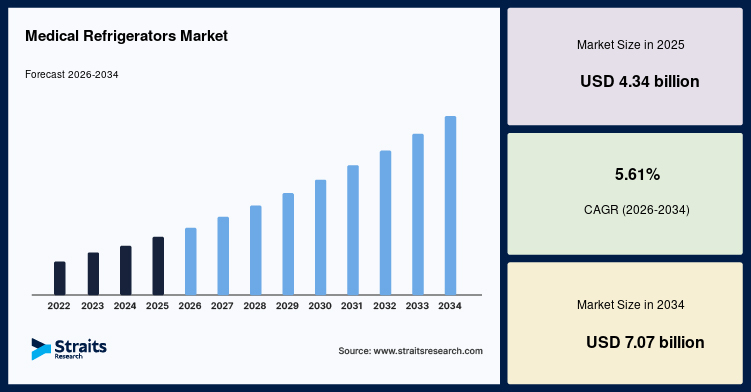
Medical Refrigerators Market
The global medical refrigerators market is experiencing steady growth as healthcare systems worldwide continue to expand cold-chain capabilities to support vaccines, biologics, blood products, and temperature-sensitive pharmaceuticals. According to recent market analysis, the medical refrigerators market was valued at USD 4.34 billion in 2025 and is projected to grow from USD 4.57 billion in 2026 to USD 7.07 billion by 2034, registering a compound annual growth rate (CAGR) of 5.61% during the forecast period from 2026 to 2034.
The market is being shaped by increasing global immunization efforts, rapid growth in biologics and personalized medicine, expansion of healthcare infrastructure, and rising investments in laboratory research. Healthcare providers, pharmaceutical manufacturers, blood banks, and research institutions are increasingly adopting specialized refrigeration systems to ensure compliance with stringent storage requirements and maintain the integrity of temperature-sensitive medical products.
Market Overview
Medical refrigerators play a critical role in healthcare and life sciences by enabling the safe storage of vaccines, blood components, reagents, pharmaceuticals, biological samples, and advanced therapeutics. Unlike conventional refrigeration systems, medical refrigerators are designed to maintain precise temperature ranges, provide continuous monitoring, and comply with strict regulatory requirements governing pharmaceutical and biological storage.
The increasing complexity of healthcare delivery and pharmaceutical development has elevated the importance of reliable cold-chain infrastructure. As biologics, cell and gene therapies, and personalized medicines become more prevalent, healthcare facilities are increasingly investing in advanced refrigeration systems capable of maintaining highly controlled storage environments.
North America accounted for the largest share of the global medical refrigerators market in 2025, representing 45.21% of total market revenue. Asia Pacific is expected to emerge as the fastest-growing regional market during the forecast period, expanding at a CAGR of 7.61%.
Growing Demand for Biologics and Specialized Healthcare Storage Drives Market Growth
One of the primary factors supporting market expansion is the increasing adoption of personalized medicine and biologic therapies. These treatments often require highly controlled storage conditions to preserve efficacy and safety, prompting hospitals, specialty pharmacies, and research laboratories to upgrade refrigeration infrastructure.
Manufacturers are responding to these evolving requirements by developing compact, customizable refrigeration units with multiple temperature zones capable of accommodating a diverse range of pharmaceutical formulations and biological materials.
The growing prevalence of point-of-care testing and expansion of mobile healthcare services are also contributing to market growth. Healthcare providers increasingly require portable and energy-efficient refrigeration systems capable of supporting medical operations in remote, rural, and emergency settings. As a result, manufacturers are introducing lightweight, battery-supported refrigeration solutions designed specifically for mobile healthcare applications.
Additionally, rising global demand for blood products, stem cell therapies, and regenerative medicine is increasing the need for advanced storage solutions, including ultra-low-temperature freezers and cryogenic systems. Enhanced cooling precision, redundant safety systems, and advanced alarm capabilities are becoming essential features in modern medical refrigeration equipment.
Trends Highlight the Shift Toward Smart and Connected Refrigeration Systems
A significant trend transforming the market is the growing emphasis on vaccine storage compliance and cold-chain integrity. Healthcare organizations are increasingly transitioning from general-purpose refrigeration units to certified medical refrigerators capable of maintaining precise temperature ranges required for vaccines and biologics.
Expansion of immunization programs across both developed and emerging economies is accelerating demand for larger-capacity and multi-zone refrigeration systems. Healthcare facilities are increasingly managing diverse inventories of vaccines, medicines, and laboratory reagents, necessitating advanced storage infrastructure capable of supporting multiple temperature requirements simultaneously.
Another notable trend is the integration of medical refrigerators with laboratory automation and digital healthcare ecosystems. Modern refrigeration systems are increasingly equipped with software-enabled capabilities, including remote temperature monitoring, automated alerts, inventory management integration, and digital quality assurance functions.
The incorporation of Internet of Things (IoT) technologies is transforming standalone refrigeration units into connected assets within broader healthcare information systems. These capabilities improve traceability, reduce manual monitoring requirements, and support regulatory compliance across healthcare environments.
High Costs and Infrastructure Limitations Present Market Challenges
Despite favorable growth prospects, several factors continue to restrain market expansion.
High acquisition and maintenance costs remain significant barriers, particularly for smaller healthcare facilities, independent laboratories, and institutions operating in cost-sensitive regions. Advanced refrigeration systems featuring sophisticated monitoring technologies, ultra-low temperature capabilities, and regulatory compliance functions often require substantial capital investment.
Dependence on stable electricity infrastructure also limits adoption in certain developing and rural regions. Medical refrigerators require uninterrupted power supply to maintain strict temperature conditions essential for preserving vaccines, blood products, and biologics. In areas with unreliable electricity access, healthcare providers may face operational challenges that restrict widespread deployment.
Regulatory complexity represents another challenge for manufacturers. Medical refrigeration products must comply with stringent national and international standards governing pharmaceutical storage, vaccine preservation, and biological sample management. Certification requirements can increase development costs, extend product approval timelines, and create barriers for smaller market entrants.
Smart Healthcare Technologies Create New Opportunities
The growing adoption of smart healthcare technologies presents substantial opportunities for market participants.
Healthcare organizations increasingly seek refrigeration solutions equipped with IoT connectivity, real-time monitoring, predictive maintenance capabilities, and automated compliance reporting. Manufacturers capable of delivering integrated, data-driven refrigeration systems are expected to benefit from rising demand for operational efficiency and digital healthcare transformation.
Expansion of global vaccination programs and cold-chain logistics networks also creates significant opportunities for equipment manufacturers. Public health agencies, hospitals, and centralized distribution facilities require scalable refrigeration solutions capable of supporting large-scale immunization campaigns and regional pharmaceutical distribution.
Furthermore, continued investments in biomedical research, clinical trials, and biobanking infrastructure are expected to drive long-term demand for specialized laboratory refrigeration systems and ultra-low temperature storage technologies.
Regional Insights
North America maintained its leading position in the global medical refrigerators market in 2025, accounting for 45.21% of total market revenue. The region benefits from advanced healthcare infrastructure, extensive biopharmaceutical research activities, and strict regulatory requirements governing storage of vaccines, biologics, and blood products.
The United States continues to represent the largest national market, supported by substantial investments in biomedical research, pharmaceutical innovation, and cold-chain logistics infrastructure. The U.S. medical refrigerators market was valued at USD 1.77 billion in 2025 and is projected to reach USD 1.86 billion in 2026.
Asia Pacific is expected to record the fastest growth through 2034, driven by rapid expansion of pharmaceutical manufacturing, biotechnology research, and healthcare infrastructure development across China, India, Japan, and South Korea. Governments throughout the region are strengthening immunization programs and expanding healthcare access, creating significant demand for advanced refrigeration systems.
Europe remains an important market, supported by stringent pharmaceutical storage regulations and strong biopharmaceutical manufacturing capabilities. Compliance with Good Distribution Practices (GDP) continues to encourage healthcare providers and pharmaceutical companies to invest in specialized refrigeration equipment.
Meanwhile, the Middle East & Africa and Latin America are witnessing increasing adoption of medical refrigeration technologies as governments expand healthcare infrastructure, strengthen immunization programs, and modernize laboratory capabilities.
Segment Analysis
Based on type, blood bank refrigerators and plasma freezers accounted for the largest market share of 38.21% in 2025. Growing blood donation initiatives, increasing transfusion procedures, and rising demand for plasma-derived therapies continue to support demand for these systems.
The ultra-low temperature freezers segment is anticipated to register robust growth during the forecast period, expanding at a CAGR of 6.12%. Increased adoption of biologics, cell and gene therapies, and biomedical research activities is driving demand for storage systems capable of maintaining temperatures below -70°C.
By end use, blood banks dominated the market in 2025, accounting for 40.21% of total revenue. Growing surgical volumes, trauma cases, and chronic disease management continue to increase blood storage requirements globally.
The pharmacies segment is expected to witness strong growth over the forecast period, registering a CAGR of 6.45%, supported by increasing distribution of vaccines, insulin, specialty pharmaceuticals, and biologic therapies through retail and hospital pharmacy networks.
Competitive Landscape
The global medical refrigerators market is moderately fragmented, with multinational medical device manufacturers, specialized cold-chain solution providers, and regional suppliers competing across healthcare and life sciences applications.
Competition is primarily centered on product reliability, temperature accuracy, regulatory compliance, energy efficiency, and global distribution capabilities. Emerging players increasingly focus on affordability, localized service support, and niche applications such as portable refrigeration and multi-zone storage systems.
Key companies operating in the market include Blackfrog Technologies, Krish Biomedicals, Helmer Scientific, Vestfrost Solutions, Thermo Fisher Scientific Inc., Felix Storch, Inc., Philipp Kirsch GmbH, Haier Biomedical, Follett LLC, PHC Holdings Corporation, LEC Medical, Zhongke Meiling Cryogenics Company Limited, and Blue Star Limited.
Recent industry developments underscore the growing emphasis on digitalization and domestic manufacturing expansion. In November 2025, Blackfrog Technologies introduced the EMON25 smart medical refrigeration monitoring system, enabling real-time monitoring and automated compliance reporting for biological storage applications. In September 2025, Krish Biomedicals expanded manufacturing capacity through a new facility in Noida dedicated to producing blood bank refrigerators and vaccine cold-chain equipment.
Click to Read the Complete Insights & Report https://straitsresearch.com/report/medical-refrigerators-market
About Straits Research
Straits Research is a global market research and consulting company providing comprehensive market intelligence, industry analysis, and strategic insights across diverse sectors. The company delivers data-driven research reports, competitive assessments, and customized consulting services that enable organizations to make informed business decisions. Straits Research serves clients worldwide across healthcare, technology, consumer goods, chemicals, energy, and industrial sectors through rigorous research methodologies and in-depth market expertise.