Annotera AI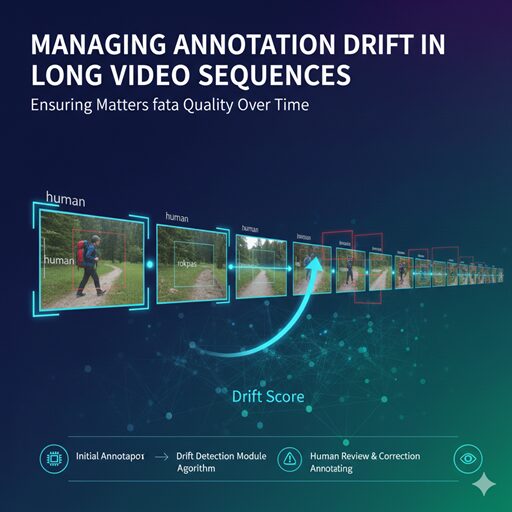
In large-scale AI systems that rely on video data, consistency is not just a quality goal—it is a performance requirement. As datasets grow longer and more complex, one subtle yet critical issue emerges: annotation drift. For organizations training surveillance AI, autonomous systems, sports analytics, or retail intelligence models, drift in labels across long video sequences can quietly degrade model accuracy, reliability, and generalization.
At Annotera, we have observed that managing annotation drift is one of the defining challenges that separates basic labeling operations from a truly professional data annotation company. Long-form video introduces temporal dependencies, context shifts, and human fatigue factors that static image workflows rarely encounter. Without a structured mitigation strategy, even well-trained annotators can unintentionally introduce inconsistencies that propagate downstream into model errors.
This article explores what annotation drift is, why it occurs, and how robust video annotation outsourcing strategies can systematically prevent it.
What Is Annotation Drift?
Annotation drift refers to the gradual, unintentional deviation in labeling standards or object definitions over the duration of a video sequence or across batches of related sequences. Unlike obvious mislabels, drift is subtle. It often appears as:
-
Bounding boxes slowly changing size or tightness
-
Object IDs being inconsistently reassigned
-
Semantic class boundaries shifting over time
-
Action labels applied with evolving interpretation
-
Temporal boundaries of events becoming inconsistent
In long surveillance or autonomous driving footage, an annotator may start with precise object boundaries but gradually loosen or tighten box placement. Similarly, a “loitering” action might initially require 10 seconds of inactivity, but later be labeled after 5 seconds due to subjective reinterpretation. These small changes accumulate into systemic noise.
For AI models that depend on temporal coherence, such inconsistencies directly impact training stability.
Why Long Video Sequences Amplify Drift
Long videos introduce cognitive and procedural pressures that accelerate drift:
1. Annotator Fatigue
Extended labeling sessions reduce attention to detail. Micro-adjustments in bounding boxes or segmentation masks become less precise over time.
2. Context Accumulation
As a scene evolves, annotators may unconsciously adjust definitions based on narrative context rather than strict guidelines.
3. Object Occlusion and Reappearance
Tracking objects through occlusions requires judgment. Without firm protocols, ID reassignment becomes inconsistent.
4. Ambiguous Edge Cases
Events that evolve gradually—like crowd formation or suspicious behavior—create shifting interpretation thresholds.
This is why relying on ad-hoc labeling processes is risky. A professional video annotation company must treat long-sequence consistency as an engineering problem, not a purely manual task.
Impact on Model Performance
Annotation drift affects multiple aspects of model training:
-
Reduced Temporal Stability: Tracking models learn inconsistent motion patterns.
-
Class Boundary Noise: Classification heads struggle with shifting definitions.
-
Lower IoU Consistency: Object detection models receive variable spatial supervision.
-
Evaluation Mismatch: Test metrics become unreliable if ground truth is inconsistent.
Ultimately, drift increases variance in model predictions, which is particularly harmful in safety-critical domains like traffic monitoring or perimeter surveillance.
Strategies to Prevent Annotation Drift
At Annotera, drift prevention is embedded into workflow architecture. Effective data annotation outsourcing requires a mix of human process control and technical enforcement.
1. Temporal Guideline Design
Standard annotation instructions are insufficient for video. Guidelines must include:
-
Frame-to-frame bounding box placement rules
-
Explicit occlusion handling logic
-
Object ID persistence criteria
-
Event start and end time thresholds
These temporal rules remove ambiguity and anchor annotator decisions.
2. Anchor Frame Methodology
Key frames are designated as “anchor points” where annotations undergo stricter validation. Subsequent frames are compared against these anchors to detect drift patterns early.
3. Sliding Window Quality Checks
Rather than auditing random frames, quality assurance reviews consecutive frame windows. This reveals gradual deviations that single-frame QA would miss.
4. Cross-Annotator Overlap
Periodic overlapping assignments allow consistency benchmarking. If two annotators diverge over time on the same sequence segment, guideline recalibration is triggered.
5. AI-Assisted Consistency Monitoring
Machine learning models can flag anomalies such as sudden bounding box scale changes or irregular ID switches. Human reviewers then verify flagged segments.
This hybrid approach ensures that drift is caught before it contaminates large dataset segments.
The Role of Tooling in Drift Control
Annotation tools play a decisive role in drift management. Advanced platforms used by a mature video annotation outsourcing partner should include:
-
Persistent object ID tracking interfaces
-
Frame interpolation with verification checkpoints
-
Change-history logs for label revisions
-
Visual trajectory overlays
-
Temporal heatmaps of label density
These features reduce reliance on memory and judgment, replacing them with structured, repeatable processes.
Training Annotators for Temporal Consistency
Technical systems alone are insufficient. Annotators must be trained specifically for long-sequence cognition:
-
Recognizing fatigue-related errors
-
Maintaining frame-to-frame spatial precision
-
Applying event thresholds consistently
-
Following occlusion recovery rules
Shorter task segmentation and rotation schedules further reduce cognitive drift.
A reliable data annotation company treats workforce ergonomics as part of data quality strategy.
Measuring Annotation Drift
Drift must be quantified, not assumed. Key metrics include:
-
Frame-to-frame IoU variance
-
ID switch frequency
-
Temporal label boundary deviation
-
Bounding box scale drift rate
-
Inter-annotator temporal agreement
Tracking these indicators enables continuous improvement and early issue detection.
Why Drift Management Matters for Enterprise AI
For enterprises building large-scale video AI, annotation drift is not a minor labeling issue—it is a dataset integrity risk. Models trained on inconsistent temporal data:
-
Require more retraining cycles
-
Exhibit unstable real-world performance
-
Fail under edge-case conditions
-
Generate higher false-positive rates
By contrast, datasets managed with rigorous drift control lead to faster convergence, stronger generalization, and more reliable deployment outcomes.
How Annotera Ensures Long-Sequence Integrity
At Annotera, drift mitigation is embedded into every stage of our workflow:
-
Temporal-first annotation guidelines
-
Multi-layer QA focused on sequence continuity
-
AI-assisted anomaly detection
-
Structured annotator rotation and retraining
-
Data-driven drift metrics monitoring
This systematic approach allows us to operate as a high-reliability video annotation company capable of supporting surveillance AI, mobility platforms, and large-scale analytics systems.
Conclusion
Managing annotation drift in long video sequences is one of the most complex challenges in modern dataset development. It requires procedural rigor, specialized tooling, trained annotators, and continuous measurement.
Organizations that overlook drift risk undermining their AI investments at the data level. Those that partner with an experienced data annotation company gain not just labeled frames—but temporally coherent, model-ready datasets.
In the evolving landscape of video AI, consistency across time is just as important as accuracy within a frame. Effective drift management ensures both.


 Job Recruitment Agencies in Lahore Soby Enterprises