Houston Systems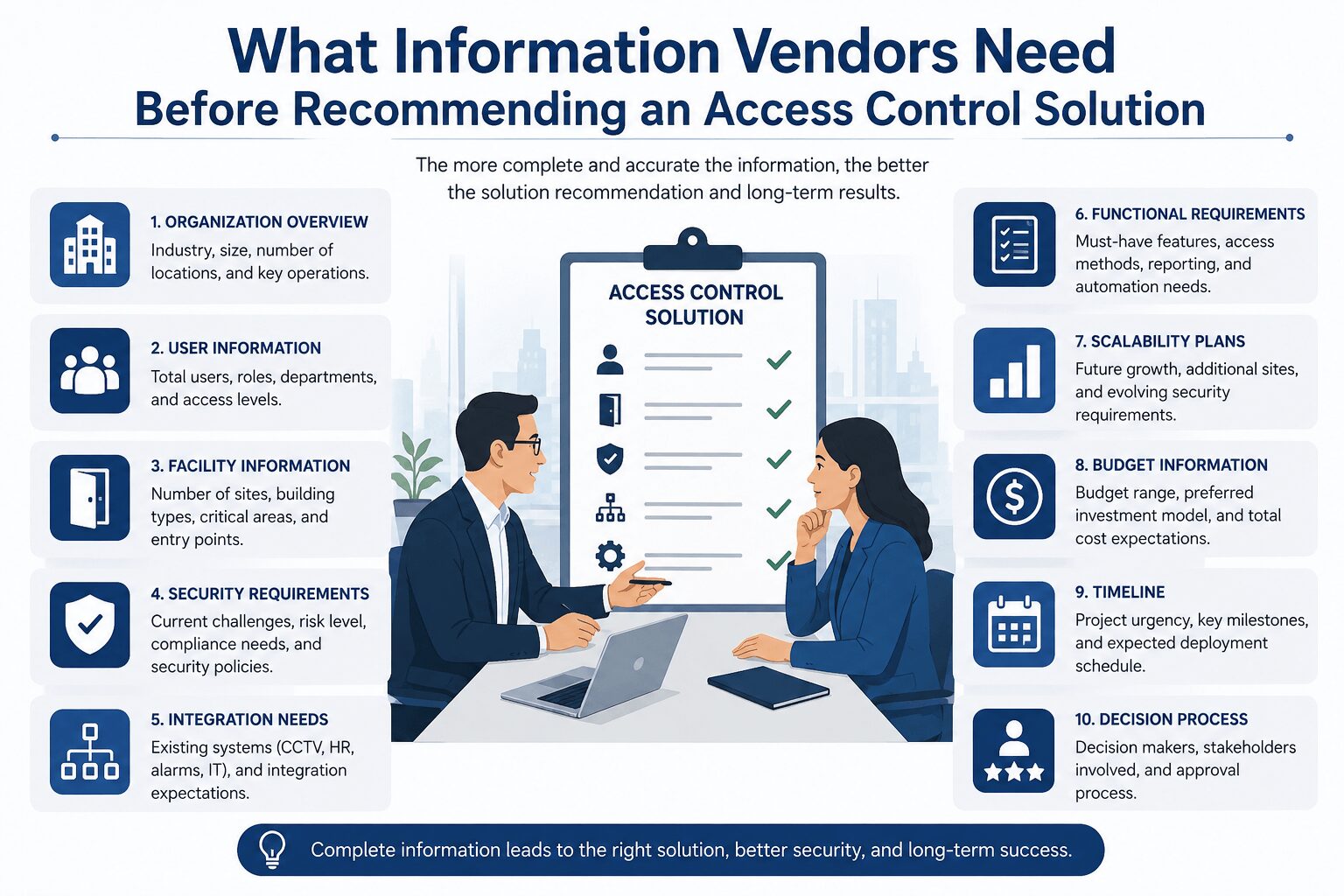
Sometimes the Wrong Recommendation Starts With the Right Conversation
Organizations often believe an access control project begins when they contact a vendor.
In reality, experienced vendors know the project usually begins much earlier.
It begins with information.
Or, more accurately, the lack of it.
This explains why two organizations experiencing similar entry problems can receive completely different recommendations from equally experienced vendors.
From the outside, this appears inconsistent.
One vendor recommends infrastructure upgrades.
Another suggests process improvements before changing equipment.
A third advises delaying the investment until additional operational data becomes available.
To the buyer, these recommendations may seem contradictory.
However, experienced consultants rarely evaluate projects by looking only at visible problems.
They try to understand everything happening behind those problems.
That difference changes the entire recommendation.
Most Projects Begin With a Symptom Instead of the Actual Problem
When organizations first discuss a new access control project, the conversation usually begins with something that is easy to observe.
Long queues.
Slow vehicle movement.
Security concerns.
Manual approvals.
Congestion during shift changes.
These observations are important because they reveal where operational pressure is becoming visible.
What they do not explain is why those situations developed in the first place.
A queue may not exist because vehicles arrive too quickly.
It may exist because delivery schedules overlap with employee arrivals.
Manual approvals may not be the real issue.
The approval process itself may be perfectly acceptable, while inconsistent operating procedures create unnecessary delays.
The visible problem is only one part of a much larger operational picture.
Experienced vendors understand that recommending a solution before understanding that picture increases the likelihood of solving the wrong problem.
The Entrance Rarely Tells the Whole Story
Imagine standing at the entrance of two different commercial facilities.
Both have similar roads.
Both process delivery vehicles.
Both experience activity during the morning.
From a distance, they appear almost identical.
Yet after spending several hours observing how each facility operates, significant differences begin to appear.
One site depends on predictable logistics schedules.
The other manages frequent visitor arrivals that change throughout the day.
One separates contractors from regular employees before they reach the entrance.
The other verifies everyone using the same procedure.
One facility experiences short periods of intense traffic.
The other operates at a steady pace throughout the day.
None of these differences are obvious from the entrance itself.
Yet they influence every infrastructure decision that follows.
This is why experienced vendors spend far more time understanding daily business activity than simply measuring lanes or reviewing drawings.
Recommendations Are Built Around Business Behaviour, Not Products
Many buyers naturally expect discussions to focus on equipment.
They ask about features.
Speed.
Technology.
Integration.
Pricing.
Those questions are important, but they usually come later.
The first objective is understanding how the organization functions when no one is talking about technology.
How are deliveries scheduled?
Who authorizes contractors?
When do temporary visitors arrive?
How are unexpected situations managed?
Which departments influence entry procedures?
How often do operational requirements change?
These conversations help vendors understand how access control supports the business rather than simply protecting the entrance.
The recommendation gradually develops from operational understanding instead of product familiarity.
That approach usually produces recommendations that remain effective long after installation.
The Information Buyers Never Include in Their First Email
Initial enquiries are often brief.
A typical message might explain that the organization requires a quotation for a new access control solution because congestion has increased or manual operations have become difficult to manage.
While that information introduces the project, it rarely provides enough context for a meaningful recommendation.
Experienced vendors know there are dozens of operational details hidden behind a short enquiry.
For example:
A warehouse may experience congestion only because transport companies arrive earlier than scheduled.
A hospital may require uninterrupted emergency access regardless of visitor traffic.
A manufacturing facility may experience completely different traffic behaviour during production changeovers.
A commercial office may process fewer vehicles than a warehouse while requiring more complex authorization procedures.
These operational characteristics are rarely included in an initial request, yet they often determine whether one solution is significantly more suitable than another.
The recommendation begins evolving as these details become clearer.
Not because the product changes, but because the understanding of the business becomes more complete.
Good Recommendations Solve Business Problems Before They Solve Entry Problems
Organizations invest in access control infrastructure for many different reasons.
Some want to improve security.
Others want smoother traffic movement.
Some are preparing for expansion.
Others want greater operational visibility.
Although these objectives appear different, they share one common requirement.
The recommended solution must support the way the business actually operates.
A technically advanced system that ignores everyday operational realities may struggle to deliver long-term value.
Conversely, a carefully planned solution that aligns with business processes often continues performing effectively even as operational requirements change.
For this reason, experienced vendors rarely begin by asking,
“Which product should we recommend?”
Instead, they begin with a more important question:
“What is this organization actually trying to achieve?”
Only after that answer becomes clear does the recommendation start taking shape.
The Best Recommendations Are Built Long Before Equipment Is Discussed
One of the biggest differences between an experienced consultant and a product salesperson is where the recommendation begins.
A product-focused discussion usually starts with equipment.
Which model?
Which technology?
Which features?
An experienced consultant approaches the project differently.
Before thinking about products, they try to understand the business environment that the future solution must support.
This changes the entire direction of the recommendation.
Instead of asking whether a particular solution is technically capable, they first determine whether it fits the way the organization operates every day.
That shift in perspective often prevents expensive decisions based on assumptions instead of evidence.
The Business Usually Knows the Symptoms Better Than the Causes
Organizations live with their daily operations.
Naturally, they notice the symptoms first.
Employees mention recurring queues.
Visitors complain about waiting.
Drivers experience delays.
Security personnel report increasing workloads.
These observations are valuable because they highlight where pressure is becoming visible.
However, visible pressure rarely identifies the underlying cause.
A delivery schedule that overlaps with employee arrivals may create congestion that appears to be an infrastructure problem.
Temporary approval procedures may slowly become permanent workflows without anyone formally recognising the change.
A parking layout designed years earlier may no longer support current traffic behaviour.
The operational issue often develops gradually, making it difficult for people working inside the organization to notice the pattern.
This is why experienced vendors spend considerable time understanding how daily activities interact rather than focusing only on the problem that was originally reported.
Small Operational Details Often Change the Final Recommendation
Projects are rarely influenced by a single factor.
Instead, recommendations evolve as multiple pieces of information begin connecting together.
Consider a facility that experiences congestion every weekday morning.
At first glance, increasing entry capacity may appear to be the obvious solution.
After further investigation, a different picture may emerge.
Employee arrivals begin at exactly the same time as supplier deliveries.
Visitor appointments are concentrated within a short period.
Contractors use the same entry procedure as permanent staff.
Service vehicles stop near the entrance while waiting for approval.
None of these situations seem significant when viewed individually.
Together, they create operational conditions that influence how any access control solution should perform.
This is why experienced vendors avoid reaching conclusions too early.
They know recommendations become stronger as operational understanding becomes more complete.
Every Recommendation Represents Hundreds of Small Decisions
By the time an organization receives a proposal, most of the important thinking has already happened.
The recommendation reflects dozens of observations that buyers rarely see.
It considers how different groups move through the facility.
It evaluates how traffic changes throughout the day.
It recognises where approvals slow movement.
It identifies procedures that no longer match current business requirements.
It also considers future expansion, changing business priorities, and the practical realities of managing the site over many years.
The final recommendation is therefore not simply about choosing equipment.
It represents the combined effect of many operational decisions that have been carefully evaluated before any product is suggested.
Why Similar Facilities Can Require Completely Different Solutions
Organizations often compare themselves with neighbouring businesses.
A nearby warehouse installed one type of system.
A commercial office chose something different.
A manufacturing facility invested in another approach altogether.
At first, these differences may seem confusing.
After all, each organization manages vehicles entering and leaving its premises.
The similarity ends there.
A logistics hub values uninterrupted freight movement.
A hospital cannot compromise emergency access.
A residential community focuses on predictable daily residents and visitor activity.
A corporate campus may place greater emphasis on employee convenience and controlled visitor processing.
Although all of them require controlled entry, they operate under completely different business conditions.
Experienced vendors recognise these differences immediately because they understand that infrastructure should support operations—not force operations to adapt to infrastructure.
Information That Rarely Appears in Project Documents
Drawings, traffic counts, and technical specifications provide valuable information.
They do not tell the complete story.
Some of the most important details only become visible through observation and discussion.
For example:
- informal working practices that developed over time
- seasonal changes in vehicle activity
- temporary procedures that became permanent
- coordination between different departments
- future business expansion plans
- operational priorities that were never formally documented
These factors are difficult to capture in a specification document.
Yet they often determine whether a recommendation continues delivering value long after implementation.
This is one reason experienced vendors spend as much time understanding the organization as they do reviewing technical information.
A successful recommendation depends on understanding both.
Recommendations Improve as Assumptions Disappear
Every assumption removed from a project improves the quality of the final recommendation.
The objective is not to collect more information simply for the sake of analysis.
The objective is to reduce uncertainty.
When uncertainty decreases, recommendations become more precise.
Organizations gain greater confidence in their investment decisions.
Future modifications become less likely.
Infrastructure is better aligned with long-term business requirements.
Ultimately, the recommendation becomes more than a suggestion about equipment.
It becomes a carefully considered response to the way the organization actually operates, both today and in the years ahead.
The Difference Between Recommending Equipment and Recommending the Right Direction
When organizations compare vendor proposals, attention naturally shifts toward specifications, delivery schedules, pricing, and technology.
Those factors certainly matter.
However, they represent only the visible part of a much larger recommendation process.
The real value of an experienced vendor often lies in the thinking that takes place before a single product appears in the proposal.
A recommendation should explain more than what an organization could install.
It should explain why that recommendation fits the business, how it addresses existing challenges, and whether it can continue supporting the organization as operations evolve.
When proposals are developed from that perspective, infrastructure becomes an operational asset rather than simply another capital purchase.
Why Rushing to a Recommendation Usually Creates Long-Term Problems
Modern organizations move quickly.
Projects have deadlines.
Budgets have approval windows.
Management often expects recommendations within a short period.
While speed is valuable, experienced vendors understand that moving too quickly can create decisions that become expensive to correct later.
Infrastructure remains in service for many years.
Business priorities change.
Traffic patterns evolve.
New departments are created.
Additional facilities may be added.
If recommendations are based only on today’s visible requirements, tomorrow’s operational demands may expose limitations that were never considered during planning.
Taking additional time to understand the business at the beginning often saves significantly more time and cost throughout the lifecycle of the infrastructure.
For experienced consultants, recommending too early is usually a greater risk than recommending slightly later with greater confidence.
The Strongest Recommendations Balance Today’s Needs With Tomorrow’s Operations
A recommendation should solve the immediate challenge without creating future limitations.
That balance is rarely achieved by looking only at current traffic levels or existing infrastructure.
It requires understanding how the organization expects to grow.
Will additional entry points be required?
Will visitor volumes increase?
Could delivery schedules change?
Will digital identification technologies become part of future operations?
These questions are not predictions.
They are part of responsible planning.
Organizations investing in vehicle entry automation often achieve better long-term results when future operational flexibility is considered from the beginning rather than added after deployment.
Recommendations that anticipate change generally remain valuable much longer than those designed only for present-day conditions.
Why the Best Projects Feel Predictable After They Are Completed
One characteristic appears repeatedly in successful infrastructure projects.
After implementation, the solution feels as though it naturally belongs within the organization.
Employees adapt quickly.
Visitors understand the process.
Daily movement becomes more consistent.
Operational teams spend less time managing avoidable interruptions.
Interestingly, this outcome is rarely achieved because the organization selected the most advanced technology.
It happens because the recommendation reflected how the business already worked.
The infrastructure supports everyday activities instead of forcing people to change well-established operational practices.
When recommendations align with business behaviour, adoption becomes smoother and long-term performance becomes far more predictable.
Looking Beyond the Proposal
Before accepting any recommendation, organizations should ask themselves an important question.
Does this proposal demonstrate an understanding of how our business operates, or does it simply describe a product?
There is an important difference.
A proposal built around equipment can usually be copied from one project to another.
A proposal built around operational understanding is far more difficult to reproduce because it reflects the unique characteristics of a specific organization.
That distinction often separates suppliers from long-term solution partners.
The most valuable recommendations are not those that contain the longest specification sheets.
They are the ones that clearly demonstrate an understanding of the environment they are intended to support.
Final Perspective
Access control projects rarely succeed because an organization purchased the latest technology.
They succeed because the recommended solution reflects the realities of the business it is intended to serve.
Behind every strong recommendation is a detailed understanding of how people move, how departments interact, how daily activities influence entry operations, and how the organization expects those activities to change over time.
That understanding cannot be captured through specifications alone.
It develops through careful observation, meaningful discussion, and a genuine effort to understand the environment before proposing a solution.
For organizations planning their next access control investment, the most valuable conversation may not be about products at all.
It may be the conversation that helps both sides understand the business before any recommendation is made.
Frequently Asked Questions
Why do experienced vendors sometimes recommend different solutions for similar facilities?
Because facilities that appear similar often operate differently behind the scenes. Daily workflows, business priorities, traffic behaviour, future expansion plans, and authorization procedures all influence the final recommendation.
Why isn’t product information enough to recommend an access control solution?
Product specifications explain what equipment can do, but they do not explain whether that equipment fits the way an organization operates. Recommendations become more accurate when they are based on business context as well as technical capability.
What usually improves the quality of a vendor’s recommendation?
Clear information about business activities, traffic patterns, entry procedures, future growth, operational objectives, and existing infrastructure allows vendors to develop recommendations that are better aligned with long-term requirements.
Can two organizations with similar traffic volumes require different solutions?
Yes. Traffic volume is only one factor. The purpose of the facility, user groups, authorization processes, delivery schedules, and future operational plans often have a much greater influence on the final recommendation.
What should organizations expect during the early stages of a project?
Rather than receiving an immediate product recommendation, organizations should expect experienced vendors to spend time understanding how the business functions. That initial effort helps reduce assumptions and produces recommendations that are more practical, scalable, and sustainable.
Closing Thought
The quality of an access control solution is rarely determined by the technology alone.
It is determined by how well that technology reflects the business it is designed to support.
Organizations that invest time in sharing meaningful operational information enable vendors to move beyond generic proposals and develop recommendations that create long-term value rather than simply solving short-term problems.


 Official Store
 GodDigital GodDigital