Navaneeth Latheesh
You’ve probably felt that nudge — meetings where colleagues casually mention AI projects, or job posts that now list AI skills as a must. If you want a clear primer before jumping in, check our A Complete Guide to Artificial Intelligence — but if you’re ready to act, an artificial intelligence certification is the single most practical step you can take to show you’re prepared for the future.
This post explains why artificial intelligence certification matters, who benefits most, how to choose the right path, and the real skills you’ll leave with. Read this like a conversation with a mentor who wants you to get ahead — not someday, but now.
Why artificial intelligence certification matters right now
AI is changing how decisions are made at work. Organisations want people who can turn data into action — and they want proof. An artificial intelligence certification does two things at once:
- It verifies technical know-how (machine learning basics, model evaluation, data handling).
- It signals practical business sense (how AI solves actual problems, not just theoretical models).
Employers increasingly use credentials to shortlist candidates for roles like business analyst and data scientist. Getting an artificial intelligence certification gives you credibility and helps you stand out when hiring managers scan dozens of resumes.
Who benefits most from artificial intelligence certification

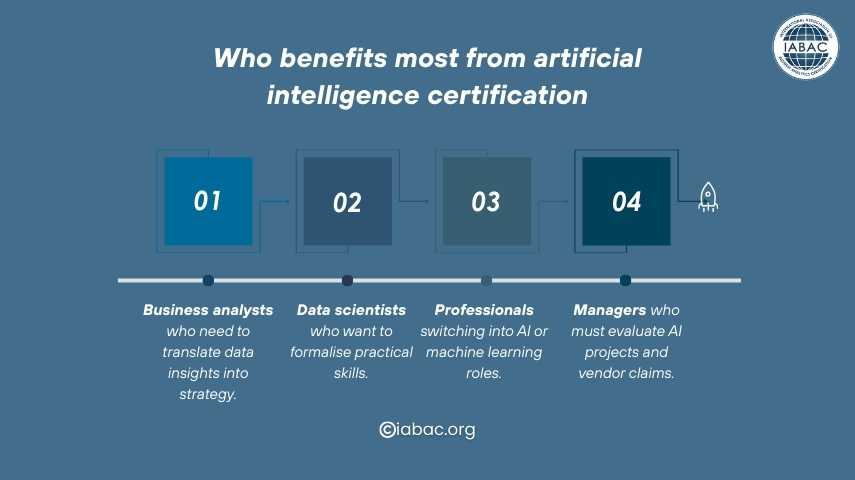
This isn’t only for developers. People who gain the most are:
- Business analysts who need to translate data insights into strategy.
- Data scientists who want to formalise practical skills.
- Professionals switching into AI or machine learning roles.
- Managers who must evaluate AI projects and vendor claims.
If you’re aiming for a promotion, planning a mid-career pivot, or trying to secure higher-impact work, an artificial intelligence certification gives a concrete signal that you can deliver value.
How to choose the right artificial intelligence certification
Not every credential fits every person. Think about your level and goals.
For beginners
Start with a foundational program that teaches core ideas, basic machine learning, and data handling. Look for hands-on assignments so you build confidence.
For working analysts and data practitioners
Pick a certification with real projects and business case studies. These show employers you can apply models to solve measurable problems.
For technical pivots into ML engineering
Choose a path that includes advanced machine learning, model deployment, and performance monitoring. Practical labs and deployment experience matter here.
You can also follow a staged approach: begin with a foundational credential (for example, Artificial Intelligence Foundation), then progress to a Certified Machine Learning Associate, and later aim for roles that value leadership in AI like the Artificial Intelligence Certified Executive or a focused Generative AI Specialist program. This laddered approach helps you learn steadily and prove growth.
What you’ll actually learn (and use tomorrow)
A good artificial intelligence certification focuses on applied skills, not just theory. Expect to practice:
- Data cleaning and feature design — how raw information becomes usable.
- Model selection and evaluation — choosing and testing the right algorithm.
- Basic machine learning workflows — training, validation, and iteration.
- Communicating results to stakeholders — turning numbers into decisions.
- Implementation basics — how models get deployed and monitored.
Those skills directly map to tasks you’ll do in roles like business analyst or data scientist. Employers value the ability to both build and explain AI solutions.
Common learner questions and practical project ideas
People often ask: “Will certification help me get hired?” and “What projects should I build?” Here are simple, actionable answers:
- Yes — certification strengthens your case, especially when paired with two strong projects.
- Build projects tied to business questions: predict customer churn, forecast sales, or automate a reporting task. Add a short writeup that explains the business impact.
A portfolio of 2–3 real projects plus an artificial intelligence certification is a powerful combo.
Career signals and real outcomes
A certification doesn’t replace experience, but it reduces uncertainty for hiring teams. It can help you:
- Get past resume filters and applicant tracking systems.
- Secure interviews where you can demonstrate thinking and communication.
- Negotiate better roles or compensation because you show validated competence.
If your goal is to switch lanes or step into a more strategic role, an artificial intelligence certification accelerates that transition by proving your readiness.
Quick study and preparation tips
- Focus on projects, not just videos. Employers ask about what you built.
- Use real datasets and explain the business question you addressed.
- Practice explaining your work in plain language — that’s what separates a good technician from a trusted advisor.
- Combine study with short, regular practice sessions instead of long, irregular cramming.
When you’re ready, Explore artificial intelligence certification to see available paths and details that match your timeline.
Take a practical next step — with options
If you’re unsure where to begin, a pragmatic route is:
- Start with a foundation course (Artificial Intelligence Foundation).
- Build two projects that solve business problems.
- Progress to a mid-level credential like Certified Machine Learning Associate.
- Consider leadership or specialised credentials later, such as Artificial Intelligence Certified Executive or Generative AI Specialist, depending on your goals.
When it’s time to compare programs, look for hands-on assessments and employer-friendly projects. And if you want recognized credentials across multiple areas, check IABAC Global Certifications as a consolidated place to explore.
Your move: make it practical, not perfect
An artificial intelligence certification is a tool — not a magic wand. Use it with real projects and clear outcomes. If you combine a certificate with 2–3 concrete projects and the ability to explain results in simple business terms, you’ll move from being “someone who knows about AI” to someone who can deliver AI value.
Ready to get started? Explore artificial intelligence certification to find a path that fits your experience and goals. You owe it to your future self to prepare now — the roles and opportunities are moving fast, and your next step can make all the difference.


 Medline Academics
 MCM Academy