Shaik Yaseen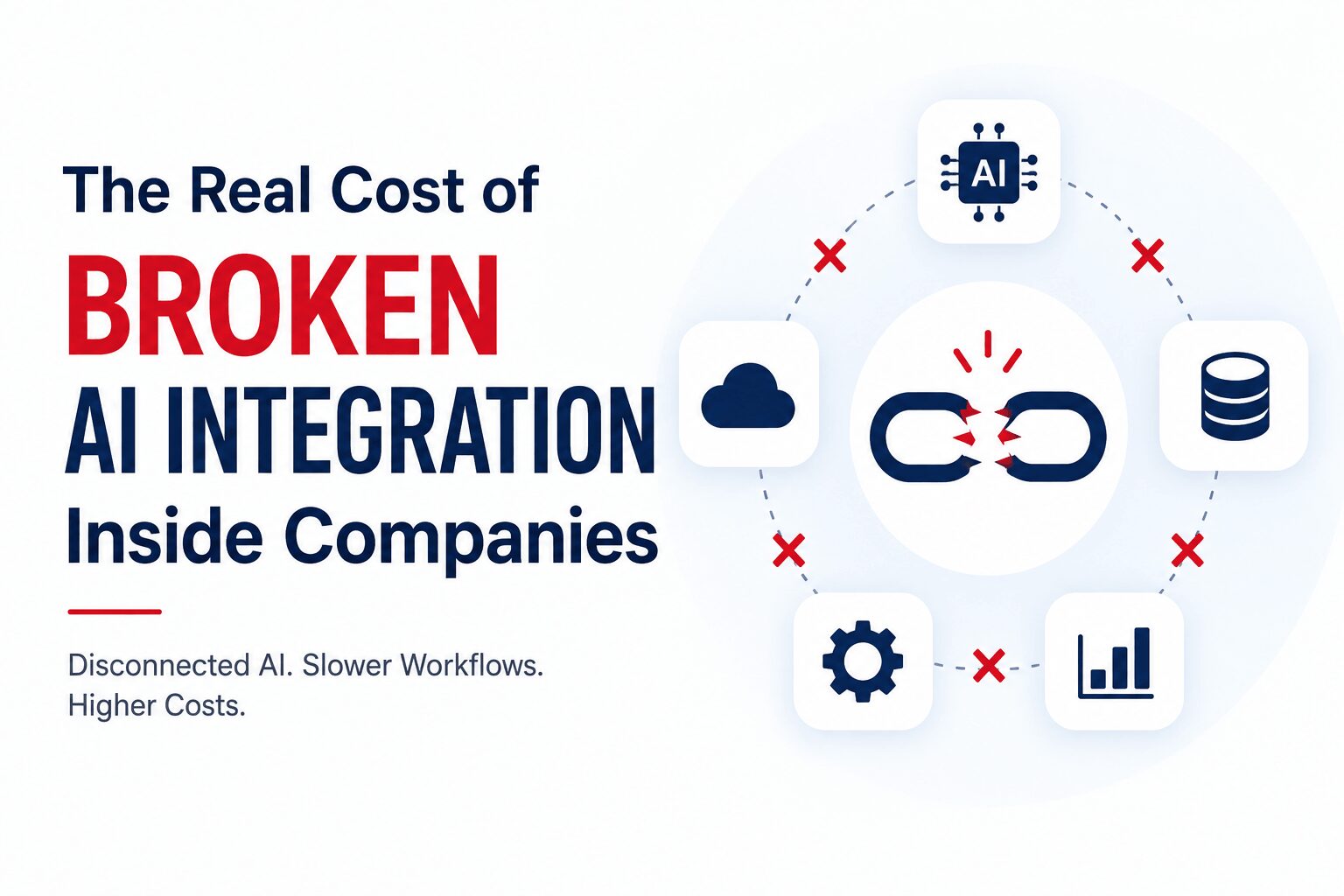
Most businesses think adopting AI is the difficult part.
It usually is not.
The real challenge begins after implementation — when companies realize their AI systems, software platforms, workflows, and operational processes do not actually work together properly.
That is the hidden problem modern businesses are facing.
AI tools are being added everywhere:
inside customer support, analytics, operations, communication systems, cybersecurity platforms, and reporting workflows. But without proper AI Integration Services, many companies end up creating disconnected digital environments that become harder to manage over time.
This creates operational friction that quietly affects:
- productivity,
- decision making,
- customer experience,
- and business scalability.
That is the real cost of broken AI integration.
Most Businesses Are Adding AI Faster Than They Can Organize It
One major reason this problem exists is speed.
Businesses are under pressure to adopt AI quickly because:
- competitors are modernizing,
- customers expect faster service,
- and operations are becoming more digital every year.
So companies begin implementing:
- AI chat systems,
- automation platforms,
- predictive analytics tools,
- AI security monitoring,
- and workflow software rapidly.
But many businesses forget one important thing:
AI systems still need operational structure.
Without integration, companies often create disconnected systems that:
- duplicate work,
- confuse employees,
- slow workflows,
- and reduce operational visibility.
Operational visibility simply means understanding what is happening across the business clearly in real time.
Companies like Rubixe are increasingly helping organizations simplify AI ecosystems because businesses now care more about connected workflows than isolated AI tools.
Broken AI Integration Creates Invisible Workflow Delays
One of the biggest problems with poor integration is that the damage often feels invisible initially.
Operations still function.
Employees still work.
Systems still run.
But underneath the surface, workflows slowly become inefficient.
For example:
employees may need to:
- copy information between systems manually,
- update multiple dashboards separately,
- switch between disconnected tools,
- or repeat the same operational tasks across platforms.
This creates workflow fragmentation.
Workflow fragmentation simply means operations becoming scattered across disconnected systems.
Over time, these small inefficiencies create major operational slowdowns.
That is why AI Integration Services are becoming increasingly important for modern businesses.
Technology focused firms like Rubixe are increasingly seeing businesses prioritize connected operational systems because workflow clarity now directly affects productivity and scalability.
AI Systems Are Only Valuable If They Share Context
One major misconception about AI adoption is that every AI tool creates value independently.
In reality, modern operations depend heavily on connected information flow.
For example:
a customer support AI system becomes far more useful if it can access:
- CRM data,
- operational history,
- inventory systems,
- and communication workflows together.
CRM simply means Customer Relationship Management systems businesses use to manage customer information and interactions.
Without integration, AI systems operate with limited context.
And limited context creates weaker operational decisions.
This is one reason businesses increasingly explore AI Consulting Services before implementing large scale AI ecosystems.
Good AI strategy now depends heavily on understanding:
- how systems communicate,
- where workflows break,
- and how information moves across operations.
The Bigger Problem Is Operational Complexity
Modern businesses already operate inside highly connected environments.
Teams constantly interact with:
- cloud systems,
- communication platforms,
- analytics dashboards,
- cybersecurity infrastructure,
- automation tools,
- and operational databases.
Every additional disconnected AI tool increases operational complexity.
Complexity simply means systems becoming harder to manage, monitor, and coordinate effectively.
This creates several hidden problems:
- slower decision making,
- inconsistent reporting,
- duplicated operational effort,
- and communication delays.
Employees often spend more time managing systems than executing meaningful work.
AI Integration Services help reduce this complexity by creating smoother operational coordination between platforms.
Companies like Rubixe are increasingly helping organizations modernize operational infrastructure because businesses no longer want fragmented digital ecosystems slowing growth.
Broken Integration Also Creates Security Risks
One overlooked consequence of poor AI integration is cybersecurity exposure.
Disconnected systems often create:
- inconsistent access controls,
- weak authentication layers,
- unmonitored data movement,
- and operational blind spots.
Blind spots simply mean areas inside systems where security visibility becomes weak or incomplete.
For example:
when AI systems operate separately from centralized monitoring infrastructure, businesses may struggle to:
- track suspicious activity,
- monitor user behavior,
- or identify operational anomalies quickly.
This creates unnecessary risk.
Modern businesses increasingly rely on AI Cyber Security Services because AI ecosystems now require continuous operational monitoring alongside automation and intelligence systems.
Companies like Rubixe are increasingly seeing businesses prioritize integrated cybersecurity visibility because operational infrastructure and security are now deeply connected.
Employees Feel the Integration Problem First
Interestingly, employees often notice poor AI integration before leadership does.
Why?
Because operational friction appears directly inside daily workflows.
For example:
employees may experience:
- delayed information access,
- inconsistent data,
- duplicated reporting,
- disconnected communication,
- or conflicting operational updates.
This creates frustration internally.
Eventually, teams stop trusting systems fully.
That is one of the most dangerous operational consequences of poor integration.
When employees lose confidence in workflows, operational efficiency drops significantly.
AI Integration Services help businesses create smoother user experiences internally so operations feel:
- connected,
- predictable,
- and easier to navigate.
AI Integration Is Becoming More Important Than AI Adoption Itself
A few years ago, businesses focused heavily on “AI adoption.”
Now the conversation is changing.
Companies are starting to realize:
bad integration can destroy the value of good AI systems.
Modern operations require:
- connected workflows,
- unified information flow,
- centralized visibility,
- and intelligent coordination between systems.
Without these foundations, even advanced AI tools create operational confusion instead of operational improvement.
This is why businesses increasingly explore AI Integration Services before scaling AI infrastructure further.
Integration is slowly becoming the difference between:
- scalable AI ecosystems,
and - operational chaos.
Why Integration Problems Grow Faster as Companies Scale
Smaller companies can sometimes operate with disconnected systems temporarily.
But as businesses grow, poor integration becomes much more expensive.
Scaling businesses deal with:
- larger customer operations,
- more employees,
- more data,
- more workflows,
- and more software platforms simultaneously.
Scalability simply means businesses growing without operations becoming unstable or chaotic.
Without proper integration:
communication delays multiply,
reporting becomes inconsistent,
and operational coordination becomes harder every year.
This slows growth directly.
Companies like Rubixe are increasingly helping businesses redesign operational workflows because scalable AI infrastructure now depends heavily on connected systems, not isolated tools.
Modern AI Infrastructure Depends on Information Flow
The most successful AI driven companies today are not necessarily using the most AI tools.
They are usually the companies where:
- information moves smoothly,
- systems communicate properly,
- workflows stay connected,
- and operational visibility remains strong.
That is what good integration creates.
Modern AI infrastructure is no longer only about automation.
It is about operational intelligence.
Operational intelligence simply means businesses understanding and managing operations dynamically using connected systems and real time information.
Organizations increasingly exploring broader Enterprise AI Services are usually trying to build operational ecosystems where:
- workflows,
- communication,
- automation,
- analytics,
- and security
work together continuously instead of functioning separately.
Broken AI Integration vs Connected AI Ecosystems
|
Broken AI Integration |
Connected AI Ecosystem |
|
Disconnected workflows |
Unified operational flow |
|
Employees repeat manual tasks |
Systems share information automatically |
|
Fragmented reporting |
Centralized visibility |
|
Slower operational decisions |
Faster workflow coordination |
|
Higher security blind spots |
Integrated monitoring and visibility |
|
Difficult scalability |
Smoother operational growth |
The Real Cost Businesses Eventually Discover
The biggest cost of broken AI integration is not technical failure.
It is an operational slowdown.
Businesses slowly become:
- harder to manage,
- slower to coordinate,
- less responsive,
- and more operationally fragmented.
This affects:
- productivity,
- customer experience,
- scalability,
- and decision making across the organization.
That is why AI Integration Services are becoming critical infrastructure for modern companies.
Companies like Rubixe are increasingly seeing businesses move away from isolated AI adoption toward connected operational ecosystems because modern companies now compete heavily on:
- execution speed,
- workflow intelligence,
- operational clarity,
- and system coordination.
The companies benefiting most from AI today are usually not the ones adding the most tools.
They are the ones making their systems work together intelligently underneath the surface.


 Kirthi kumar
 Little Divas Day Spa