Priyanka SMGC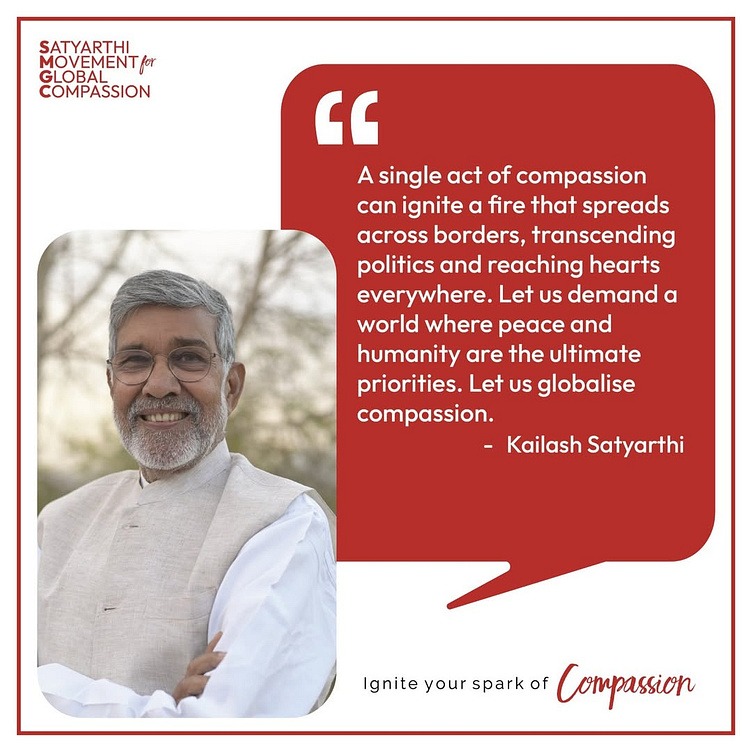
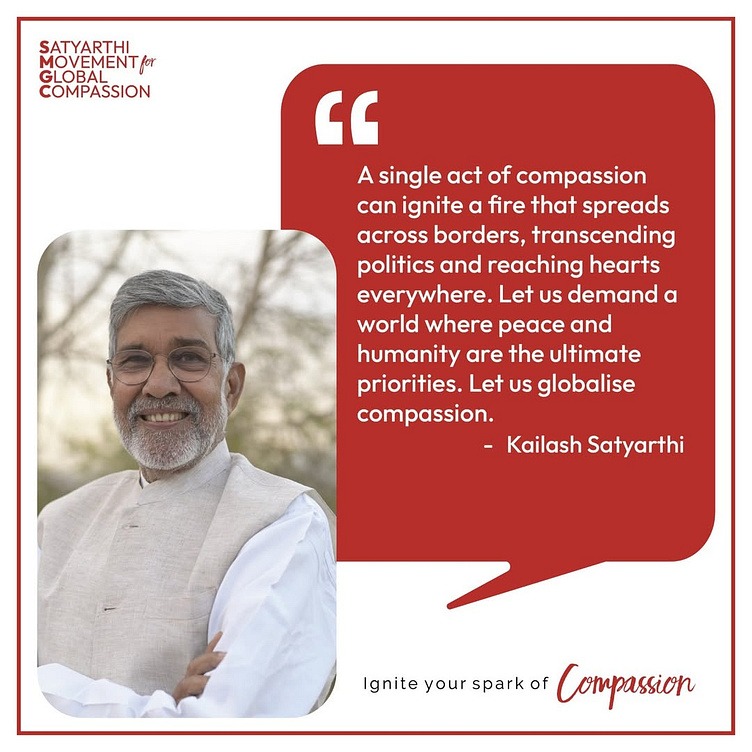
The concept of compassion frequently seems more like a lofty ideal than a practical force in a world full of injustice, inequality, and conflict. However, Nobel Peace Prize winner Kailash Satyarthi has spent more than 40 years demonstrating the opposite, turning compassion from an emotion into a potent tool for social change. As the creator of the Satyarthi Movement for Global Compassion, Kailash Satyarthi is still an advocate for children’s rights and an inspiration to a worldwide movement that views empathy as a catalyst for equity, justice, peace, and sustainability.
The Man Behind the Movement
Kailash Satyarthi, who was born in Vidisha, Madhya Pradesh, started his activism journey with a straightforward but profound query. He was profoundly impacted as a child when he witnessed another boy, the son of a cobbler, working instead of attending school. A lifelong commitment to defending children’s rights to freedom and education was sparked by this early experience with injustice.
Satyarthi left a promising engineering career to devote his life to child rights, instead starting grassroots initiatives to fight child labor, trafficking, and exploitation. He founded the Bachpan Bachao Andolan (Save the Childhood Movement) in 1980, which would go on to save tens of thousands of children and influence international child protection policy.
Child Rights: A Foundation of Human Flourishing
Kailash Satyarthi’s unwavering dedication to each child’s fundamental rights is at the heart of her work. Millions of children around the world are frequently deprived of these rights, which include freedom from forced labor, access to education, safety, dignity, and the chance to dream. Kailash Satyarthi’s advocacy has repeatedly emphasized that upholding these rights is not only a moral obligation but also the cornerstone of societal advancement and human development.
International frameworks have been significantly shaped by his efforts. Notably, the International Labour Organization’s (ILO) Convention 182, which calls for the abolition of the worst forms of child labor, was adopted thanks in part to the Global March Against Child Labor. In addition, Kailash Satyarthi co-founded the Global Campaign for Education, which upholds the fundamental tenet of children’s rights: every child should have access to high-quality education.
Compassion: More Than Emotion — A Force for Transformation
Satyarthi’s philosophy is based on a radical reinterpretation of compassion. Kailash Satyarthi believes that compassion is a transformative force that can destroy structural oppression and create just communities, despite the fact that society frequently views it as a sentimental emotion. The Satyarthi Movement for Global Compassion’s goal of globalizing compassion among people, organizations, and countries is centered on this concept.
The Movement contends that compassion needs to be linked to action. In the Founder’s Corner, Kailash Satyarthi highlights that compassion is active engagement with suffering rather than passive sympathy. It forces us to challenge unfair systems and strive for systemic fixes that protect human dignity and children’s rights.
From Local Action to Global Impact
Kailash Satyarthi’s humanitarian activism has had a significant impact. His work has freed thousands of children from abusive environments, trafficking networks, and exploitative labor through grassroots mobilization, legislative advocacy, and direct interventions. In addition to rescue efforts, Kailash Satyarthi’s model incorporates education, rehabilitation, and reintegration to guarantee that children not only avoid exploitation but also prosper in society.
Additionally, national and international policies have been impacted by his advocacy. His campaigns helped ensure that the right to education was guaranteed by the Indian Constitution. His contributions to the United Nations Sustainable Development Goals (SDGs) increased awareness of child rights on a global scale by incorporating issues related to child labor and education.
Globalizing Compassion in the 21st Century
Kailash Satyarthi envisions a world in which compassion influences education, policy, economics, and daily decision-making through programs like Satyarthi’s Compassion Quotient and international discussions highlighted in the Founder’s Corner. He exhorts people to broaden their “circle of compassion,” a notion that unites individual empathy with group action.
Beyond child rights, the Movement’s work fosters compassionate discussions about ethical consumerism, corporate responsibility, and geopolitical peace. These initiatives are a reflection of Satyarthi’s conviction that significant social change necessitates involvement from a variety of sectors, including local communities, corporations, governments, and youth leaders.
A Legacy of Hope and Action
Kailash Satyarthi’s decades of commitment were acknowledged globally in 2014 when he received the Nobel Peace Prize, confirming his role in the emancipation and education of children all over the world. Kailash Satyarthi did not rely on this honor; instead, she used it to raise awareness of the need for compassion and child rights around the world.
Kailash Satyarthi is a living example of how compassion can be used to transform societies and uplift the most vulnerable through his life’s work. His vision challenges everyone to view compassion as an urgent, practical commitment that can change communities and create a more compassionate world, rather than as a passive quality.


 Lord Gomes
 Sonal Patil