Sophie Hayes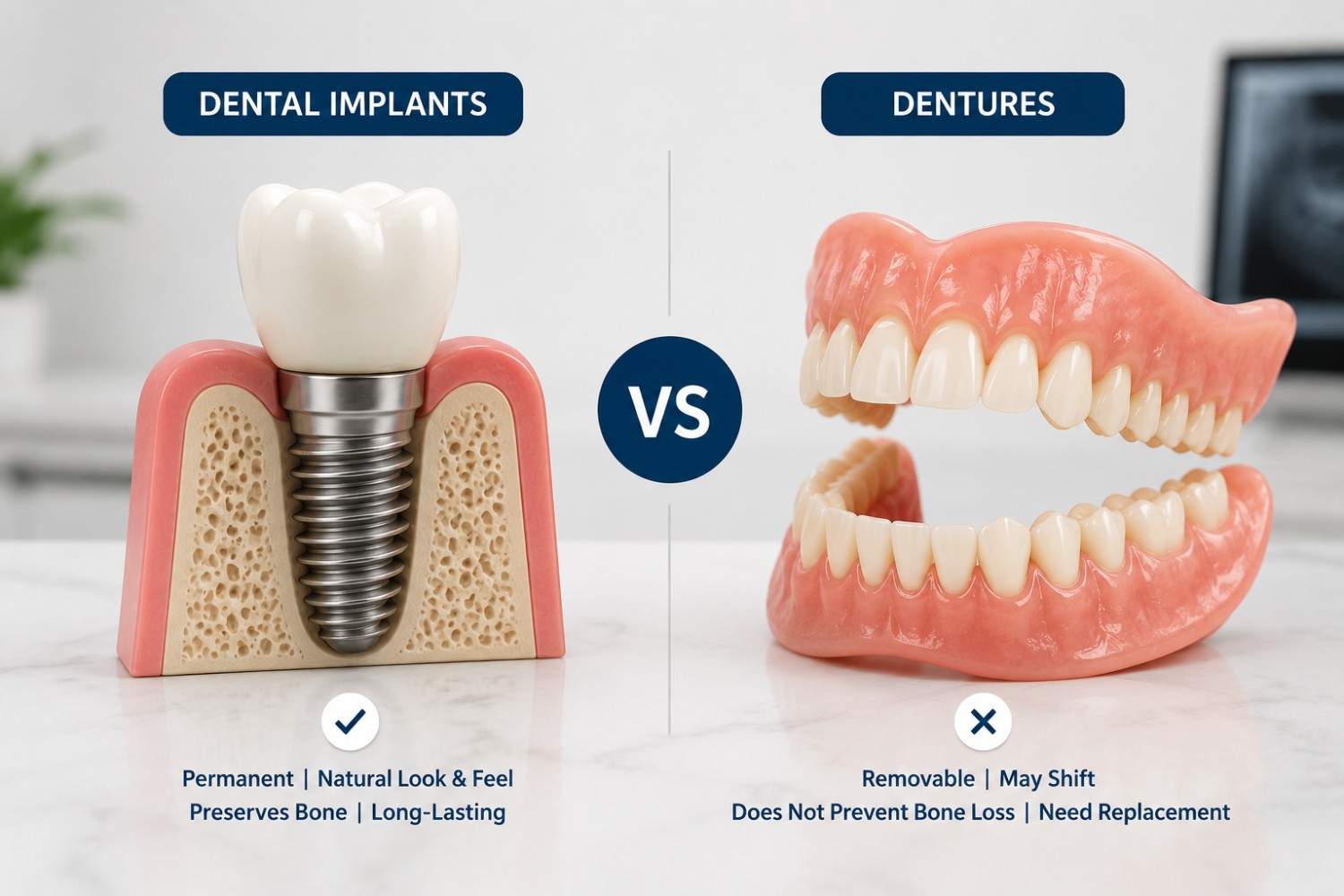
When you lose a tooth or several the next question is almost always the same: what now? Your dentist will likely present you with more than one option, and for most patients the conversation eventually comes down to two of the most common solutions in modern dentistry: dental implants and dentures. Both are effective. Both can restore your smile, your chewing ability, and your confidence. But they work very differently, suit different patients, and come with different long-term implications.
This guide breaks down the key differences honestly, so you can walk into your next dental appointment with a clearer sense of what you are looking for.
Why the Decision Matters More Than People Realise
Choosing a tooth replacement option is not just a cosmetic decision, it is a long-term oral health decision. As outlined in this overview of how missing teeth affect your oral health and why early replacement matters, an untreated gap sets off a chain of changes in the jawbone and surrounding teeth that become progressively harder to manage over time. The replacement option you choose will directly influence how well those changes are prevented or addressed.
Understanding the distinction between implants and dentures is therefore worth the time particularly before bone loss or tooth shifting has progressed to the point where certain options are no longer viable.
What Are Dental Implants?
A dental implant is a small titanium post surgically placed into the jawbone to act as an artificial tooth root. Once it integrates with the bone a process called osseointegration that takes several weeks to months a custom crown, bridge, or implant-supported denture is attached on top.
The result is a fixed, stable restoration that functions like a natural tooth. It does not move, does not rely on adjacent teeth for support, and critically continues to stimulate the jawbone the way a natural root would, preventing the bone resorption that occurs when a gap is left untreated.
Implants can replace a single tooth, multiple teeth, or provide the foundation for a full arch restoration.
What Are Dentures?
Dentures are removable appliances designed to replace several or all missing teeth. They sit on the gum line and are removed for cleaning and at night. Partial dentures replace some teeth while retaining existing natural teeth; full dentures replace an entire arch.
Modern dentures have improved significantly in terms of comfort, fit, and appearance compared to older designs. Implant-supported dentures which clip onto a small number of implants placed in the jaw offer considerably more stability than conventional removable dentures and represent a middle ground between traditional dentures and full implant restorations.
Key Differences: Implants vs Dentures
Bone preservation
This is arguably the most clinically significant difference. Implants actively prevent bone loss by stimulating the jawbone through normal biting and chewing forces. Conventional dentures sit on top of the gum and provide no such stimulation meaning bone resorption continues beneath them. Over years, this can cause dentures to fit less well as the jaw shape changes, requiring periodic relining or replacement.
Stability and function
Implants are fixed in place and function essentially like natural teeth. You eat, speak, and clean them without thinking about movement or dislodgement. Conventional dentures, particularly lower dentures, can shift during eating or speaking a common source of discomfort and self-consciousness for patients.
Maintenance
Implants are cleaned like natural teeth brushing and flossing, with regular professional check-ups. Dentures require removal for cleaning and soaking overnight. Implant-supported dentures are removed for cleaning but offer significantly better daytime stability.
Longevity
A well-placed, well-maintained implant can last decades potentially a lifetime. Dentures typically require replacement or adjustment every five to ten years as the mouth changes shape.
Treatment timeline
Dentures can often be delivered more quickly than implants. Implant treatment involves a surgical phase followed by a healing period before the final restoration is fitted a process that typically spans three to six months. For patients who need teeth replaced promptly, a temporary solution can bridge the gap during this period.
Cost
Implants have a higher upfront cost than conventional dentures. However, when factored over a ten to twenty year period accounting for denture replacements, relining, and the longer-term costs of bone loss the overall investment in implants is often comparable or lower for suitable patients.
Who Is Best Suited to Implants?
Implants are the stronger long-term option for patients who:
- Have sufficient jawbone density to support the implant post (or are willing to undergo bone grafting to restore volume)
- Are in good general health and do not have conditions that impair healing
- Are non-smokers, or are committed to quitting around the time of treatment
- Have healthy gum tissue free of active periodontal disease
- Are looking for a permanent, fixed solution with minimal long-term maintenance
Who Might Be Better Suited to Dentures?
Dentures remain an excellent solution for patients who:
- Are missing multiple or all teeth and require a full arch replacement
- Have significant bone loss that makes implant placement complex without extensive grafting
- Have medical conditions that make surgery inadvisable
- Are looking for a faster or more cost-accessible treatment pathway
- Prefer a removable option they can adjust or replace more easily over time
Implant-supported dentures are worth serious consideration for patients in this group who want improved stability without committing to full individual implant placement.
The Role of a Comprehensive Assessment
No guide can tell you which option is right for you that determination requires an examination of your specific jaw structure, bone density, gum health, existing teeth, and medical history. What works well for one patient may be entirely unsuitable for another.
At Appin Dental Surgery, patients receive a thorough assessment before any tooth replacement pathway is recommended. The team takes a patient-focused approach, explaining the clinical reasoning behind each option clearly so that patients can make informed decisions without feeling rushed or pressured.
If you are based in the area and considering your options, booking a consultation with a dentist in Wilton is the most practical first step toward understanding what is right for your specific situation.
Final Thoughts
Both dental implants and dentures are reliable, well-established solutions for tooth loss. The right choice comes down to your bone health, your general health, the number of teeth being replaced, your lifestyle, and your long-term goals.
What matters most is not which option sounds better on paper it is which option is clinically appropriate and sustainable for you personally. A qualified dental assessment gives you that clarity. The sooner you seek it, the more options remain available.

 Sayyal Health
 anaya george