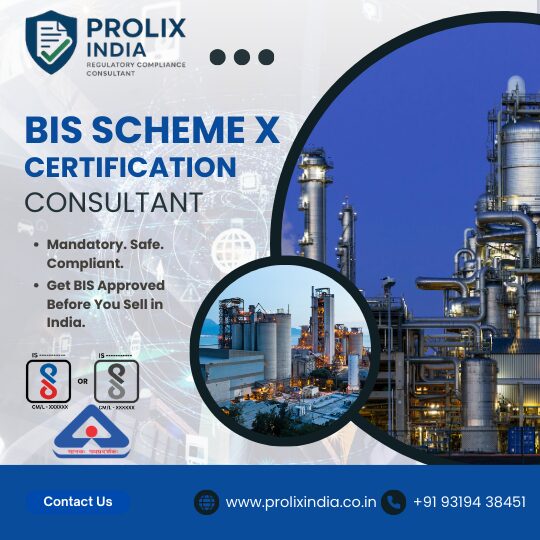
Detailed Guide to BIS Scheme X Certification and QCO Compliance in India

India’s quality regulatory framework has become increasingly structured and enforcement-driven over the past decade. The Bureau of Indian Standards (BIS), as the national standards authority, administers various conformity assessment schemes to ensure that products available in the Indian market meet defined safety and performance benchmarks. Among these mechanisms, BIS Scheme X has emerged as a significant compliance route for products notified under mandatory Quality Control Orders (QCOs).

This article provides a comprehensive understanding of BIS Scheme X, the certification procedure, regulatory implications of QCOs, and the importance of engaging experienced consultants for smooth approval.


What is BIS Scheme X?

BIS Scheme X is a conformity assessment scheme introduced for specific categories of products that are brought under compulsory certification through government-issued Quality Control Orders. When a product is covered under this scheme, manufacturers and importers must obtain certification before selling, distributing, or importing it into India.

The objective of this framework is to:

  • Ensure consistent product quality

  • Protect consumer health and safety

  • Prevent circulation of substandard goods

  • Regulate imports effectively

  • Strengthen India’s quality infrastructure

Unlike voluntary certification, compliance under Scheme X becomes legally mandatory once a QCO is notified for a product category.


Understanding BIS Scheme X QCO

A Quality Control Order (QCO) is a statutory notification issued by the concerned ministry under the Government of India. It mandates that specific products comply with the applicable Indian Standard and obtain BIS certification before being placed in the market.

When a product falls under a BIS Scheme X QCO:

  • Manufacturing without certification becomes unlawful

  • Import consignments require valid BIS licensing

  • Non-compliant goods may be seized

  • Regulatory enforcement increases significantly

Businesses must closely track QCO notifications because non-compliance can result in penalties, financial loss, and operational disruptions.


BIS Scheme X Certification Process

The BIS Scheme X Certification process is systematic and involves detailed evaluation of both product conformity and manufacturing capability.

1. Application Filing

Manufacturers must submit an application through the BIS online portal along with required documentation. The documentation generally includes:

  • Business incorporation certificates

  • Factory license and layout plan

  • Manufacturing process details

  • List of machinery and testing equipment

  • Calibration certificates

  • Quality control procedures

  • Authorized signatory details

Foreign manufacturers must appoint an Authorized Indian Representative (AIR) to coordinate with BIS.


2. Product Testing

The product must be tested at a BIS-recognized laboratory according to the relevant Indian Standard. Testing verifies compliance with safety, performance, and quality parameters defined in the standard.

If the product does not meet requirements, corrective measures such as design modifications or material adjustments may be necessary before re-testing.


3. Factory Inspection

BIS officials conduct a factory inspection to assess:

  • Production infrastructure

  • In-house testing capabilities

  • Quality management systems

  • Raw material control

  • Record maintenance practices

The purpose of inspection is to confirm that the manufacturer can consistently produce conforming products.


4. Grant of License

Upon satisfactory review of documents, test reports, and inspection findings, BIS grants the certification license. The manufacturer is then authorized to use the BIS Standard Mark as per applicable guidelines.

The license remains valid for a specified duration and must be renewed periodically.


Financial Aspects of Certification

The cost of certification under Scheme X varies depending on product type and production volume. Common cost components include:

  • Application fee

  • Laboratory testing charges

  • Inspection fee

  • Annual license fee

  • Marking fee (based on production quantity)

Additional costs may arise if product modifications or retesting are required. Businesses should consider both initial certification expenses and ongoing compliance costs.


Post-Certification Obligations

Certification is not a one-time process. License holders must maintain continuous compliance by:

  • Conducting periodic product testing

  • Maintaining quality records

  • Allowing surveillance inspections

  • Paying marking and renewal fees

  • Reporting production data when required

Failure to comply with ongoing obligations can result in suspension or cancellation of the license.


Importance of a Scheme X Consultant

Regulatory certification involves technical, procedural, and documentation complexities. A professional scheme x consultant assists businesses in navigating the process efficiently.

Key services typically include:

  • Identifying applicable Indian Standards

  • Interpreting QCO notifications

  • Preparing and reviewing documentation

  • Coordinating laboratory testing

  • Ensuring factory readiness for inspection

  • Responding to regulatory queries

Engaging a top scheme x consultant helps minimize errors, reduce approval time, and avoid costly delays. Consultants bring experience in dealing with BIS authorities and understand procedural nuances that may not be obvious to first-time applicants.

For foreign manufacturers unfamiliar with Indian regulatory systems, professional assistance is particularly valuable.


Common Challenges Faced by Manufacturers

Despite structured guidelines, businesses often encounter challenges such as:

  1. Technical Non-Conformities
    Products may fail initial testing due to design or material gaps.

  2. Inadequate Testing Facilities
    Manufacturing units may need to upgrade in-house laboratories.

  3. Documentation Errors
    Missing calibration certificates or inconsistent quality manuals can delay approval.

  4. Regulatory Amendments
    Updates to QCOs or Indian Standards may affect ongoing applications.

Proactive planning and compliance audits significantly reduce these risks.


Strategic Importance of Scheme X Compliance

BIS Scheme X is not merely a regulatory obligation; it is a strategic advantage. Certification enhances brand credibility and assures customers of product reliability.

Benefits include:

  • Improved market reputation

  • Better consumer confidence

  • Competitive advantage in regulated sectors

  • Reduced risk of legal action

  • Smooth customs clearance for imports

As India strengthens its quality ecosystem, adherence to mandatory certification frameworks becomes integral to sustainable business growth.


Best Practices for Smooth Certification

Manufacturers can streamline the process by:

  • Conducting internal compliance audits before application

  • Reviewing QCO notifications carefully

  • Ensuring proper calibration of testing equipment

  • Maintaining organized production records

  • Engaging experienced regulatory professionals

A structured approach prevents last-minute corrections and unnecessary financial burden.


Conclusion

BIS Scheme X establishes a mandatory compliance pathway for products notified under Quality Control Orders in India. Through application review, product testing, factory inspection, and ongoing surveillance, the scheme ensures adherence to prescribed Indian Standards. Manufacturers and importers must treat compliance as a strategic priority to avoid legal complications and operational interruptions.

Professional guidance plays a crucial role in achieving timely certification and maintaining regulatory integrity. Organizations seeking comprehensive support for BIS Scheme X Certification can rely on Prolix India for structured assistance and end-to-end compliance management.



Related Posts

Rugged Tablet – The Ultimate Mobile Computing Solution for Harsh Environments

Discover the benefits of a rugged tablet for industrial, construction, logistics, and field service applications. Learn how rugged tablets improve productivity, durability, and performance in harsh environments.

Rugged Tablet – The Ultimate Mobile Computing Solution for Harsh Environments Rugged Tablet: The Ultimate Mobile Computing Solution for Harsh Environments In today’s fast-paced industries, businesses need technology that can perform reliably in demanding conditions. A rugged tablet is specifically designed to withstand harsh environments where standard consumer tablets may fail. From construction sites and manufacturing facilities to logistics operations and field services, rugged tablets provide durability, performance, and mobility that help organizations improve productivity and efficiency. What Is a Rugged Tablet? A rugged tablet is a durable mobile computing device built to operate in challenging environments. Unlike conventional tablets, rugged tablets are engineered with reinforced materials, shock-resistant frames, sealed ports, and protective screens. These features allow them to survive drops, vibrations, extreme temperatures, dust, and water exposure. Rugged tablets are commonly used by professionals who work outdoors or in industrial settings where equipment reliability is critical. Their robust design ensures continuous operation even in conditions that would damage standard devices. Key Features of a Rugged Tablet Exceptional Durability One of the most important advantages of a rugged tablet is its durability. These devices are designed to meet military-grade standards and often carry IP ratings that certify resistance to water and dust. Rugged tablets can withstand accidental drops, rough handling, and exposure to environmental hazards. Powerful Performance Modern rugged tablets come equipped with advanced processors, ample memory, and fast storage solutions. This enables users to run business-critical applications smoothly while working in the field. Whether managing inventory, collecting data, or accessing cloud-based systems, a rugged tablet delivers dependable performance. Long Battery Life Field workers often spend long hours away from charging stations. Rugged tablets are designed with high-capacity batteries that provide extended operating time. Some models even feature hot-swappable batteries, allowing users to replace batteries without shutting down the device. Sunlight-Readable Displays Outdoor workers need screens that remain visible under direct sunlight. A rugged tablet typicall

Discover the benefits of a rugged tablet for industrial, construction, logistics, and field service applications. Learn how rugged tablets improve productivity, durability, and performance in harsh environments.

Leave a Reply

Your email address will not be published. Required fields are marked *

You Missed

Fiber Optic Market Competition Analysis and Demand Forecast for Industry Stakeholders

Fiber Optic Market Competition Analysis and Demand Forecast for Industry Stakeholders

Rugged Tablet – The Ultimate Mobile Computing Solution for Harsh Environments

Rugged Tablet – The Ultimate Mobile Computing Solution for Harsh Environments

Rugged Tablet – The Ultimate Mobile Computing Solution for Harsh Environments Rugged Tablet: The Ultimate Mobile Computing Solution for Harsh Environments In today’s fast-paced industries, businesses need technology that can perform reliably in demanding conditions. A rugged tablet is specifically designed to withstand harsh environments where standard consumer tablets may fail. From construction sites and manufacturing facilities to logistics operations and field services, rugged tablets provide durability, performance, and mobility that help organizations improve productivity and efficiency. What Is a Rugged Tablet? A rugged tablet is a durable mobile computing device built to operate in challenging environments. Unlike conventional tablets, rugged tablets are engineered with reinforced materials, shock-resistant frames, sealed ports, and protective screens. These features allow them to survive drops, vibrations, extreme temperatures, dust, and water exposure. Rugged tablets are commonly used by professionals who work outdoors or in industrial settings where equipment reliability is critical. Their robust design ensures continuous operation even in conditions that would damage standard devices. Key Features of a Rugged Tablet Exceptional Durability One of the most important advantages of a rugged tablet is its durability. These devices are designed to meet military-grade standards and often carry IP ratings that certify resistance to water and dust. Rugged tablets can withstand accidental drops, rough handling, and exposure to environmental hazards. Powerful Performance Modern rugged tablets come equipped with advanced processors, ample memory, and fast storage solutions. This enables users to run business-critical applications smoothly while working in the field. Whether managing inventory, collecting data, or accessing cloud-based systems, a rugged tablet delivers dependable performance. Long Battery Life Field workers often spend long hours away from charging stations. Rugged tablets are designed with high-capacity batteries that provide extended operating time. Some models even feature hot-swappable batteries, allowing users to replace batteries without shutting down the device. Sunlight-Readable Displays Outdoor workers need screens that remain visible under direct sunlight. A rugged tablet typicall

Rugged Tablet – The Ultimate Mobile Computing Solution for Harsh Environments Rugged Tablet: The Ultimate Mobile Computing Solution for Harsh Environments In today’s fast-paced industries, businesses need technology that can perform reliably in demanding conditions. A rugged tablet is specifically designed to withstand harsh environments where standard consumer tablets may fail. From construction sites and manufacturing facilities to logistics operations and field services, rugged tablets provide durability, performance, and mobility that help organizations improve productivity and efficiency. What Is a Rugged Tablet? A rugged tablet is a durable mobile computing device built to operate in challenging environments. Unlike conventional tablets, rugged tablets are engineered with reinforced materials, shock-resistant frames, sealed ports, and protective screens. These features allow them to survive drops, vibrations, extreme temperatures, dust, and water exposure. Rugged tablets are commonly used by professionals who work outdoors or in industrial settings where equipment reliability is critical. Their robust design ensures continuous operation even in conditions that would damage standard devices. Key Features of a Rugged Tablet Exceptional Durability One of the most important advantages of a rugged tablet is its durability. These devices are designed to meet military-grade standards and often carry IP ratings that certify resistance to water and dust. Rugged tablets can withstand accidental drops, rough handling, and exposure to environmental hazards. Powerful Performance Modern rugged tablets come equipped with advanced processors, ample memory, and fast storage solutions. This enables users to run business-critical applications smoothly while working in the field. Whether managing inventory, collecting data, or accessing cloud-based systems, a rugged tablet delivers dependable performance. Long Battery Life Field workers often spend long hours away from charging stations. Rugged tablets are designed with high-capacity batteries that provide extended operating time. Some models even feature hot-swappable batteries, allowing users to replace batteries without shutting down the device. Sunlight-Readable Displays Outdoor workers need screens that remain visible under direct sunlight. A rugged tablet typicall

Best Online Reputation Management Services in India for Brand Protection

Best Online Reputation Management Services in India for Brand Protection

Rugged Tablet – The Ultimate Mobile Computing Solution for Harsh Environments Rugged Tablet: The Ultimate Mobile Computing Solution for Harsh Environments In today’s fast-paced industries, businesses need technology that can perform reliably in demanding conditions. A rugged tablet is specifically designed to withstand harsh environments where standard consumer tablets may fail. From construction sites and manufacturing facilities to logistics operations and field services, rugged tablets provide durability, performance, and mobility that help organizations improve productivity and efficiency. What Is a Rugged Tablet? A rugged tablet is a durable mobile computing device built to operate in challenging environments. Unlike conventional tablets, rugged tablets are engineered with reinforced materials, shock-resistant frames, sealed ports, and protective screens. These features allow them to survive drops, vibrations, extreme temperatures, dust, and water exposure. Rugged tablets are commonly used by professionals who work outdoors or in industrial settings where equipment reliability is critical. Their robust design ensures continuous operation even in conditions that would damage standard devices. Key Features of a Rugged Tablet Exceptional Durability One of the most important advantages of a rugged tablet is its durability. These devices are designed to meet military-grade standards and often carry IP ratings that certify resistance to water and dust. Rugged tablets can withstand accidental drops, rough handling, and exposure to environmental hazards. Powerful Performance Modern rugged tablets come equipped with advanced processors, ample memory, and fast storage solutions. This enables users to run business-critical applications smoothly while working in the field. Whether managing inventory, collecting data, or accessing cloud-based systems, a rugged tablet delivers dependable performance. Long Battery Life Field workers often spend long hours away from charging stations. Rugged tablets are designed with high-capacity batteries that provide extended operating time. Some models even feature hot-swappable batteries, allowing users to replace batteries without shutting down the device. Sunlight-Readable Displays Outdoor workers need screens that remain visible under direct sunlight. A rugged tablet typicall

Rugged Tablet – The Ultimate Mobile Computing Solution for Harsh Environments Rugged Tablet: The Ultimate Mobile Computing Solution for Harsh Environments In today’s fast-paced industries, businesses need technology that can perform reliably in demanding conditions. A rugged tablet is specifically designed to withstand harsh environments where standard consumer tablets may fail. From construction sites and manufacturing facilities to logistics operations and field services, rugged tablets provide durability, performance, and mobility that help organizations improve productivity and efficiency. What Is a Rugged Tablet? A rugged tablet is a durable mobile computing device built to operate in challenging environments. Unlike conventional tablets, rugged tablets are engineered with reinforced materials, shock-resistant frames, sealed ports, and protective screens. These features allow them to survive drops, vibrations, extreme temperatures, dust, and water exposure. Rugged tablets are commonly used by professionals who work outdoors or in industrial settings where equipment reliability is critical. Their robust design ensures continuous operation even in conditions that would damage standard devices. Key Features of a Rugged Tablet Exceptional Durability One of the most important advantages of a rugged tablet is its durability. These devices are designed to meet military-grade standards and often carry IP ratings that certify resistance to water and dust. Rugged tablets can withstand accidental drops, rough handling, and exposure to environmental hazards. Powerful Performance Modern rugged tablets come equipped with advanced processors, ample memory, and fast storage solutions. This enables users to run business-critical applications smoothly while working in the field. Whether managing inventory, collecting data, or accessing cloud-based systems, a rugged tablet delivers dependable performance. Long Battery Life Field workers often spend long hours away from charging stations. Rugged tablets are designed with high-capacity batteries that provide extended operating time. Some models even feature hot-swappable batteries, allowing users to replace batteries without shutting down the device. Sunlight-Readable Displays Outdoor workers need screens that remain visible under direct sunlight. A rugged tablet typicall

Why Working with a Trusted Pittsburgh Real Estate Agent Makes a Difference

Why Working with a Trusted Pittsburgh Real Estate Agent Makes a Difference