Shaik Yaseen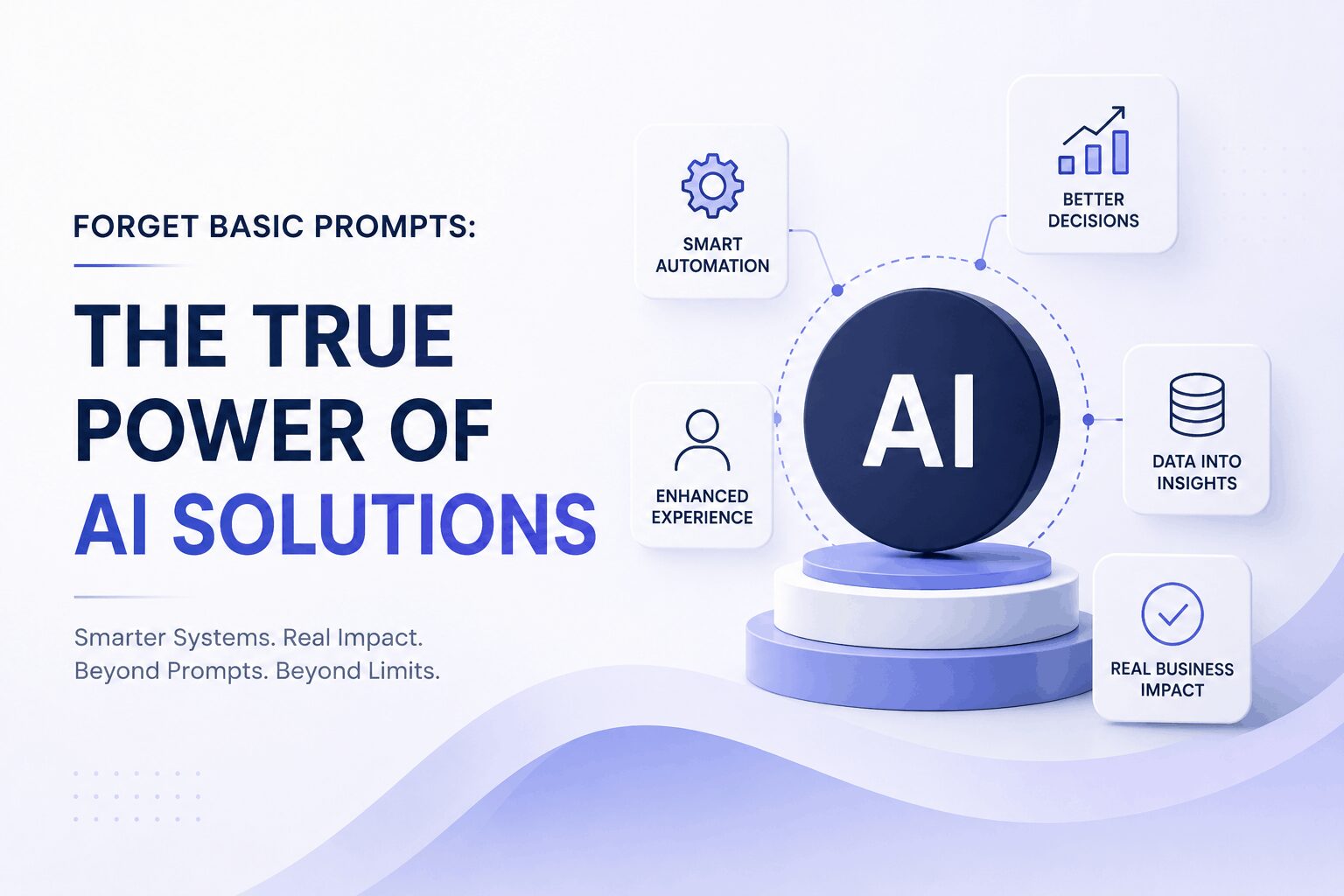
Most businesses think they’re using AI because they’ve experimented with a chatbot. The reality is that prompts are only the beginning.
The first wave of AI adoption introduced businesses to what artificial intelligence could do. Teams used AI to generate content, summarize documents, and answer questions faster than ever before. While these capabilities are impressive, they represent only a small fraction of AI’s potential.
The real value of AI emerges when it moves beyond individual prompts and becomes part of business operations. Modern AI solutions can automate workflows, improve decision-making, analyze massive datasets, and continuously optimize processes behind the scenes. Instead of helping employees complete individual tasks, they help entire organizations operate more efficiently.
This shift is changing how businesses think about artificial intelligence. The conversation is no longer about asking better questions. It is about building smarter systems that deliver measurable business outcomes.
The Prompt Era Changed Everything
There is no denying the impact of generative AI.
Businesses across industries quickly adopted AI tools to improve productivity. Marketing teams used AI to create content. Customer service teams used AI-powered chatbots. Analysts used AI to summarize reports and research.
These use cases created excitement because they delivered immediate value. However, most prompt based interactions share a common limitation. They require human involvement. Someone still needs to ask the question, review the output, and decide what happens next. While this improves productivity, it does not fundamentally transform how a business operates.
That is where AI solutions create a much bigger impact.
Why Prompts Alone Create Limited Business Value
Prompt-based AI is useful, but it often functions as a standalone tool rather than an integrated business capability.
For example:
- A chatbot can answer customer questions.
- An AI writer can generate content.
- An AI assistant can summarize meetings.
These tasks save time, but they typically remain isolated activities.
Businesses looking for long-term advantages need systems that connect directly to workflows, operations, and decision-making processes. This requires moving beyond simple prompts and toward intelligent automation.
Organizations that stop at prompt engineering often miss the larger opportunity.
The goal should not be making individual employees faster.
The goal should be making the entire organization smarter.
What Real AI Solutions Actually Do
Modern AI solutions operate at a completely different level.
Instead of responding to individual requests, they continuously process information, identify opportunities, and support business operations.
Examples include:
- Predictive demand forecasting
- Automated customer support systems
- Intelligent document processing
- Workforce optimization
- Fraud detection
- Predictive maintenance
These systems work continuously without requiring constant human input.
This is why businesses increasingly view AI as an operational capability rather than a productivity tool.
Organizations investing in AI Solutions are often focused on creating scalable systems that improve efficiency across multiple departments simultaneously.
AI Works Best When It Disappears
One of the most interesting aspects of successful AI implementation is that users often stop noticing it.
The best AI systems work quietly in the background.
Customers receive faster responses. Employees spend less time on repetitive work. Managers gain better insights. Operations become more efficient.
The technology itself becomes less visible.
What remains visible are the results.
Companies like Rubixe frequently help organizations identify opportunities where AI can create value without disrupting existing workflows. This approach improves adoption while delivering measurable business outcomes.
AI Solutions Turn Data Into Action
Most organizations already possess enormous amounts of data.
The challenge is turning that data into useful decisions.
Modern AI solutions help businesses:
- Identify trends
- Predict future outcomes
- Detect operational inefficiencies
- Improve customer experiences
- Support strategic planning
Without AI, much of this information remains underutilized.
With AI, businesses gain the ability to transform raw data into actionable intelligence.
This capability is becoming increasingly important as organizations generate more information than ever before.
Why Businesses Are Moving Beyond Chatbots
Chatbots introduced many organizations to artificial intelligence, but expectations have evolved.
Businesses now want systems that can:
- Automate complex workflows
- Improve operational efficiency
- Reduce costs
- Support decision-making
- Scale with growth
This requires a broader approach to AI adoption.
Companies are no longer evaluating AI solely on what it can say. They are evaluating it on what it can do.
Organizations exploring AI Automation initiatives are increasingly focused on creating end-to-end processes that deliver measurable improvements rather than isolated productivity gains.
The Competitive Advantage of AI Solutions
The companies gaining the most value from AI are not necessarily those using the most advanced models.
They are the companies integrating AI directly into their operations.
Competitive advantages often come from:
- Faster decision-making
- Improved customer experiences
- Reduced operational costs
- Better resource allocation
- Enhanced scalability
These benefits compound over time.
As AI adoption increases, businesses that treat AI as infrastructure rather than experimentation will be better positioned to outperform competitors.
Companies like Rubixe are seeing this shift firsthand as organizations move from testing AI tools to building AI-powered business capabilities.
The Bottom Line
Prompts helped businesses discover the potential of artificial intelligence. They demonstrated what AI could do on an individual level and accelerated adoption across industries.
But prompts are only the beginning.
The real power of AI emerges when technology becomes embedded within business operations. Modern AI solutions automate workflows, improve decisions, optimize resources, and create systems that generate value continuously.
Businesses that move beyond simple prompt-based interactions will be the ones that unlock the greatest competitive advantage. The future of AI is not about asking better questions.
It is about building smarter businesses.
FAQ
What are AI solutions?
AI solutions are systems that use artificial intelligence to automate processes, improve decision-making, analyze data, and optimize business operations.
How are AI solutions different from chatbots?
Chatbots focus on conversations and task assistance, while AI solutions can automate workflows, support operations, and improve business performance.
Why are businesses investing in AI solutions?
Organizations use AI solutions to improve efficiency, reduce costs, enhance customer experiences, and gain competitive advantages.
Can AI solutions work without constant human input?
Yes. Many AI solutions operate continuously by monitoring data, automating tasks, and providing insights in real time.
What industries benefit from AI solutions?
Healthcare, retail, finance, manufacturing, logistics, and professional services all benefit from AI-powered solutions.
How do AI solutions improve decision-making?
AI analyzes large volumes of data, identifies patterns, predicts outcomes, and provides insights that support better business decisions.


 Usama Bajwa
 Jhon Kary