divyanshi sain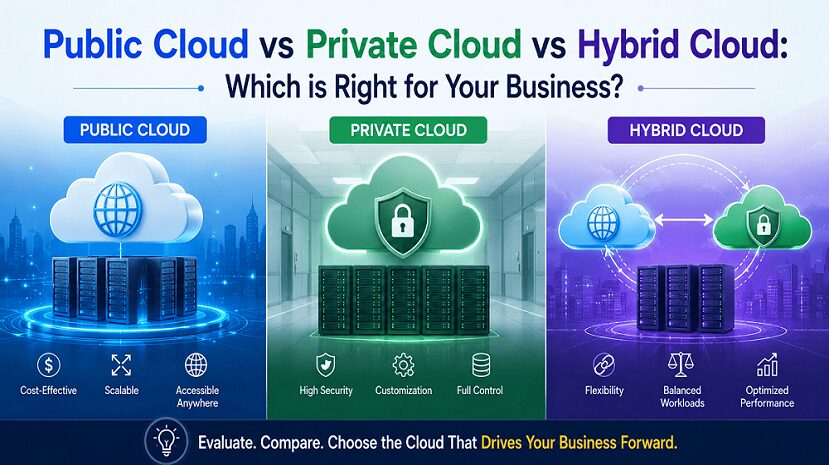
Public Cloud vs Private Cloud vs Hybrid Cloud: Which is Right for Your Business?
A few years back, a small textile business owner in Jaipur told me something simple. He said his billing software crashed every time festival season sales went up. His server just could not handle the load. He had two choices. Buy more hardware and let it sit idle for eleven months, or find another way. He picked the cloud, and his problem disappeared within a week.
This story is not rare anymore. Flexera’s 2026 State of the Cloud report found that 73% of organisations now run a hybrid cloud setup, mixing public and private cloud together. That number tells us something important. Businesses are no longer picking just one type of cloud. They are picking whatever mix works best for them.
But here is the real problem most people face. When someone says “move to the cloud,” it sounds like one simple thing. It is not. There are three main paths, public cloud, private cloud, and hybrid cloud. Each one solves a different problem and creates different costs. Many business owners in Jaipur and nearby cities pick a cloud model just because a vendor pushed it on them. Later they realise it does not fit their business at all.
This guide clears up that confusion. We will explain Public Cloud vs Private Cloud vs Hybrid Cloud in plain and simple language, so you can pick what actually fits your business, your budget, and your data needs.
What is Cloud Computing?
Cloud computing simply means using computer power, storage, and software over the internet instead of running everything on your own machines. You do not need a big server room in your office. You rent space and power from a cloud provider, and you pay only for what you use.
This idea has grown fast in the last few years. Cloud computing is no longer just for big IT companies. Small shops, schools, hospitals, and even local traders now use some form of cloud service daily, often without even realising it.
What is Public Cloud
Public cloud is the most common cloud deployment model. A provider like AWS, Microsoft Azure, or Google Cloud owns the servers. They rent out space to many different customers on the same shared infrastructure. You get your own private section, but the physical hardware is shared with others.
Public cloud is popular because it is quick to set up and cheap to start. You do not buy any hardware. You just sign up and start using storage, servers, or software instantly. This is why so many startups and small businesses choose public cloud first.
The only concern some businesses raise is data control. Since your data sits on shared servers owned by another company, some industries with strict compliance rules feel more cautious about it.
What is Private Cloud
Private clouds work differently. Here, the cloud infrastructure is used by only one organisation. It can sit inside your own office as a private data centre, or a provider can host it for you on dedicated hardware that nobody else touches.
Private cloud gives full control over data, security settings, and performance. Banks, hospitals, and government offices often prefer private clouds because they handle sensitive information and must follow strict rules.
The tradeoff is cost. Private cloud needs more investment upfront and more staff to manage it. It is not the easiest option for a small business just starting out, but it makes sense for organisations that cannot compromise on data control.
What is Hybrid Cloud
Hybrid cloud combines both public and private cloud. A business keeps sensitive data and critical systems on a private cloud, while using public cloud for less sensitive work like websites, testing, or handling extra traffic during busy periods.
This model is now the most common choice among large organisations, and the trend is growing fast among smaller businesses too. It gives the best of both sides, tight control where needed, and flexibility where speed and cost savings matter more.
A textile trader can keep customer payment records on a private server, while running the online store and marketing tools on a public cloud. That is a hybrid cloud working in real life.
Public Cloud vs Private Cloud Comparison
When people search for a Public Cloud vs Private Cloud comparison, they usually want a quick answer about cost, security, and control.
Public cloud wins on cost and speed. You pay only for what you use, and you can scale up or down in minutes. It suits businesses with changing workloads, seasonal demand, or a small IT team.
Private cloud wins on control and compliance. You know exactly where your data lives and who can access it. It suits businesses in finance, healthcare, or government work, where rules around data storage are strict.
Neither one is better in every case. The right pick depends on what your business actually needs, not on what sounds more advanced.
Public vs Private vs Hybrid Cloud Differences
Here is a simple way to remember the Public vs Private vs Hybrid Cloud differences.
Public cloud shares resources among many users and costs less to start. Private cloud gives one business full ownership and stronger security, but costs more. Hybrid cloud sits in the middle, using private cloud for sensitive work and public cloud for everything else.
Think of it like housing. Public cloud is like renting a flat in a shared building. A private cloud is like owning your own independent house. Hybrid cloud is like owning a house but also renting extra space during a big family function. You use exactly what you need, when you need it.
This is the real intent behind the search term Public Cloud vs Private Cloud vs Hybrid Cloud. People are not looking for technical definitions alone. They want to know which one saves money, which one keeps data safe, and which one grows with their business without breaking it.
How to Choose the Right Cloud Model
Choosing the right cloud deployment model does not need to be complicated. Ask yourself a few honest questions.
How sensitive is your data? If you handle financial records, medical data, or government contracts, lean towards private cloud or hybrid cloud.
How much can you spend right now? If the budget is tight and you want to start fast, public cloud is the easier door to walk through.
Does your traffic or workload change a lot? Seasonal businesses, online stores, and apps with sudden spikes benefit from the flexibility of public cloud, often mixed with private cloud through a hybrid setup.
Do you have an IT team to manage servers? Private cloud needs more hands-on management. If your team is small, a public cloud or a managed hybrid setup reduces that burden.
Most growing businesses today land on hybrid cloud, because it adjusts to changing needs instead of locking you into one path. If you want to understand this better, the best way is to learn cloud computing practically. Try a free tier on any public cloud provider, run a small project, and see how storage, scaling, and pricing actually work in real time. Reading about it only gets you halfway. Hands-on practice makes the concept stick.
Conclusion
Public cloud, private cloud, and hybrid cloud are not competing ideas. They are tools, and each one fits a different job. Public cloud gives speed and low cost. Private clouds give control and stronger compliance. Hybrid cloud blends both, and that is exactly why most businesses in 2026 are choosing it.
The right choice for your business comes down to your data, your budget, and how much your workload changes through the year. Take time to map these out before you commit to any cloud deployment model. A wrong choice can cost time and money later. A right choice, even a small one, can help your business run smoother and grow faster.


 Zio Tech
 Thatware LLP