Northern Lights Solar Solutions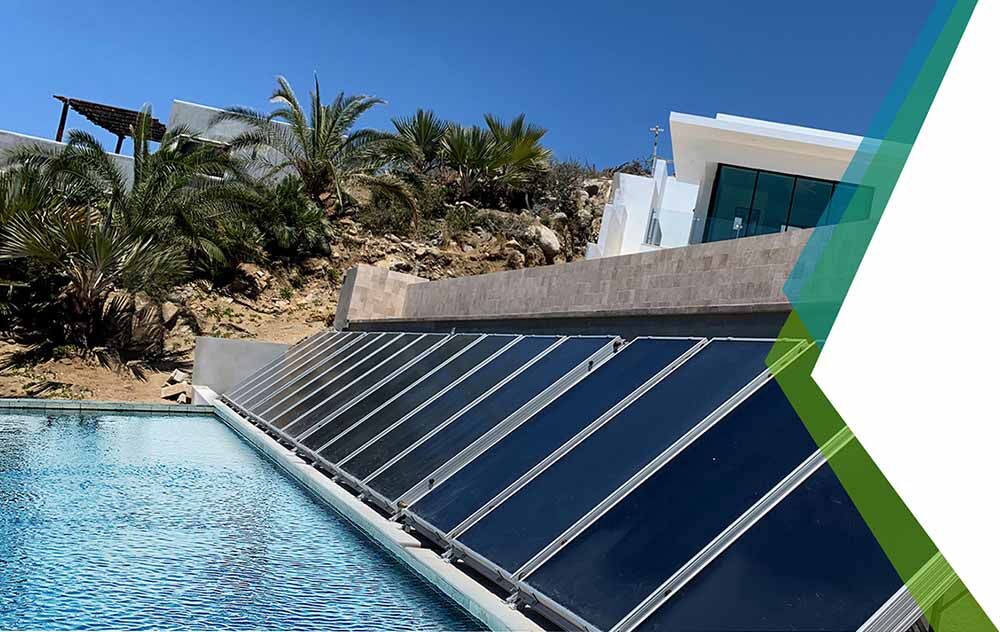
sick of your pool not getting any use for 6 months out of the year because the water is like an ice bath? You are not the only one. More and more American homeowners are now questioning the issue; with electricity prices being unstable as ever and old gas heaters needing to be replaced, what’s a way to consistently get warm pool water at a reasonable price?
Solar pool heaters are not suddenly a ‘fad,’ and their adoption is primarily due to finally making financial sense. In this article we move beyond the sales talk and provide you with the engineering, cost, and real performance you need to know whether and how to size a system.
How Solar Pool Heaters Work (It’s Simpler Than You Think)
There’s no fancy boiler; you already own your pool pump. Water is pumped through a series of black collectors (usually on your roof), which direct sunshine straight to it. A differential controller compares roof temperature to pool temperature and will only pump water when there is surplus heat available for free!
Remember it is thermal, not photovoltaic (PV). PV cells produce electricity at an efficiency of 19-24%. An efficient solar collector turns 80-90% of sun radiation directly into heat. Water’s specific heat capacity is immense. No flames, no compressors, no fancy controls, only your pump you already have.
Unglazed vs. Glazed Collectors
Typically in the US, residential pools use unglazed collectors. Most use UV stabilized polypropylene or EPDM rubber. These are relatively lightweight, freeze tolerant, and function well as long as ambient air temperatures do not dip below freezing. Consider Florida, Texas and Southern California.
Glazed collectors contain polymer or copper tubes housed in tempered glass. Though more expensive, they can retain heat effectively in cold, windy weather. The Department of Energy considers them most appropriate for all-season use, indoor swimming pools or for use in cooler climates where swimming will occur even in 45°F ambient air temperatures. The thermal performance is given in Btu per square foot per day. Certified OG-400 models can be found through the Solar Rating & Certification Corporation (SRCC).
What Real-World Performance Looks Like in 2026
You will probably see a 5-12F temp lift in most climates once you get the sizes right and up to 15-18F in Sun Belt states with a cover. There’s no magic to performance, only surface area and hours of sun.
DOE says one collector at its most efficient on a bright summer day puts out about 1000-1500 Btu/ft/day. If they are within 25 Btu per ft per day, call them the same—it’s installation that makes a bigger difference than a spec sheet.
Life span is the dark horse. Unglazed can last 15-20 years, glazed over 20 years, with minimal maintenance; the only moving part is a valve. Think about this next to the 5-10 years a gas heater will last in chlorinated air.
Installation, Maintenance, and Longevity
The installation must be right; otherwise the rest will not matter. The position of your roof will play some part, but the effect is greatly exaggerated; roofs that face west or east will be down only 10–15% from optimum true south almost everywhere in the country. The angle should be about the same number of degrees as your latitude, minus 10 to 15, if the system will be used primarily in the summer.
Find a licensed solar thermal installer. The pool guys do not cut it. Ask:
- How many solar thermal pool systems have you installed in the last 2 years?
- Are you NABCEP Solar Heating certified or licensed in your state as a plumber?
- Can you furnish the SRCC rating of your collectors?
Maintenance is simple: wash and go. Maintain proper pool chemistry; backwash periodically, and in dry regions hose off glazed collectors once a year or so. If there is danger of freezing, drain the system in the winter.
The Smart System Approach: Solar + Pump + Cover
The top-performing setups for 2026 aren’t about any single product: free gains in sunlight from solar collectors, supplemental heat on cloudy days from an inverter heat pump, and a decent cover for retaining the heat it has already gained are combined for top performance. Indeed, SolarTubs has carved out a niche and built their brand on exactly these three technologies (combining German Thermax solar collectors with cold-graded heat pumps that maximize swim season without excessive costs).
The goal is to prevent heat loss rather than increase BTU output. Covers alone will reduce demand on other forms of heat by 50-70 percent.
Is It Worth It in 2026?
If you are swimming over three months of the year and spending more than $1.20 per therm on gas or more than $0.16 per kWh on electricity, the payback is between 3 and 7 years, after which the heating is free. For holiday lets or when heating the house to 84-88°F for a family, it pays for itself even quicker.
The environmental argument is just as simple: no local emissions, no combustion and no leaking refrigerant if you run a heat pump as a standalone.
To Sum Up
Solar pool heating is no longer a luxury; it is the standard for savvy pool ownership. Know your collector type and size for your climate, not for your neighbor-insist on a good cover, and check the installer against SRCC ratings. Do all that, and you’ll have a pool that sips, doesn’t drink, and heats for 15-20 years with a meter that barely skips a beat.
When comparing bids, don’t be impressed by the number of panels; Ask for Btu/day per dollar, warranty details, and an estimate of climate-adjusted performance. That way, you buy one pool and enjoy many more swims.
For those with an eye on colder climates, where engineering an integrated system may prove challenging, working with specialists like SolarTubs may be a more efficient first step.

 Mark Johansan