Mike Todd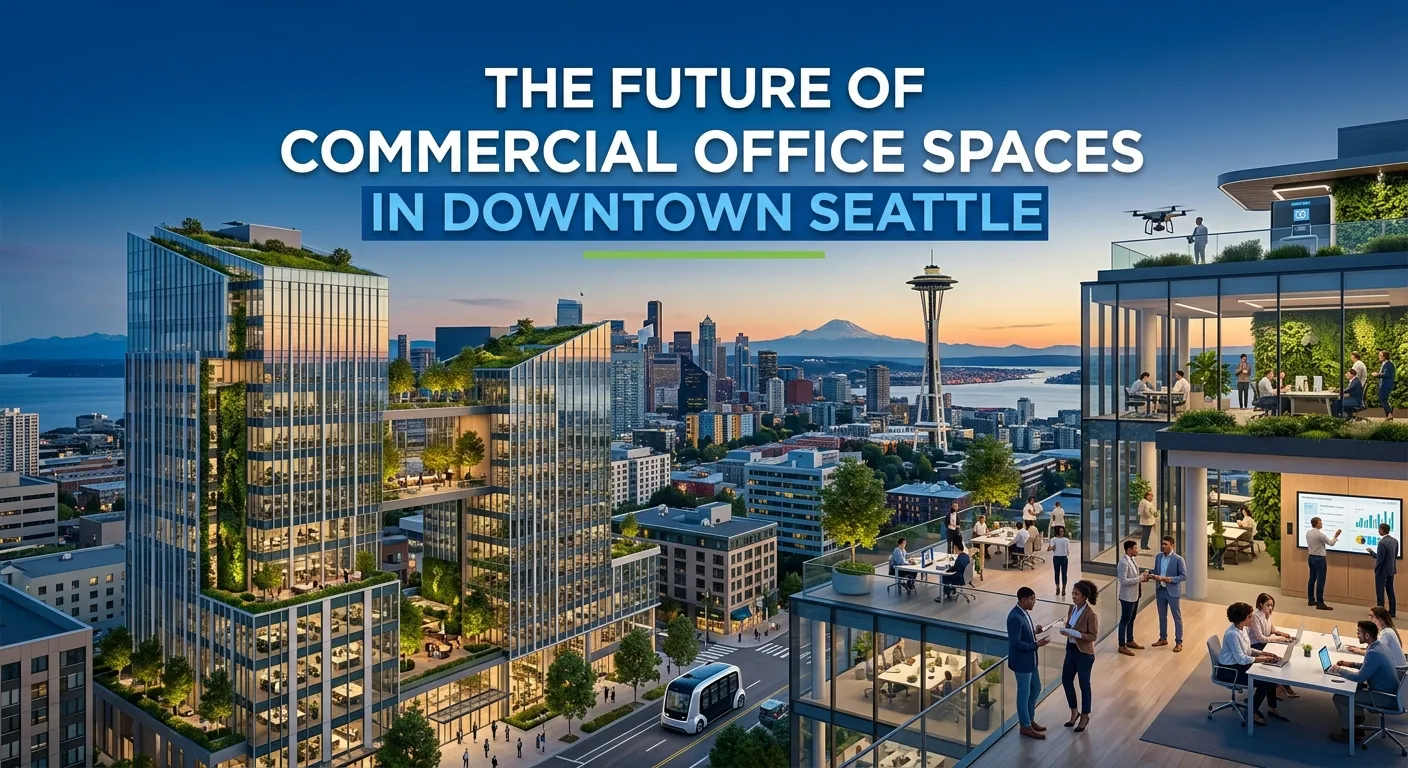
For decades, Downtown Seattle has stood as the undisputed economic engine of the Pacific Northwest. Fueled by rapid expansions in the technology, aerospace, and global retail sectors, the city’s skyline was a testament to relentless corporate growth. However, the paradigm of how, when, and where professionals work has undergone a seismic shift. The traditional office market is currently navigating a period of profound transformation, moving away from legacy models of real estate toward highly adaptable, tenant-focused environments. As the market stabilizes in 2026, the future of commercial office spaces in Downtown Seattle is coming into sharp focus—defined not by raw square footage, but by hyper-focused data, tenant experience, and unprecedented flexibility.
The 2026 Statistical Landscape: Vacancies and Valuations
To understand the trajectory of Downtown Seattle’s office sector, one must examine the current empirical data. According to recent market reports closing out 2025 and moving into 2026, the Puget Sound office market has shown signs of stabilization after years of volatility, but challenges remain concentrated in the urban core. Vacancy rates in Seattle ended the previous year at a historic 27.6%, an increase from earlier quarters and up significantly compared to previous years.
Simultaneously, the financial metrics of these assets are shifting. Average capitalization rates (cap rates) for office properties have ticked upward to approximately 5.5%, reflecting the increased risk premium investors are placing on traditional office assets amidst elevated borrowing costs. This statistical reality indicates that the market is bifurcated: properties are not universally struggling, but specific classes of assets are bearing the brunt of the vacancy spike. The era of the monolithic, single-use office building simply existing and collecting rent is over. Survival and profitability in 2026 require a proactive, highly strategic approach to asset management.
The Flight to Quality and the “Commute-Worthy” Mandate
The overarching narrative in Seattle’s commercial real estate sector is the aggressive “flight to quality.” While outdated Class B and Class C spaces face grueling, slow leasing cycles and rising vacancies, premium Class A office spaces with flexible layouts remain in surprisingly high demand. As corporate tenants reduce their overall square footage to accommodate hybrid work models, they are reinvesting their real estate savings into upgrading the physical quality of their remaining footprint.
Employers are now faced with the critical challenge of making their physical spaces “commute-worthy.” When an employee has the option to work from a home office in Ballard or Bellevue, the downtown Seattle office must offer something functionally and aesthetically superior. This demand is forcing a complete reimagining of the office floor plan. The traditional dense cubicle farms are obsolete. In their place, corporate tenants are demanding spaces optimized for deep connection, mentorship, and high-level collaboration.
Redesigning for the Modern Workforce
Modern office layouts in top-tier Seattle high-rises now dedicate significantly more square footage to communal, hospitality-driven areas. This includes expansive, cafe-style kitchens, modular brainstorming rooms with advanced acoustic treatments, and technology-enabled conference centers designed specifically to integrate in-person and remote participants seamlessly. Tenants are seeking modular furniture systems and movable partitions that allow them to reconfigure their space daily based on specific needs—whether hosting a large all-hands meeting or facilitating small project sprints. Landlords who invest capital into pre-built, flexible “spec suites” are experiencing vastly accelerated lease-up times compared to those offering traditional, raw shell spaces that require lengthy tenant build-outs.
Infrastructure Upgrades: Technology and ESG Compliance
Beyond layout changes, the actual infrastructure of commercial buildings is dictating their market viability. A tech-driven demographic naturally expects tech-enabled environments. Forward-thinking property owners are retrofitting assets with high-speed fiber optics, biometric security systems, and smart HVAC controls that allow for localized climate adjustments.
Furthermore, Environmental, Social, and Governance (ESG) criteria are no longer optional marketing points; they are strict leasing requirements for major corporate tenants. Seattle has historically led the green building movement, and local environmental regulations are becoming increasingly stringent. Large tech and financial firms operating downtown have aggressive carbon-neutral mandates. They specifically target buildings with LEED certifications, smart energy management systems, superior indoor air quality, and sustainable waste reduction programs. Buildings that fail to meet these ESG standards are rapidly being filtered out of initial site selections by corporate brokers.
Navigating High Vacancies with Strategic Property Management
With vacancies hovering around 27.6% and tenant expectations at an all-time high, the complexity of operating a commercial office building has grown exponentially. Landlords are no longer just collecting rent; they are executing complex hospitality and facility management operations. The financial stakes have never been higher. With rising interest rates impacting debt service and increased insurance premiums squeezing Net Operating Income (NOI), property owners cannot afford operational inefficiencies, deferred maintenance, or prolonged tenant disputes.
Securing a long-term, high-quality tenant is only the initial hurdle; retaining them requires proactive, flawless management. This sophisticated environment is exactly why utilizing expert commercial property management services in Seattle is no longer a luxury, but an operational necessity. A dedicated, localized management team handles the rigorous day-to-day operations, aggressive preventative maintenance schedules, and localized tenant relations required to stabilize distressed assets. By outsourcing the complex layers of lease administration, vendor negotiations, and emergency response, property owners can safeguard their investments and maintain competitive yields even in a challenging, tenant-favorable market.
Adaptive Reuse and the Fate of Legacy Assets
While Class A buildings adapt and thrive, the future is incredibly complex for the aging Class B and Class C office buildings scattered throughout the downtown core and historic districts like Pioneer Square. These properties, which often lack the modern infrastructure, high ceilings, and comprehensive amenity packages of their newer counterparts, are contributing most heavily to the city’s elevated vacancy metrics.
This dilemma has sparked significant industry debate regarding adaptive reuse—specifically, the conversion of obsolete office buildings into residential apartments or mixed-use lifestyle centers. While converting empty offices seems like a logical solution to Seattle’s housing demands, the economic and structural realities are daunting. Office floor plates are often too deep to provide necessary natural light to residential units, and upgrading plumbing and electrical systems to residential codes requires massive capital investment. While adaptive reuse will certainly play a role in Downtown Seattle’s revitalization over the next decade, it will likely be limited to specific buildings with the right architectural “bones” and will heavily rely on public-private financial partnerships to become economically viable.
The Horizon: A Restructured, Mixed-Use Downtown
Looking ahead to the remainder of the decade, the narrative that Downtown Seattle is in terminal decline is fundamentally flawed. Cities are resilient, living organisms that evolve, and Seattle is currently in a necessary transitional phase. The era of the monolithic, 9-to-5 single-use office district is concluding, making way for a more vibrant, 18-hour neighborhood model.
The future of downtown real estate will be defined by dynamic, mixed-use developments that seamlessly integrate office, residential, retail, and entertainment spaces within the same block. As ground-floor retail adapts to serve both hybrid office workers and a growing downtown residential population, street-level energy will return. The commercial office buildings that will define the skyline of the 2030s will be highly efficient, profoundly flexible, and hyper-focused on the human experience. While the transition may remain turbulent for outdated properties in the near term, the ultimate result will be a more resilient, integrated Downtown Seattle that meets the complex demands of the modern economy.

 Realtor Pro
 Fast Cash Home Buyer